



Introducing hydrogen in industry requires more than new technology. Based on interviews with operators and managers, SINTEF researchers have identified four ways organisations can prepare their people, processes and decision-making structures for the transition.
Technology is advancing. Is the organisation keeping pace?
Hydrogen is expected to play an important role in decarbonising energy-intensive industries, including metal and glass production. Across Europe, companies are investing in technologies, infrastructure and production systems to support the transition.
But introducing hydrogen is not simply a matter of replacing one energy source with another. It can change everyday work, decision-making, safety routines and the division of responsibilities between operators, engineers and automated systems.
In the H2GLASS project, we examined how organisations prepare for hydrogen integration before the technology is fully implemented. The case study focused on the metal sector and drew on interviews with operators and managers in three companies. The findings show that technical readiness alone is not enough. Organisations also need to prepare employees, working practices and decision-making structures for change.
Safe hydrogen adoption depends on more than technology. It requires a shared understanding of risks, procedures, and safeguards across the entire organization, says Christina Mitcheltree, Research Scientist at SINTEF
Four ways to build organisational readiness
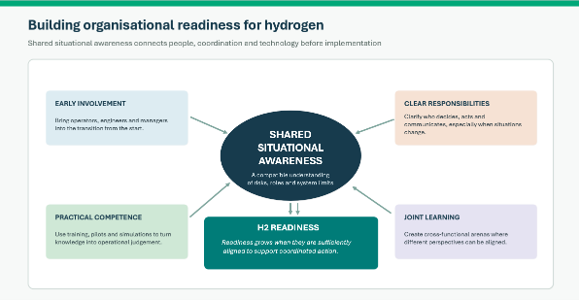
The study highlights four practical areas that organisations can work on before hydrogen systems enter operation.
1. Involve the people who will use the technology
Hydrogen projects are often driven by technology development, but operators and maintenance personnel understand how work is carried out in practice. Involving employees early can reveal operational challenges, improve the quality of decisions and build ownership of the transition.
2. Create opportunities to practise
Formal training is essential, but it should be complemented by workshops, simulations, demonstrations and pilot activities. Practical learning helps employees connect technical knowledge to real working situations and explore how hydrogen may affect daily operations before the systems are commissioned.
3. Clarify roles before unexpected situations occur
As hydrogen technologies become integrated with monitoring systems and automation, organisations need to decide who is responsible for what. Clear roles, decision authority and escalation routes reduce uncertainty and support coordinated action when an unexpected situation arises.
4. Learn across disciplines and organisations
Hydrogen projects bring together different disciplines, organisations and professional cultures. Cross-functional workshops and structured reviews can help participants develop a sufficiently shared understanding of objectives, risks, system limitations and operational priorities. The aim is not to make everyone think alike, but to ensure that different areas of expertise can work together effectively.
A shared understanding supports better decisions
The research uses the concept of situational awareness to explain how people understand what is happening, recognise potential risks and anticipate what may happen next. In an industrial transition, this capability extends beyond the individual-level. It depends on whether relevant groups can combine their knowledge and coordinate their responses.
The interviews showed that readiness was shaped by how employees interpreted unfamiliar risks, reconsidered established routines, built trust and coordinated across organisational boundaries. Shared situational awareness can therefore support learning and decision-making while technology, standards and operational practices are still evolving.
Preparation starts before installation
Successful hydrogen implementation begins long before the first system is commissioned. By involving employees, providing opportunities for hands-on learning, clarifying responsibilities and building a shared understanding across the organisation, companies can prepare their people and processes alongside the technology.
This early preparation can make it easier to identify barriers, manage uncertainty and coordinate decisions when hydrogen becomes part of daily operations.
How SINTEF can support industry
The challenges identified in the study sit at the intersection of technology, people and organisation. SINTEF combines expertise in hydrogen technologies, industrial processes, safety, organisational development and human factors.
We can support companies by assessing organisational readiness and risks, developing competence, communication and collaboration, and exploring future operational scenarios through workshops, simulations and interdisciplinary analysis.
About the research
This article is based on: Mitcheltree, C. M., Bly, K. & Silva, T. L. (2026). Advancing situational awareness for decarbonization: a case study on hydrogen integration in an energy-intensive industry. Journal of Innovation and Entrepreneurship, 15, 55. Read the research article







Comments
No comments yet. Be the first to comment!