
Guest blogger: Dr. ing. Claudia Tomescu, ISPE – Institute for Studies and Power Engineering Bucuresti
The researcher take part in the IMPACTS project: IMPACTS is a collaborative project co-funded by the European Commission under the 7th Framework Programme. IMPACTS is run by SINTEF Energy Research. Find out more about IMPACTS.
In 2010 Romania launched the initiative to develop the Getica CCS Demo Project and the Global CCS Institute (GCCSI) has provided AU$2.55 million grant in support of a feasibility study. A NER 300 application was submitted to the EU in February 2011. The project reached the reserves shortlist but not the final stage. In 2014, due to economic crisis, the Government decided that the investment for GETICA was not a priority at that time so the project has been put on hold. Among studies and research projects developed in the field, Romania rolled out the GCCSI regulatory test toolkit and prepared the CCS Roadmap for Romania “Our future is carbon negative”.
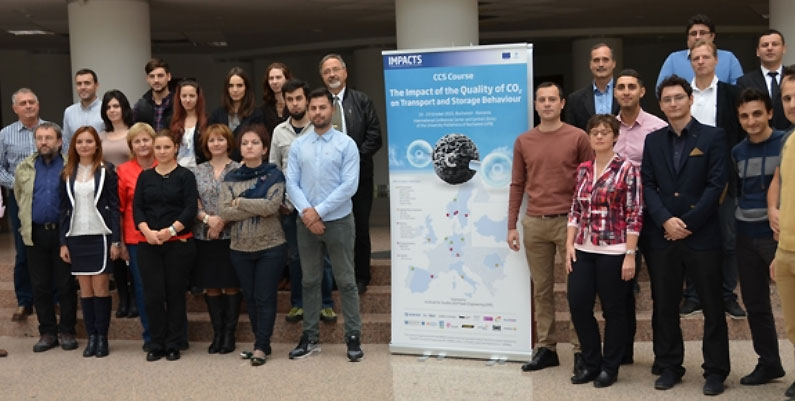
Considering the above it is not surprising that 43 students and representatives of academia, research institutes, industry (power sector and gas and oil), as well as the national regulatory authority in the field of mineral resources, have been so interested in participating to the CCS course „The impact of the quality of CO2 on transport and storage behaviour”.
As part of the IMPACTS project, the course was organized for one week, at the end of October, by the Institute for Studies and Power Engineering, partner in IMPACTS project, at the International Conference Center and Central Library of the University Politehnica of Bucharest, Romania.
The main goal of the course was to facilitate knowledge sharing and make the results from IMPACTS project available to students and people from industry. The base for the training course material was: the main achievements from IMPACTS research, the IMPACTS toolbox and the IMPACTS recommendations.
Lecturers have been IMPACTS researchers: Stefan Herrig, lecturer of Ruhr-University Bochum (RUB) from Germany; Jacob Stang, research scientist at SINTEF Energy Research from Norway; Filip Neele, project manager at the Netherlands Organisation for Applied Scientific Research (TNO); Charles Eickhoff, project manager of Progressive Energy Ltd. (PEL) from United Kingdom; Amy Brunsvold, research scientist at SINTEF Energy Research from Norway; Geir Skaugen, research scientist at SINTEF Energy Research from Norway; Miguel Angel Delgado Calvo, R&D project manager at Fundación Ciudad de la Energía (CIUDEN) from Spain; Juan Andres Marin Vidal, head of pilot plant for CO2 geological storage at Fundación Ciudad de la Energía (CIUDEN) from Spain; Ingrid Raben, risk analyst at the Netherlands Organisation for Applied Scientific Research (TNO).
The IMPACTS CCS course had ten technical sessions:
Session 1: Models on thermodynamic properties and equilibrium;
Session 2: Typical CO2 mixtures and operating conditions, transport and storage gap analysis, classification of CO2 impurities;
Session 3: Typical CCS chains;
Session 4: Corrosion of pipeline steels caused by CO2 mixtures;
Session 5: The influence of CO2 mixture composition;
Session 6: Techno-economic analyses of impacts of CO2 quality;
Session 7: Operational and material effects of impurities in CO2 streams;
Session 8: Chemical and physical effects of impurities on CO2 storage;
Session 9: Risk assessment of CO2 transport and storage infrastructure;
Session 10: IMPACTS recommendations.
Romanian academia and industry have showed great interest in the topics presented during the CCS course and highly appreciated the event. There is a real openness in Romania for future similar events, which, by easing the transfer of specific knowledge, could be relevant in supporting and proving the existing CCS technology and in demonstrating it on a large scale integrated CCS project.






Comments
No comments yet. Be the first to comment!