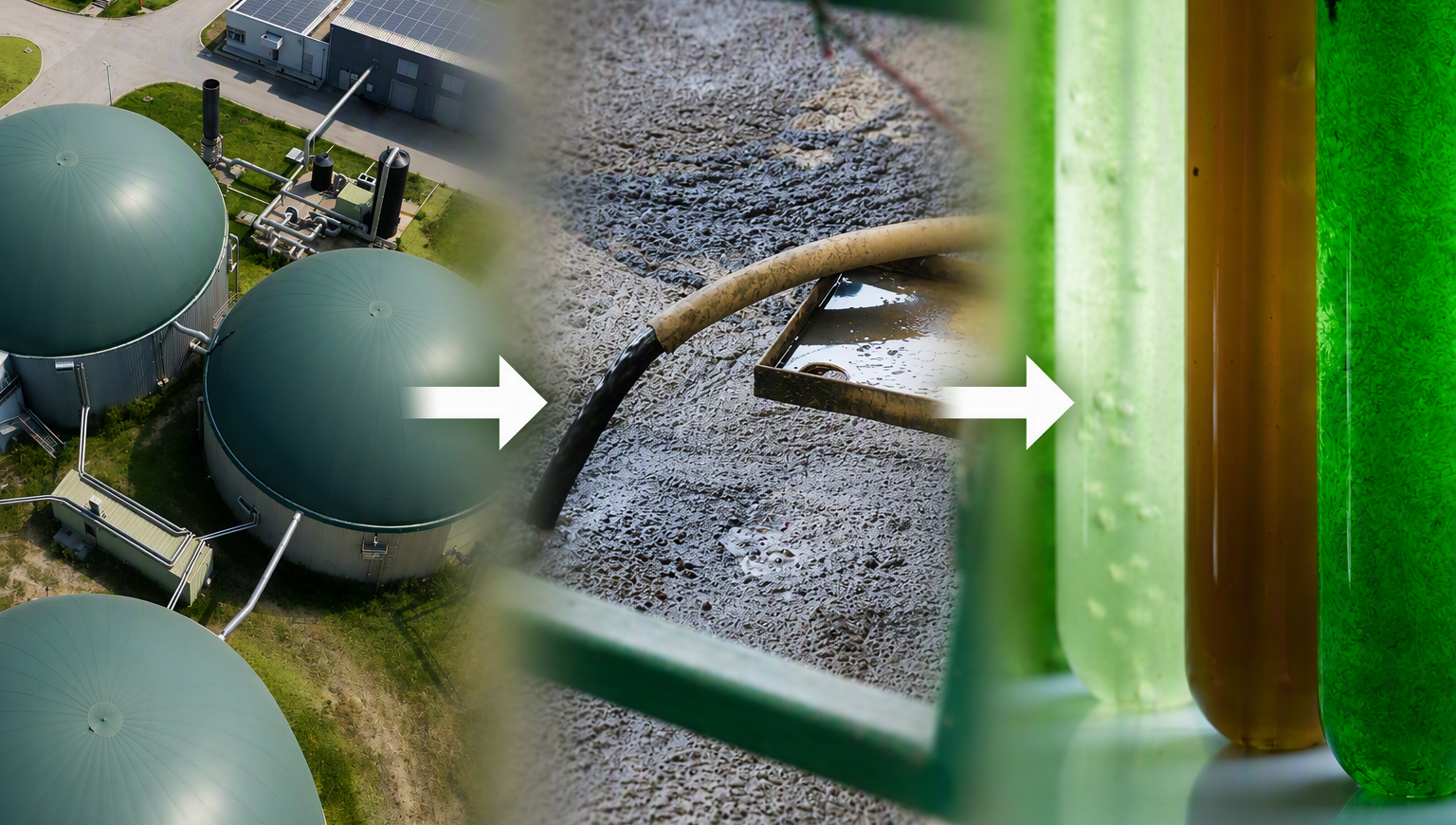

Biogas is becoming an increasingly important part of Norway’s transition to a circular bioeconomy. By converting organic waste into renewable energy, biogas helps reduce greenhouse gas emissions while keeping valuable resources in circulation.
Every biogas plant also produces digestate -a nutrient-rich by-product containing valuable nitrogen and phosphorus. As biogas production expands, making the best possible use of these nutrients will become just as important as producing the renewable energy itself.
Today, digestate is primarily used as fertiliser in agriculture, but this application has important limitations. Agricultural demand is seasonal, whereas digestate is produced continuously throughout the year, requiring long-term storage. This creates logistical challenges, increases transportation costs and greenhouse gas emissions, and limits efficient nutrient utilisation.
In addition, many future biogas plants will be located far from agricultural land, while digestates from phosphorus-rich feedstocks such as fish sludge may contain more phosphorus than local agriculture can effectively utilise.
As biogas production continues to grow, there is an increasing need for new solutions that recover nutrients from digestate and transform them into valuable products, supporting a more circular bioeconomy.
The research project BioInnova addressed this challenge through three complementary activities:
- A nationwide mapping of digestate production and composition in Norway,
- A detailed assessment of digestate originating from the Norwegian food system, and
- Evaluation of microalgae cultivation as a novel nutrient recovery pathway.
Nationwide mapping of digestate from Norwegian biogas plants
The mapping study assessed the quantity and quality of digestate from both existing (2024) and future Norwegian biogas plants based on available feedstocks. The results indicate that Norway’s biogas production potential could increase from 620 GWh to approximately 3 920 GWh, with available feedstocks increasing from about 1 million tonnes to more than 18 million tonnes (wet weight).
Livestock manure represents by far the largest untapped resource, followed by wastewater sludge and food waste, while fish ensilage, fish hatchery sludge, aquaculture sludge, and straw provide additional feedstock potential.
Nitrogen and phosphorus
This expansion will substantially increase nutrient recovery potential. Total nitrogen available in biogas feedstocks could increase from 6 379 to 75 184 tonnes, while phosphorus could increase from 2 943 to 20 620 tonnes. Livestock manure accounts for most of this future potential, reflecting Norway’s increasing focus on manure-based biogas production.
Assuming that digesters operate at approximately 5% total solids and that 50% of dry matter is degraded during anaerobic digestion, current biogas production is estimated to generate around 3.8 million tonnes of digestate, increasing to 36.4 million tonnes if Norway’s full biogas potential is realised.
Future digestate could contain approximately 37 600 tonnes of nitrogen and 10 300 tonnes of phosphorus. To offer a comparison, Norwegian agriculture utilised 136 900 tonnes of nitrogen and 18 400 tonnes of phosphorus from mineral fertilisers and livestock manure in 2023.
Digestate quality
The mapping also evaluated digestate quality. Nutrient and organic matter concentrations in food waste and fish sludge digestates exceed the emission limits defined by the Best Available Techniques-associated Emission Levels (BAT-AEL), demonstrating that nutrient removal is essential before discharge.
Heavy metal concentrations are generally acceptable for food waste, fish sludge and livestock manure digestates, whereas sewage sludge digestate requires additional attention due to elevated metal concentrations.
Bio-CO2
In addition to digestate, the study estimated Norway’s future bio-CO₂ potential. Bio-CO₂, the second major by-product of biogas production, could increase from approximately 74 000 tonnes today to 470 000 tonnes, creating opportunities to replace fossil-derived CO₂ in industrial applications.
Logistics
Finally, downstream processing requirements were assessed since digestate transport and storage often require volume reduction. Mechanical dewatering requires relatively little energy, whereas thermal drying dominates total processing energy demand.
Drying all digestate produced under Norway’s future biogas potential would require almost 2 TWh of heat, highlighting the importance of improved dewatering, partial drying and utilisation of industrial surplus heat as well as direct land application.
From digestate management to food system circularity
In addition to the nationwide mapping, we focused specifically on digestates originating from the Norwegian food system because of their importance to both climate mitigation and food system circularity.
Norway’s planned expansion of biogas production from livestock manure, food waste, fish sludge, and fish ensilage will substantially increase digestate generation. In particular, increased utilisation of livestock manure supports the Norwegian agricultural climate agreement by reducing greenhouse gas emissions associated with manure management while simultaneously producing a nutrient-rich digestate.
Reducing dependence on mineral fertilisers
This digestate represents an important opportunity to recycle nitrogen and phosphorus back into food production and reducing dependence on mineral fertilisers.
Feedstock and digestate volumes from livestock manure, food waste, fish sludge, and fish ensilage were projected to increase by more than 14-fold, while nitrogen and phosphorus contents increased by approximately 19-fold. Future digestate was estimated to contain 34 971 tonnes of nitrogen and 7 472 tonnes of phosphorus, corresponding to approximately 25% of Norway’s agricultural nitrogen demand and 40% of its phosphorus demand.
New utilisation pathways
However, fertiliser is only one possible utilisation pathway. Digestate can also serve as a nutrient source for microalgae cultivation, allowing nutrients to be recovered into new biomass rather than being returned directly to agricultural land. Together, these two pathways—fertiliser production and feed production—create complementary nutrient loops that strengthen circularity throughout the Norwegian food system while contributing to greenhouse gas emission reductions.
This study investigated the use of fish sludge digestate as a cultivation medium for the freshwater microalga Chlorella sorokiniana. The algae successfully grew in 100% digestate containing up to 920 mg NH₄-N/L, producing protein-rich biomass with a total amino acid content of 53–59% of dry weight.
During 5–10 days of cultivation, the process removed 26–28% of ammonium, 43–53% of chemical oxygen demand (COD), and 31–42% of total organic carbon (TOC).
In addition to utilizing nutrients recovered from biogas digestate, microalgae cultivation can also make use of bio-CO₂ generated during the biogas upgrading process. Instead of releasing this biogenic CO₂ to the atmosphere, it can be supplied as a carbon source for algal growth, increasing biomass productivity while improving overall carbon utilization within the biogas value chain. Integrating digestate and bio-CO₂ into microalgae production therefore strengthens resource efficiency and supports a more circular and climate-efficient bioeconomy
These results demonstrate that microalgae cultivation can simultaneously treat digestate while recovering nutrients into valuable biomass. In the future, such biomass may contribute to alternative feed production, providing an additional nutrient recycling pathway alongside the direct use of digestate as fertiliser.
Looking ahead
BioInnova project demonstrates that digestate should no longer be viewed simply as a by-product of biogas production requiring management. Instead, it should be regarded as a strategic nutrient resource that can support climate mitigation, reduce dependence on mineral fertilisers, and strengthen circularity across the Norwegian food system.
By combining renewable energy production with nutrient recovery through both fertiliser applications and emerging technologies such as microalgae cultivation, biogas systems can play an increasingly important role in building a more sustainable and resource-efficient bioeconomy.







Comments
No comments yet. Be the first to comment!