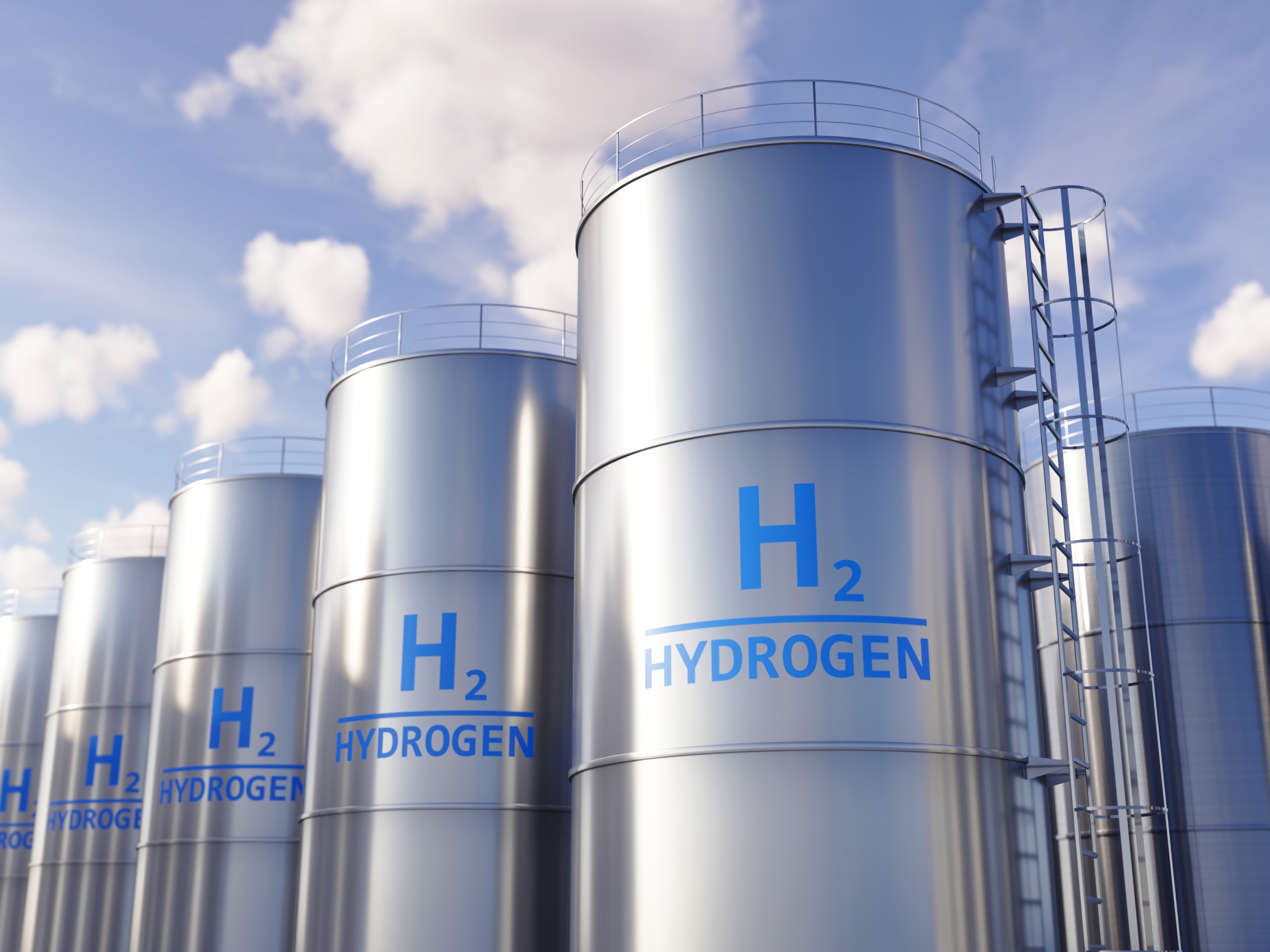


Hydrogen is increasingly being positioned as a cornerstone of the global energy transition. Governments and researchers see major potential for hydrogen in sectors where direct electrification remains difficult.
Here are seven key trends emerging from the hydrogen sector.
1. Hydrogen demand could increase sixfold by 2050
Today’s global consumption sits at roughly 90 million tonnes per year, almost entirely as grey hydrogen used in ammonia synthesis (51% of demand), oil refining (31%), and methanol production (10%).
Future demand, however, is expected to expand far beyond this.
Projections from the IEA, IRENA and the Hydrogen Council suggest global hydrogen demand could reach 600 million tonnes annually by 2050, equivalent to roughly 10–12% of global final energy consumption.
Heavy industry is expected to remain the dominant consumer, particularly steel, ammonia and refining, while shipping, aviation and heavy-duty transport are projected to become major new growth sectors.
Battery-electric systems are better suited to passenger cars and short-haul transport. Hydrogen’s case is strongest where energy density, high-temperature process heat, or chemical feedstocks are the hard constraints.
With a lower heating value of 120 MJ/kg — roughly three times that of diesel by mass — hydrogen is an exceptionally weight-efficient energy carrier. This makes it particularly attractive for aviation, long-haul shipping, and heavy freight, where carrying battery mass becomes prohibitive. Steel production is another priority: hydrogen-based direct reduction of iron ore (H-DRI) replaces coking coal in the blast furnace and is now at commercial demonstration scale
2. Electrolysis may become the dominant production pathway
Today, over 95% of hydrogen production still relies on fossil fuels, primarily through steam methane reforming (SMR). At a levelised cost of $1.06–1.80/kg, it is cheap but carbon-intensive, generating significant CO₂ emissions.
Blue hydrogen — SMR combined with Carbon Capture and Storage (CCS) capturing over 90% of CO₂ — costs $1.20–2.00/kg and is a viable transition pathway, though residual lifecycle emissions remain a concern.
Green hydrogen from water electrolysis powered by renewable electricity currently ranges from $1.60–10.30/kg depending on electrolyser technology and local electricity price — but costs are falling fast.
Among these technologies, water electrolysis powered by renewable electricity is expected to become increasingly important as renewable energy costs continue to fall.
The most prominent electrolysis technologies include:
- Alkaline electrolysis (ALK) — currently the most mature and commercially deployed technology
- Proton exchange membrane electrolysis (PEM) — offering higher flexibility for intermittent renewable power
- Solid oxide electrolysis (SOEC) — potentially delivering higher efficiencies at elevated temperatures
- Anion exchange membrane electrolysis (AEM) — an emerging pathway with future cost-reduction potential
The economics of electrolysis are highly sensitive to the cost of input electricity. In low-cost renewable regions, such as Australia, Norway, and parts of the Middle East, green hydrogen costs could fall below $2.00/kg by 2050. In grid-connected regions with expensive electricity, cost parity may never be achieved without dedicated renewable buildout.
The electrolyser scale-up challenge: to meet 2050 demand projections, global electrolyser capacity must grow from 1.4 GW in 2023 to 170–365 GW by 2030 and potentially 1,400–7,800 GW by 2050. That represents a capacity increase of several orders of magnitude in under 30 years — an unprecedented build rate in energy infrastructure.
3. Geography will shape future hydrogen trade
Not all countries will produce hydrogen competitively. Regions with abundant solar, wind or hydropower resources are expected to emerge as major exporters, while industrialised economies with limited renewable potential may become large-scale importers.
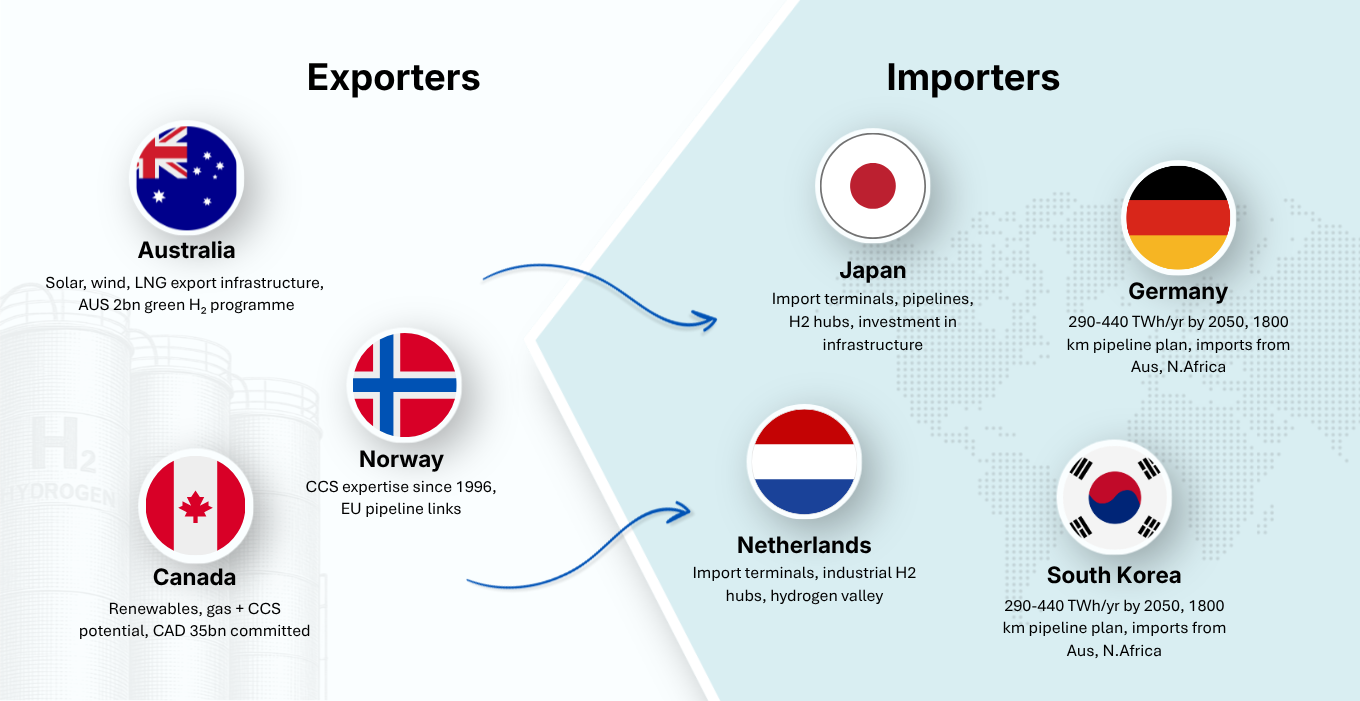
Australia is arguably the best-placed future exporter: exceptional solar irradiance, vast land for wind, existing LNG export infrastructure, proximity to Asian markets, and an AUD 2 billion green hydrogen subsidy programme. Its export target is 30 Mt/year by 2050.
Norway combines near-100%-renewable domestic electricity, decades of carbon capture and storage expertise from North Sea operations, and existing pipeline infrastructure to mainland Europe.
When it comes to production, Norway has operated CCS on the Norwegian Continental Shelf since 1996, making it exceptionally well placed for blue hydrogen production from natural gas with high CO₂ capture rates. The Sleipner and Snøhvit CCS projects represent decades of operational experience with offshore geological carbon storage.
Canada has abundant renewables, natural gas with CCS potential, and strong political backing — with CAD 35 billion committed across federal programmes.
On the demand side, Japan, South Korea, Germany and the Netherlands are investing heavily in hydrogen import terminals, pipelines and industrial hydrogen hubs.
Germany plans hydrogen consumption of 290–440 TWh/year by 2050, expects to import from Australia and North Africa, and has committed to 1,800 km of dedicated hydrogen pipeline.
Future hydrogen trade could reshape global energy geopolitics in much the same way liquified natural gas markets transformed natural gas trade.
4. Liquefied hydrogen could become critical for long-distance transport
Hydrogen’s physical properties create fundamental engineering challenges that no policy ambition can bypass. While its gravimetric energy density is exceptional (120 MJ/kg LHV), its volumetric energy density is very low. This is the core problem of hydrogen logistics.
Compressed gaseous hydrogen suits local distribution and mobility (refuelling stations, short-haul truck fleets), with transport costs of $0.90–1.90/kg for cylinder delivery over short distances. For international maritime trade, liquefied hydrogen (LH₂) is the preferred carrier – but liquefaction requires cooling to −253°C (just 20 degrees above absolute zero) and consumes roughly 30–40% of the hydrogen’s own energy content in the process.
Once liquefied, further losses accumulate. Boil-off in cryogenic storage tanks runs at 0.3–1.0% per day, with losses up to 10% over a long-distance voyage. Storing 5 kg of compressed gaseous hydrogen at 700 bar requires approximately 125 litres of tank volume — highlighting the density problem even before liquefaction is considered. LH₂ storage tanks (double-walled, vacuum-insulated) cost $1,000–1,500 per kg of storage capacity.
Pipeline transport is far more cost-efficient at $0.20–0.50/kg over long distances, but requires hydrogen-compatible materials (standard steel is susceptible to hydrogen embrittlement) and entirely new or retrofitted infrastructure. Blending up to 20% hydrogen by volume into existing natural gas pipelines is a transitional option, though the hydrogen cannot typically be separated at the point of use, limiting it to combustion applications.
5. The hydrogen storage gap
Compressed gaseous hydrogen storage is already commercially mature and widely used in fuel-cell mobility systems. It is already deployed at scale in Japan (Tokyo, Osaka and Fukushima) for fuel cell vehicles and industrial users.
The cost is relatively low but volumetric density remains a constraint.
Liquid hydrogen enables much higher storage density — around 70 kg/m³ compared to just 5 kg/m³ for compressed gas — but storage efficiency is only 60–70% and cryogenic tanks cost $1,000–1,500 per kg of capacity.
Geological storage in salt caverns and depleted gas reservoirs offers the most promising route to low-cost, large-scale seasonal buffering, with estimated costs as low as $0.05–0.15/kg for salt caverns and around $1.07/kg for depleted gas reservoirs.
However, both technologies currently achieve only around 40% round-trip efficiency and require 45–55% of their volume to be filled with cushion gas simply to maintain operational pressure. These are significant engineering constraints that most national hydrogen strategies fail to address in detail.
These storage systems may become increasingly important for balancing intermittent renewable electricity production across national energy systems.
6. Europe is accelerating hydrogen infrastructure development
Europe has become one of the most active regions for hydrogen policy development. Germany alone plans hydrogen demand of up to 440 TWh annually by 2050 alongside a dedicated hydrogen pipeline network extending roughly 1,800 kilometres.
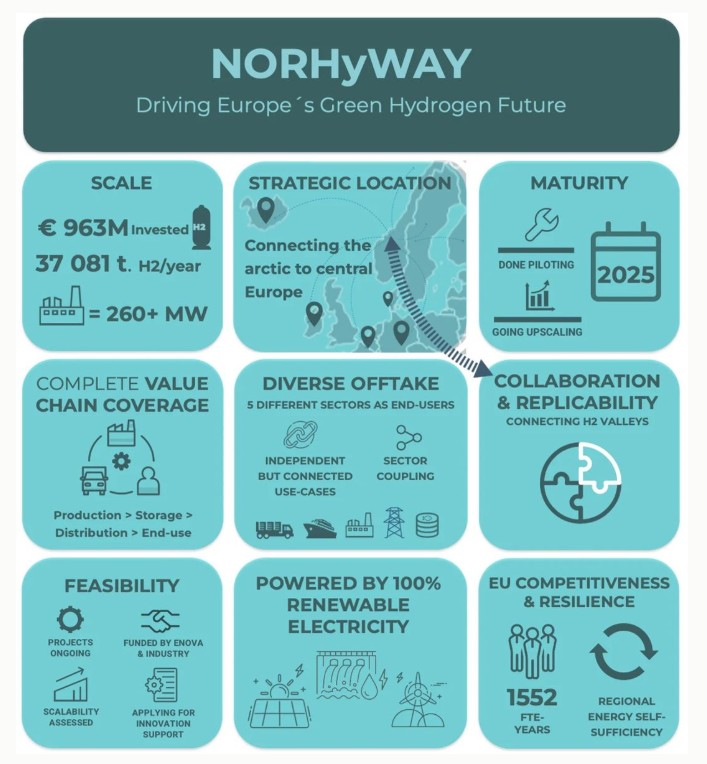
Hydrogen valleys (integrated regional ecosystems connecting production, storage, distribution and industrial use) are emerging as an important model across Europe, including in Norway – with the development of the NORHyWAY hydrogen valley in early 2026.
France, Spain, the Netherlands and Denmark are investing heavily in electrolysis capacity and renewable hydrogen production.
Many countries are also exploring hydrogen blending into existing natural gas pipelines as a transitional strategy. Blends of up to 20% hydrogen by volume may be technically feasible in parts of the existing gas network, potentially enabling faster infrastructure scaling while dedicated hydrogen systems are developed.
The Northern Netherlands Hydrogen Valley in Groningen integrates offshore wind electrolysis, salt cavern storage, and pipeline distribution to serve petrochemicals, mobility, and residential heating, supported by EU FCH JU funding.
The HyNet North West project in England takes a different route — blue hydrogen from SMR with CCS, distributed via dedicated pipeline to industrial users across Merseyside. Poland and Spain are also exploring high-efficiency cogeneration (combined heat and power from hydrogen), which can improve overall system efficiency by simultaneously producing electricity and useful industrial heat from the same fuel input.
7. Hydrogen’s success will depend on system integration
Ultimately, hydrogen should not be viewed as a standalone technology, but as part of a much broader integrated energy system.
Scaling hydrogen successfully will require coordinated development across renewable electricity generation, electrolysers, pipelines, storage systems, shipping infrastructure and industrial end-use applications.
When production targets are summed and compared to the demand projections published, projected 2050 demand exceeds projected supply by approximately 730 TWh – a 30% shortfall.
Full implementation of national strategies still leaves large gap.
This shortfall also points to a deeper problem: most strategies optimise for production alone, without accounting for the cumulative energy losses that occur across the full hydrogen value chain. Every stage involves thermodynamic penalties — electrolysis operates at 55–80% efficiency, liquefaction consumes a further 30–40% of the hydrogen’s energy content, compression adds losses of 5–15%, and geological storage achieves only around 40% round-trip efficiency.
A tonne of green hydrogen at the point of production may deliver very different amounts of useful energy depending on how it is stored, transported and used. Strategies that ignore this risk systematically overstating hydrogen’s contribution to decarbonisation.
Norway illustrates what a genuinely integrated approach could look like.
Its real competitive advantage is not just low-carbon production, but also the ability to deliver hydrogen to European markets via pipeline, avoiding the 30–40% energy penalty of liquefaction that makes long-distance LH₂ shipping from Australia or the Middle East so costly.
Combined with dispatchable hydropower for electrolysis, existing offshore pipeline infrastructure, and decades of operational CCS experience, Norway has credible pathways across almost every stage of the hydrogen value chain simultaneously.
Realising that potential requires integrated value chain planning, through connecting production, storage, and exports.
Hydrogen alone will not solve every decarbonisation challenge. But when integrated effectively with renewable energy systems, carbon capture technologies and industrial infrastructure, it could become a defining pillar of the future low-carbon economy.

Research conducted at NTNU, supported by SINTEF Energy’s HYDROGENi Research Centre.
Original paper: Konovalov, D., Adams II, A.T., (2026). “Hydrogen power development: A comparative review of national strategies and the role of energy in scaling green hydrogen.” Renewable and Sustainable Energy Reviews, Volume 226, Part D, January 2026, 116378







Comments
No comments yet. Be the first to comment!