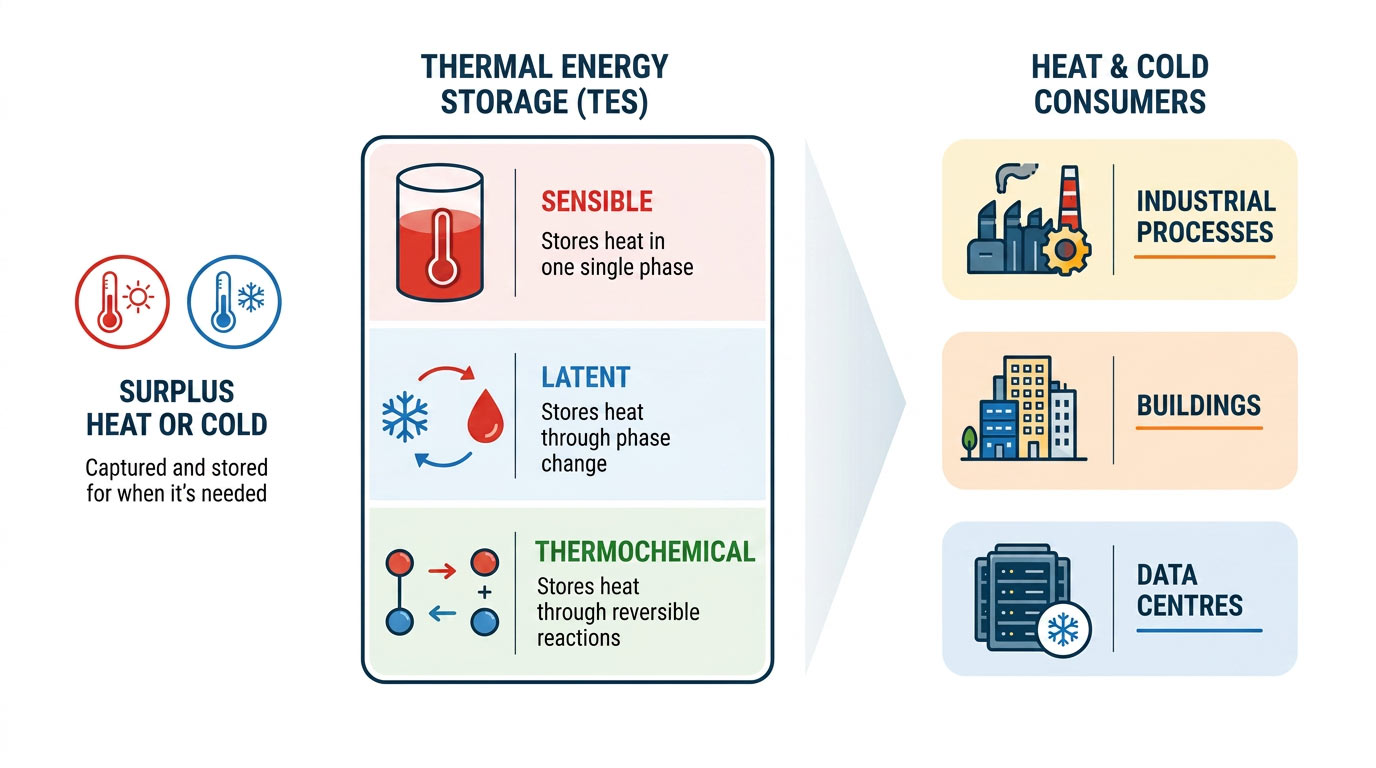

For years, thermal energy storage (TES) has been described as a promising technology for the energy transition. TES technologies generally fall into three main categories: sensible storage, based on heating materials with high heat capacity; latent storage, based on phase-change materials (PCM); and thermochemical storage, based on reversible chemical reactions.
Today, the question is no longer if TES will matter, but where it is already becoming commercial. To understand why interest in TES is accelerating, we need to look at three key signals highlighted in the International Energy Agency’s (IEA) Global Energy Review 2026:
- Renewables Integration: Solar PV alone accounted for around 70% of global electricity generation growth in 2025, increasing the need for flexibility in renewable-based energy systems.
- Extreme Weather: Heating and cooling demand continues to grow due to climate change provoking higher weather variability.
- AI Boom: Data centres accounted for around 50% of electricity demand growth in the United States, driven by the rapid expansion of AI and digital infrastructure.
All three trends have one thing in common: they increase the need to store and shift energy use across different temperature ranges, from cooling applications below 25°C to industrial heat above 500°C. TES has long been discussed as a key enabling technology for flexibility, efficiency, and sector coupling, but the question now is:
Where does TES actually stand in the market today?
Within the framework of IEA Technology Collaboration Programme on Energy Storage, we are working to answer that question by mapping commercial suppliers, technologies, and applications already being deployed across buildings, industry, and emerging sectors such as data centres.
The data presented here comes from ongoing work within IEA Task 47, where experts on TES from research institutes, universities, and industry across multiple countries collaborate and meet regularly under the IEA framework. This current and updated mapping already includes more than 70 commercial TES suppliers and continues to grow through direct contributions and validation from the participating experts.
Who is buying TES?
One of the first things that becomes clear from the mapping is that TES is not a single market. It is already fragmented into several application-driven markets, each with different technical requirements, operating temperatures, storage durations, and levels of commercial maturity. The figure below shows that today’s supplier landscape is mainly divided between industrial processes, domestic applications, and buildings. At the same time, data centres already appear as a distinct category, despite still representing a relatively small share of the identified suppliers. This is an important signal: TES is beginning to follow the same transformation affecting the wider energy system, where electrification, flexibility, and heating/cooling demand are reshaping energy use across sectors.
The domestic and building segments together currently represent the most established commercial landscape. These applications are strongly connected to heating, cooling, HVAC systems, and thermal comfort in residential buildings, offices, supermarkets, and warehouses. This part of the market already includes many suppliers offering standardised and integrated solutions, suggesting that TES is moving beyond pilot projects into broader commercial deployment.
The next figure shows that latent TES technologies — particularly phase change materials (PCM)— dominate the domestic and building environments. In general, latent TES systems tend to be compact and relatively easy to integrate into existing buildings, making them attractive for space-constrained applications. Sensible TES systems, by contrast, often require larger storage volumes but can be simpler and more scalable for larger installations and industrial processes. Thermochemical TES remains a smaller and more emerging segment, with potential advantages in storage duration and energy density, but with fewer commercially established solutions today.
The industrial segment tells a different story. Industrial TES is increasingly connected to industrial electrification, renewable integration, and process heat decarbonization. Here, sensible heat storage technologies dominate the landscape, using materials such as molten salts, concrete, sand, ceramics, graphite, and rocks. Compared with the building sector, industrial systems are typically larger and more site-specific, often designed around the operational needs of a given industrial process.
What emerges from the data is not a single TES industry, but several parallel markets evolving at different speeds and responding to very different energy challenges. Factors like operational temperatures and space limitations can drive the suitability.
Which TES technology covers each different need?
The temperature range of a TES system is one of the clearest indicators of its intended application, technical maturity, and storage requirements. The figure below shows that the commercial TES landscape is strongly segmented by temperature, with different technologies dominating different thermal regimes. This reflects a simple reality: storing heat or cold for buildings is not the same challenge as storing energy for industrial processes.
The lower temperature ranges (<25°C and 25–100°C) are dominated by latent TES technologies, particularly PCM systems. In this part of the market, compactness and modularity are often more important than big capacities or very long storage durations. This helps explain why latent TES has become commercially attractive: PCM can store relatively large amounts of energy within limited volumes, making them suitable for locations where space matters. The market also appears more mature, with many suppliers already offering modular commercial solutions, such as Cartesian (Norway), Cowa (Switzerland).
The picture changes significantly at higher temperature ranges (100–450°C and >500°C), where sensible TES technologies dominate. This is strongly connected to industrial processes, where systems are typically larger, more site-specific, and designed around operational reliability and cost. Companies such as EnergyNest (Norway), Kraftblock (Germany), and Rondo (US) illustrate this trend, developing large-scale storage systems based on materials such as concrete, recycled mineral materials, and ceramic bricks. Cheap and available materials become more attractive because they are scalable, robust, and better suited for users that do not mind a larger volume if the cost is lower. By contrast, large-scale latent TES systems for industrial heat are still relatively limited, while thermochemical TES remains an emerging segment with promising theoretical advantages in energy density and storage duration, but comparatively fewer commercially established solutions today. This is the research gap we address in SINTEF Energy Research, together with other IEA partners (AIT, Austria) in the HiTES project.
One interesting exception is the growing data centre sector. While it operates mainly in the lowest temperature range, its flexibility needs are beginning to resemble those of critical energy infrastructure rather than conventional buildings. As AI-driven cooling demand grows, TES may become an increasingly strategic technology for digital infrastructure.

The data centre sector is emerging as a particularly interesting application area for TES. Unlike many industrial processes, data centres operate within relatively narrow temperature ranges, where even small temperature deviations can affect the reliability and lifetime of IT infrastructure. This makes compact and fast-response TES solutions especially attractive for cooling flexibility and thermal management, particularly latent TES. Several suppliers identified in the mapping, including Rebound (US), sp.ICE storage (Germany), and TIZZIN (Netherlands), are already targeting this segment with ice- or PCM-based systems designed to support cooling demand shifting, backup cooling capacity, and integration with increasingly electrified and flexible energy systems. In SINTEF Energy Research we are exploring this concept further, including participation in reserve markets, check out the La-Flex project.
Who is selling TES?
The geographical distribution of suppliers shows that TES commercialisation is already taking place across multiple regions, with particularly strong activity in Europe and North America. European suppliers currently dominate the mapping, especially in countries such as Germany, the Netherlands, Italy, Denmark, Norway, and UK. The database remains an active and evolving effort within IEA Task 47, continuously updated by participating experts from different countries, and should therefore be seen as an expert-driven market snapshot rather than a complete global assessment.
TES is no longer a future concept waiting for commercialisation. The market is already taking shape — but not as one single industry, rather as several parallel markets evolving at different speeds and responding to different energy challenges.
- Market Split —Strongly segmented market, with small- and large-scale applications evolving largely independently. Unlike conventional battery storage, which has converged around widely accepted standards, thermal storage lacks equivalent standardisation.
- New Drivers — Higher flexibility needs, increased heating/cooling demands, and data centers are rapidly expanding the demand for TES solutions across wider temperature ranges. This connects with the three drivers mentioned at the start (renewables integration, extreme weather, and AI boom).
- Open Gaps — Large-scale latent TES, long-duration storage, and commercially mature thermochemical systems still represent important research gaps and future market opportunities.
The mapping presented here is part of the ongoing effort within IEA Task 47 and continues to evolve through contributions from international experts and industry partners. If you are a TES supplier, developer, or researcher interested in contributing to the Task and accessing the evolving supplier landscape, feel free to get in touch — or follow the Task outputs to access the final supplier list once published.
Reach out to us
Want to join our work?
IEA task 47 “Components for Thermal Energy Storage” is always on the lookout for new collaborators.





Comments
I read with interest your recent note on Thermal Energy Storage (TES) market mapping within International Energy Agency (IEA) Task 47.
I found the distinction between industrial processes, buildings, domestic applications and data centres particularly useful, especially the point that TES is not developing as one single market, but as several parallel application-driven markets.
I would be interested in learning a bit more about your work, in particular:
whether the supplier mapping will become publicly available;
how you see the commercial maturity of high-temperature industrial TES;
whether there are opportunities for industrial companies or technology developers to follow or contribute to Task 47 activities.
By way of background, I am involved in industrial and digital projects connected to energy efficiency, biomass valorisation and process optimisation in Europe and Ukraine.
If appropriate, I would be glad to have a short introductory exchange.
Thank you, Claudio — glad you found the article useful.
Yes, the supplier mapping will eventually become fully or partially public through the IEA ES and SHC programmes. For industrial TES, we’re seeing a lot of momentum right now: the technologies themselves are not new, but growing flexibility needs and new storage materials are driving rapid commercialization and upscaling.
And absolutely — industrial companies and technology developers are encouraged to follow and contribute to the Task activities.
I’d be happy to have a short chat. Feel free to reach out via my SINTEF profile:
https://www.sintef.no/en/all-employees/employee/jorge.beceiro/