Skip to content

SINTEF Blog Gå til forsiden

  • Energy
  • Ocean
  • Digital
  • Health
  • Industry
  • Climate and environment
  • Building
  • Society
  • EN
  • NO
Energy Society

Scientists from Europe gathered in Trondheim to coordinate research on transmission networks

author
Knut Samdal
Research Director
Published: 23. Feb 2015 | Last edited: 22. Apr 2025
2 min. reading
Comments (0)

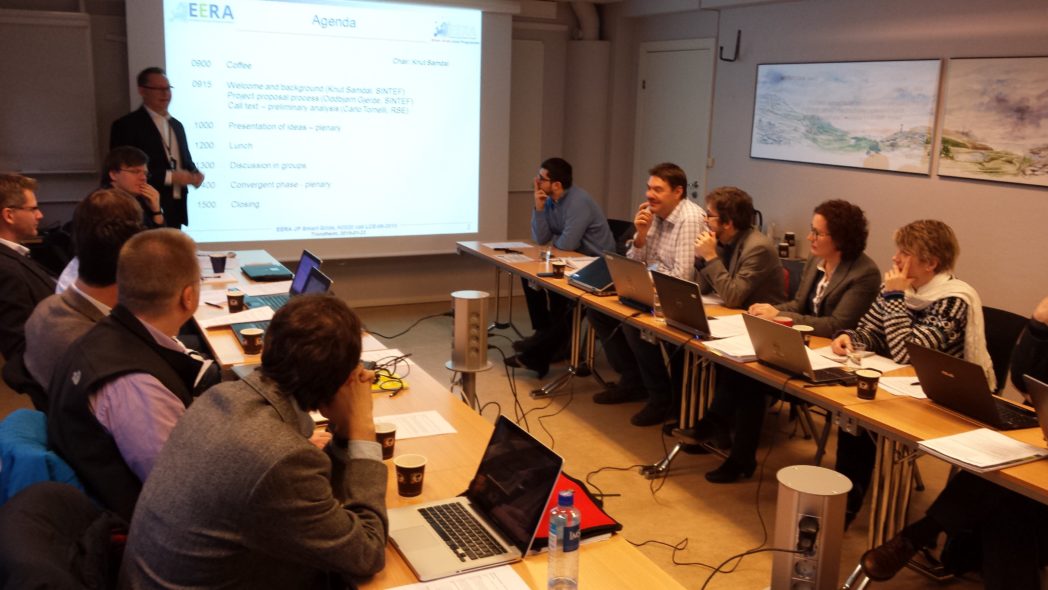
Scientists from across Europe met in Trondheim, Thursday 22 January, to coordinate future research projects on transmission networks.

5 May is the application deadline for EU’s funding program for research and innovation, Horizon 2020. The call gives you the opportunity to gain support for major European research projects.

In Horizon 2020 they emphasize research that will lead to new adoptable intelligent solutions.

The ambition is that research in Horizon2020 will solve major societal challenges in areas such as secure, clean and efficient energy.

We at SINTEF Energy and our research partners in Europe are ready to contribute to solving major societal challenges. To realize the objectives of the SET-plan (The SET-Plan is the technology pillar of the EU’s energy and climate policy) it is essential that the European research is coordinated and targeted. SINTEF plays a particularly important role as coordinator of transmission network research together with RSE (IT)  in the European Energy Research Alliance (EERA) in our joint program on Smartgrid.

Result: Three project applications

Those who attended our meeting in January were research partners we work with in EERA, on both Smart Grid and  WindEnergy. Participants came from TNO from the Nederland, VITO and Laborelec from Belgium, Institute of Electronics and Computer Science from Latvia, VTT from Finland, Tecnalia and CIRCE from Spain, RSE from Italy, Instytut Energetyki from Poland, Technical University of Denmark, Austrian Institute of Technology, University of Strathclyde from Scotland, and SINTEF and NTNU from Norway.

During the day, several promising project ideas and proposals were developed. From these we are now in the process of formulating three project applications. We hope our applications will receive support through H2020, because we think they will be an important contribution to solving the energy challenges in Europe.

I believe we will have some good projects ready by 5. May.
Comments

No comments yet. Be the first to comment!

Leave a comment Cancel reply

Your email address will not be published. Required fields are marked *

More about Energy

How much can energy-efficient voyage planning save? Evidence from 11 months of North Atlantic data

Author Image
Author Image
2 forfattere
Infographic showing the flow of thermal energy storage (TES) from surplus heat or cold to end users. On the left, red and blue thermometer icons represent surplus heat and cooling, accompanied by the text “Surplus heat or cold – Captured and stored for when it’s needed.” In the centre, a large panel titled “Thermal Energy Storage (TES)” presents three storage technologies. The top section, “Sensible TES,” shows a container with a thermometer and the text “Stores heat in one single phase.” The middle section, “Latent TES,” shows a water droplet and snowflake connected by circular arrows, with the text “Stores heat through phase change.” The bottom section, “Thermochemical TES,” shows two connected coloured circles that separate and reconnect, illustrating a reversible reaction, with the text “Stores heat through reversible reactions.” A large pale arrow-shaped wedge points from the TES panel toward the right side of the figure. On the right, three application areas are shown in separate boxes with icons: industrial processes, buildings, and data centres. The layout conveys that surplus heat or cold can be stored using sensible, latent, or thermochemical TES technologies and later supplied to industrial facilities, buildings, and data centres.

Thermal energy storage is already commercial  

Jorge Salgado Beceiro
Research Manager

Burning ammonia cleanly: How timing changes everything 

Author Image
Author Image
2 forfattere

Technology for a better society

  • About this blog
  • How to write a science blog
  • Sign up for our newsletter
  • News from NTNU and SINTEF
  • Facebook
Gå til SINTEF.no
SINTEF logo
© 2026 SINTEF Foundation
Privacy Editorial Press contacts Website by Headspin