
The global interest in reducing carbon emissions has made hydrogen a promising alternative to fossil fuels in the green energy transition. However, while the specific physical–chemical properties of hydrogen make it viable for a wide range of applications (for example: power, fuel, heat), these properties also raise significant safety concerns related to flammability, explosivity, corrosivity to certain materials and general handling challenges.
Failures of equipment containing hydrogen can lead to severe consequences and losses. Currently, there is insufficient data and understanding of both failure modes and consequences, which limits both their modelling and analysis to prevent furuther failures. This is particularly the case when deploying new hydrogen technologies or using these technologies in new industrial fields.
Hydrogen systems are complex, with developing properties, non-linear behaviours and adaptive responses. Interactions between single components can potentially lead to unexpected outcomes. As such, conventional “safety barriers”, which are often considered as static and isolated components, may be insufficient to prevent failures or mitigate their consequences.
Ensuring safety requires a holistic perspective that includes human and environmental elements
Traditional safety barrier models, which focus on physical and technical controls, are no longer sufficient to represent the complexity of hydrogen systems. Therefore, we have proposed a new approach to hydrogen safety, wherein safety barriers are considered as Socio-Technical Systems (STS). STSs extend beyond machines, technology and infrastructures (the technical component) to include human operators, organisational structures (the social component) and external factors such as regulations, market forces and physical conditions (the environment component) .
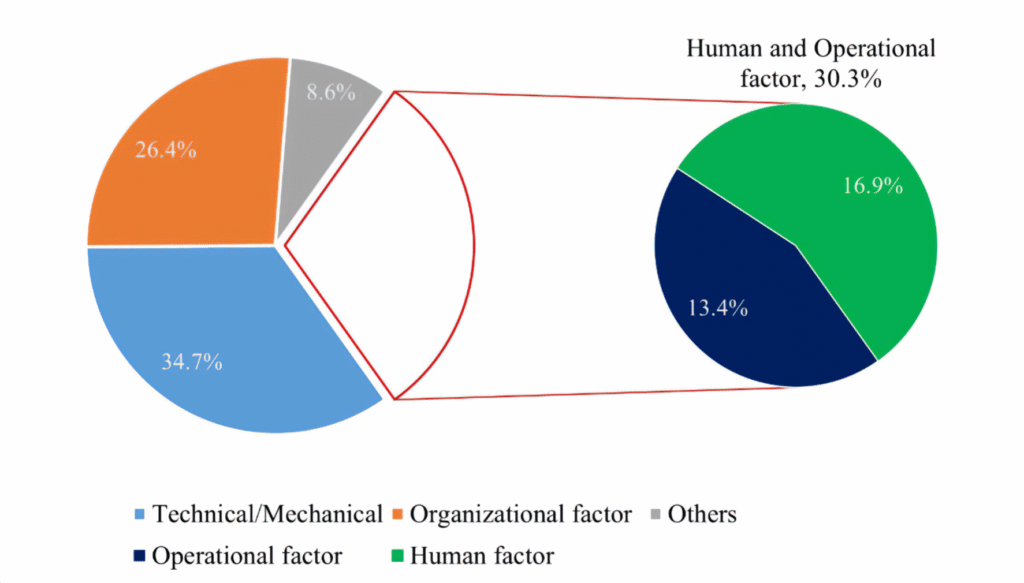
The study analysed 42 key publications related to hydrogen production, storage and distribution. While many safety assessments implicitly involve socio-technical elements (e.g. human reliability, organisation resilience), few explicitly define barriers in STS terms. This limits the ability to model developing risks, adaptive responses and interactions across system layers.
A new definition of safety barriers is therefore proposed as:
Safety barriers are socio-technical systems and can be physical or/and abstract elements that are in place to reduce the potential harm or mitigate the unintended event outcomes; should any component or the system deviate or/and interacts to emerge from its intended function.
This definition of safety barriers as STS integrates the principles of Safety-II. The Safety-II approach focuses on understanding how system components usually perform as intended rather than on a conventional safety approach of preventing mishaps. Therefore, the focus proposed in this work is on ensuring that things go right, rather than merely preventing failures from occurring or mitigating their consequences.
This reframing opens the door to smarter, more adaptive safety strategies that can evolve with hydrogen technologies and a wide range of applications. For engineers, safety analysts, and system designers working in hydrogen infrastructure, this reframing offers a more robust foundation for risk modelling, barrier validation, and safety assurance especially in high-uncertainty environments.
This content is adapted from the paper “Reframing safety barriers as socio-technical systems: a review of the hydrogen sector“, by Abhishek Subedi, Marta Bucelli and Nicola Paltrinieri.









Comments
No comments yet. Be the first to comment!