

After over 7 years of outstanding research efforts and results, FME CenBio – the Norwegian Bioenergy Innovation Centre – sent a large delegation to the European Biomass Conference and Exhibition (EUBCE) this June.
CenBio selected the EUBCE to share its many achievements and gather CenBio industry and research members in an internationally relevant context. The EUBCE is a highly respected international scientific conference with an industrial exhibition and gathers participants from research, industry, policy and business within the bioenergy sector.
FME CenBio contributed with 24 scientific presentations
CenBio members submitted 24 scientific abstracts to the EUBCE scientific committee. They were without exception accepted, out of which seven were invited for oral presentations. The remaining were presented as posters. The core content of these various presentations presented CenBio’s latest research activities. One of our researchers, Francesco Cherubini, researcher and associate professor at NTNU, was especially distinguished by being offered a prime spot in a plenary session with his presentation entitled “Unravelling the Knot of CO2 Emissions from Bioenergy and Climate Change”. Many of the contributions will also be published in conference proceedings. If you are interested to see what topics were presented, and who presented them, you will find more information here.
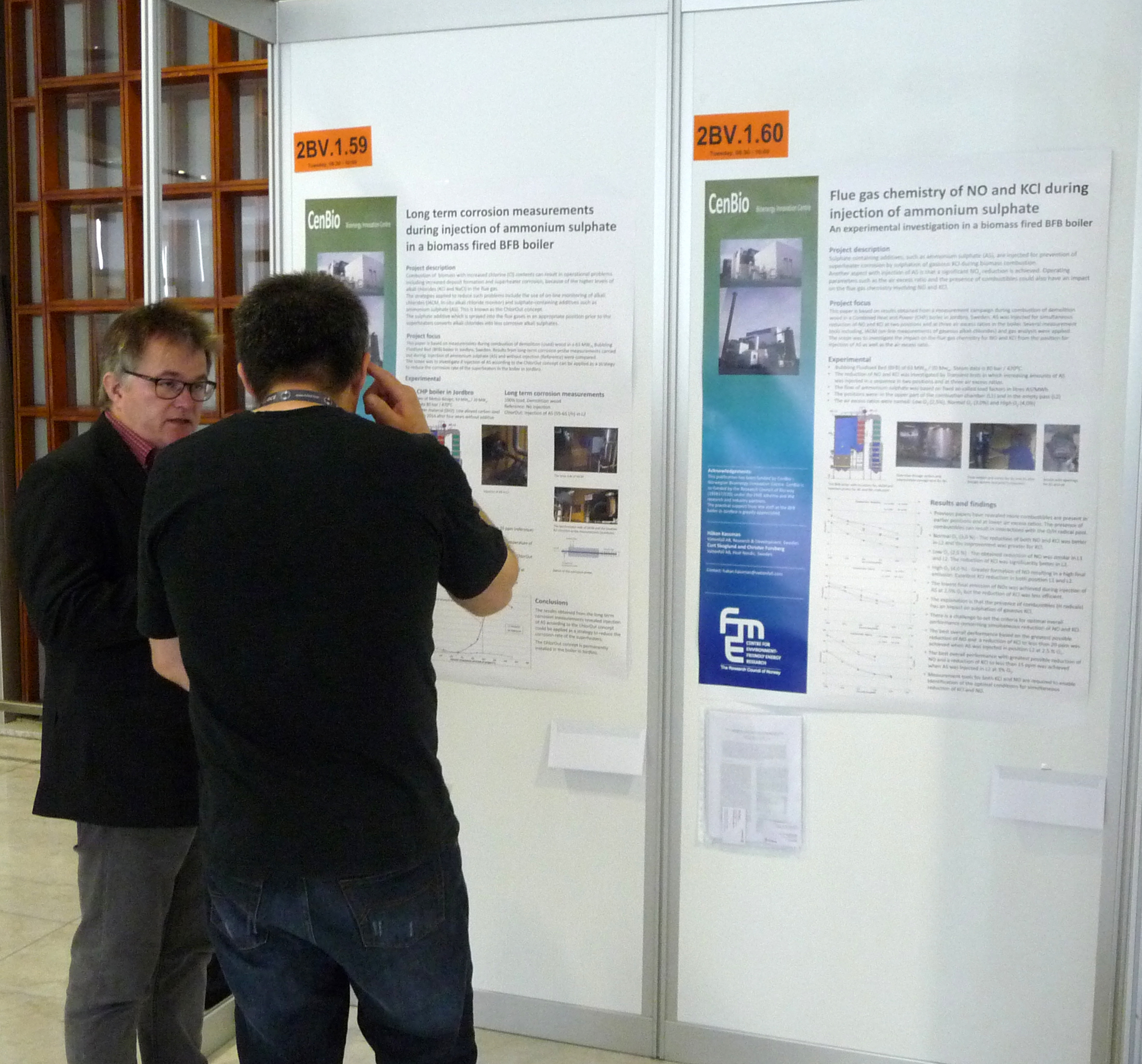
Photo: SINTEF/Line Rydså
Workshop: Sustainability of forest bioenergy
On the second day of the conference, CenBio organised an EUBCE workshop entitled Sustainability of forest bioenergy.
The workshop presented and discussed research in the field of
- technology improvements
- integrated value chain analysis
- climate change impacts
- policy instruments for enabling a sustainable and cost-efficient bioeconomy
The agenda included speakers from CenBio as well as invited international experts. The workshop contributors represented Norway, Sweden, Finland and the European Commission.
During the session dedicated to Technology and Value Chains, the winner of the 2016 Bioenergy Innovation Award was presented. Our congratulations goes to this year’s winner – Antec Biogas! You can read more about them in a different blogpost (in Norwegian).
The workshop included a panel debate moderated by Trond Værnes from the Research Council of Norway. In addition to four of the workshop speakers, the panel included two CenBio industry representatives, Morten Fossum (Statkraft Varme) and Eilif Due (Norges Skogeierforbund/Norwegian Forest owners Association). They actively contributed with their valuable viewpoints.

Photos: Odd Jarle Skjelhaugen, NMBU
Large Norwegian representation at the Exhibition
The third contribution to the conference was a CenBio/Norway stand in the Exhibition area. The stand was an ideal meeting place for social and professional networking with the Bioenergy community, as well as a natural meeting point for the 30+ CenBio (and related) participants.


Photos: SINTEF/Line Rydså and Odd Jarle Skjelhaugen, NMBU
A good week
Our collective participation was noticed by other conference participants, and several people we spoke to mentioned the high number of presentations from Norwegian institutions.
In addition to the contributions mentioned above, several CenBio-members were chosen as session chairs and co-chairs (Michaël Becidan and Øyvind Skreiberg – SINTEF Energi, Tormod Briseid – Nibio), as well as reviewers and members of the scientific committees (Michaël Becidan, Øyvind Skreiberg and Liang Wang, all SINTEF Energi).
If you want to know more about the work we have been doing in CenBio, you can visit our webpage.
Comments
No comments yet. Be the first to comment!