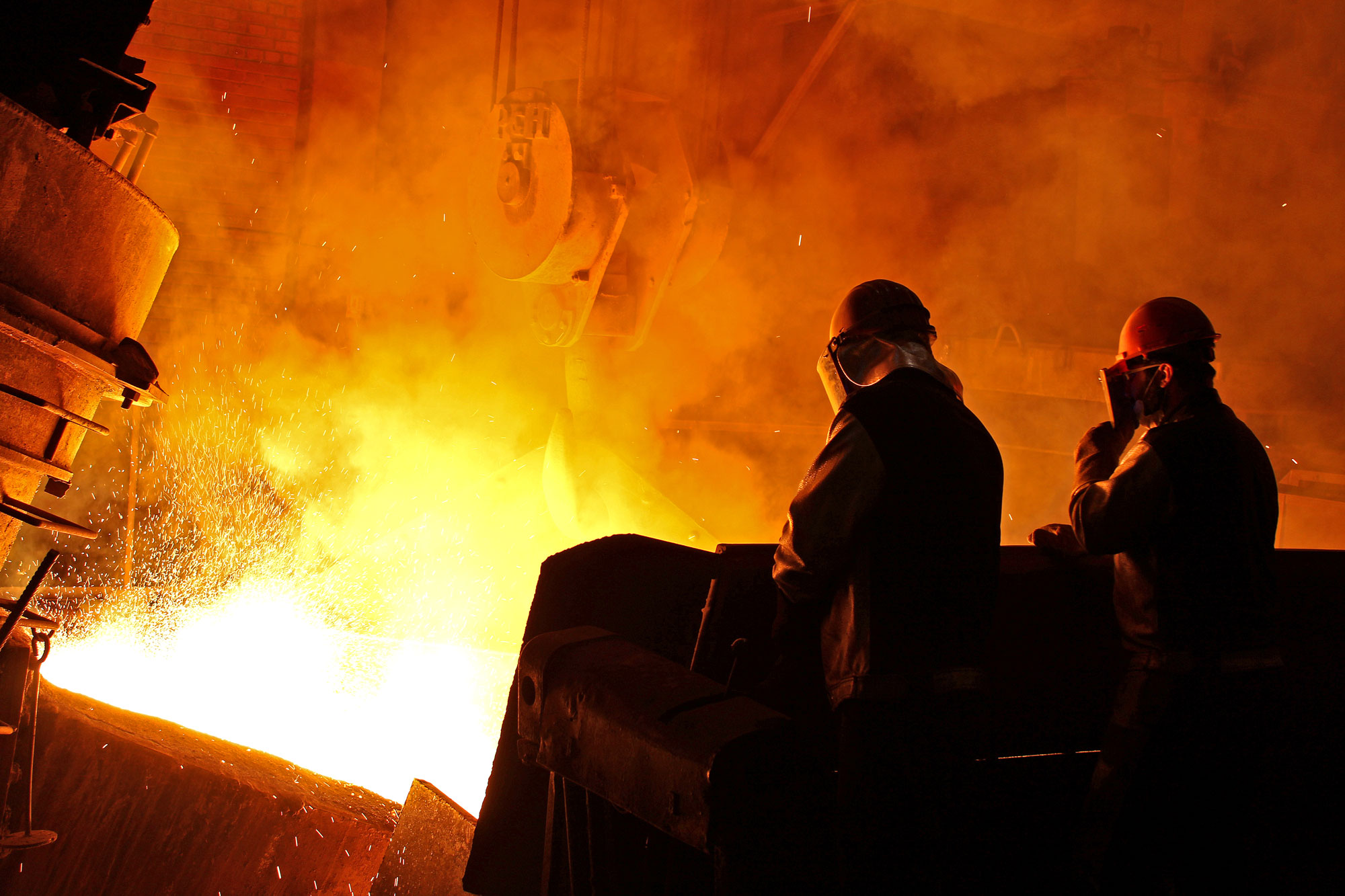


In industrial processes that consume large amounts of energy also release substantial quantities of excess heat. Energy efficiency measures can reduce these losses to some extent, but a lot of it is unavoidable. That is why we are working to both capture this heat and connect it to meaningful applications. In doing so, some of society’s largest energy consumers can avoid letting valuable energy go to waste.
Norway’s ferroalloy industry, including companies such as Elkem and Eramet, has long utilised parts of its excess heat to generate electricity and supply district heating to local communities. However, there is still significant potential for recovering and making productive use of even more excess heat. Together with the ferroalloy industry, SINTEF has spent several years researching how this potential can be realised through:
- mapping and characterising existing and emerging heat sources,
- identifying promising applications for the heat, and
- developing technologies and smart solutions for heat recovery.
So how much more heat can Norwegian smelters actually recover? In the ADVENCCS project, we mapped the energy flows in two representative ferroalloy production plants to find out. While they produce large quantities of excess heat, much of it is already utilised, difficult to access, or available only at relatively low temperatures. Still, there is untapped potential. Our analysis points to several opportunities for increased heat recovery, as well as research needs that could make even more of this valuable energy available in the future.
Not all heat is equally easy to use
The temperature of excess heat is the most important factor when determining if it can be reused. The source must be at a higher temperature than the intended application, as some heat is always lost in the transfer. Consequently, higher-temperature heat is more valuable, and temperature is the key parameter when assessing heat recovery opportunities.
Even when the heat is available at high temperatures, extracting it from industrial processes is often very challenging. Off-gases from ferroalloy production typically contain substances that can cause wear, fouling and corrosion. Operating conditions can also vary dramatically, with sudden temperature fluctuations of 500°C or more. Heat-recovery equipment generally requires a lot of space, and ideally needs to be located close to the source in order to minimise losses. The more heat attempted to be captured, the more complex and expensive the system becomes.
Once an accessible heat source at a sufficiently high temperature has been identified, one final requirement remains: a suitable solution for capturing the heat. Large process industries with clean heat sources have access to a wide range of standardised technologies. However, companies operating in smaller markets or seeking to utilise unconventional heat sources may struggle to find suitable suppliers. Using immature technologies or non-standard solutions can help pave the way for the entire industry, but this can also entail considerable financial risk for the smelter.
Why smelters are excellent heat sources
Publicly available statistics show that Norwegian smelters consume between 700 and 2,500 GWh of energy annually in the form of raw materials and electricity. 50-70% of this energy ultimately becomes heat that is either recovered or lost to its surroundings.
To understand the opportunities for heat recovery, we first need to understand the processes that generate excess heat. In this case, the source is submerged arc furnaces, which produce molten metal from ore, using large amounts of electricity and carbon sources, such as wood chips and coke. The remaining material exists the furnace as slag, while large volumes of off-gas containing CO2 are also produced. Everything leaving the furnace is extremely hot and therefore contains large amounts of excess thermal energy.
There are two main types of furnaces used to produce ferroalloys: open furnaces and closed furnaces.
Open furnaces emit allow large amounts of air to enter from the outside, causing combustible gases, particularly carbon monoxide (CO), to burn completely. This combustion generates heat and produces off-gases with high temperatures. These furnaces are used to produce silicon and ferrosilicon.
Closed furnaces do not allow air to enter, and therefore avoid combustion. As a result, there is a lower volume of off-gas, which contains a high concentration of CO. Heat can nevertheless be recovered from this gas through controlled combustion downstream of the furnace. These furnaces are used to produce ferromanganese and silicomanganese.
Off-gas from the furnaces is the most useful heat source from the ferroalloy industry. Most Norwegian smelters already utilise it for electricity generation through steam turbines, which enables them to cover up to 30% of their own electricity demand. The high temperatures make the gas particularly suited for this purpose.
At the same time, several challenges limit how much heat can actually be recovered from the off-gas. First and foremost, it is very dirty; it contains dust, soot, sulphur and other contaminants that can damage heat recovery equipment and must be filtered out before the gas can be released into the atmosphere. As a result, the gas cannot be cooled as much as would otherwise be desirable. In addition, both gas flow rates and temperature vary significantly over time. These fluctuations, combined with the risk of equipment damage, require heat exchangers and similar systems to be oversized, reducing their efficiency.
The heat contained in the molten metal and slag tapped from the furnaces is another potential energy source, but one that is currently utilised to a limited extent. Both metal and slag are tapped in liquid form, and large amounts of heat are lost during subsequent casting operations. Their temperatures are extremely high, meaning that if this heat could be captured, it would offer significant potential for further use. However, the amount of available heat varies across smelters, as some processes produce considerably larger volumes of metal and slag than others with the same size furnace.
The main reason this heat is not used today is that recovering it would require substantial modifications to the casting areas. In addition, no technology specifically designed to capture this type of heat is currently commercially available. Within the HighEFF research centre, new concepts for efficient collection of radiant heat from casting operations were investigated, but these solutions have not yet been tested under industrial conditions. Batch casting, as opposed to continuous casting, together with the extreme temperatures involved, create major challenges for heat recovery, and introducing energy recovery systems so close to a core production process without affecting operations is a complex task.
In addition, significant quantities of heat are also removed from furnaces and other equipment through cooling water systems. Although the equipment being cooled operates at very high temperatures, the cooling water itself is typically only 50-60°C. This makes it well suited for space heating and district heating applications, but demand is often lower than the amount of heat available. Integration into other processes for preheating purposes, or increasing the temperatures with heat pumps, are also possible if suitable applications can be identified. However, such opportunities are relatively uncommon in the ferroalloy industry.
Opportunities for increased heat recovery
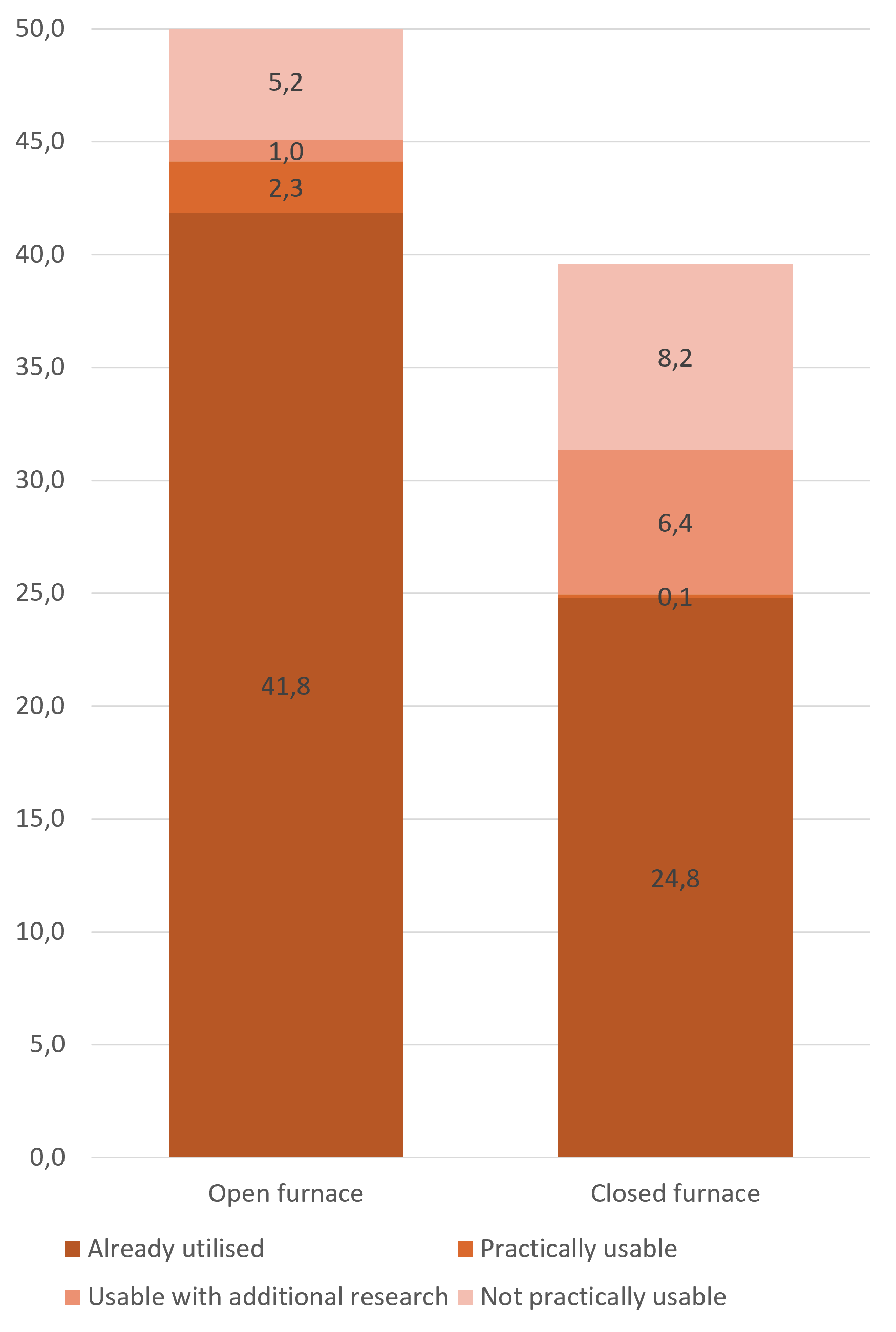
General energy mapping shows that most of the excess heat from ferroalloy furnaces leaves the process via the off-gas. In closed furnaces, however, significant amounts of heat are also contained in the metal and slag produced. Current energy recovery systems utilise most of the heat in the off-gas while simultaneously generating cooling water at much lower temperatures.
In open furnaces, the gas is still very hot as it travels through the ducts to the energy recovery system, and some heat is inevitably lost to the surroundings along the way. In closed furnaces, the gas is typically cooler before it is combusted in the recovery system, making it easier to utilise the available energy more completely.
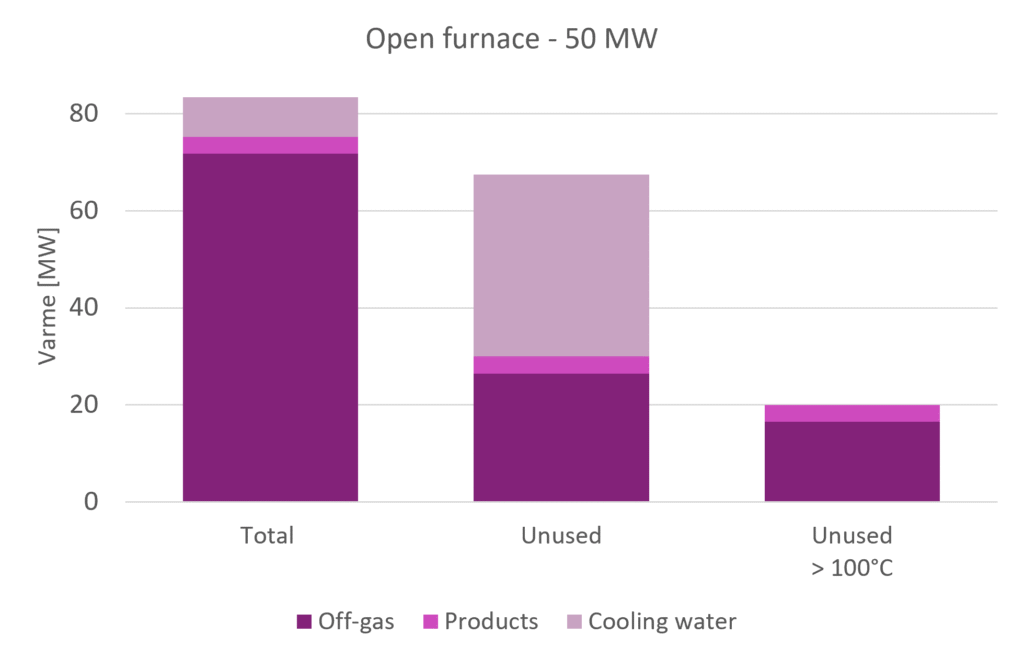
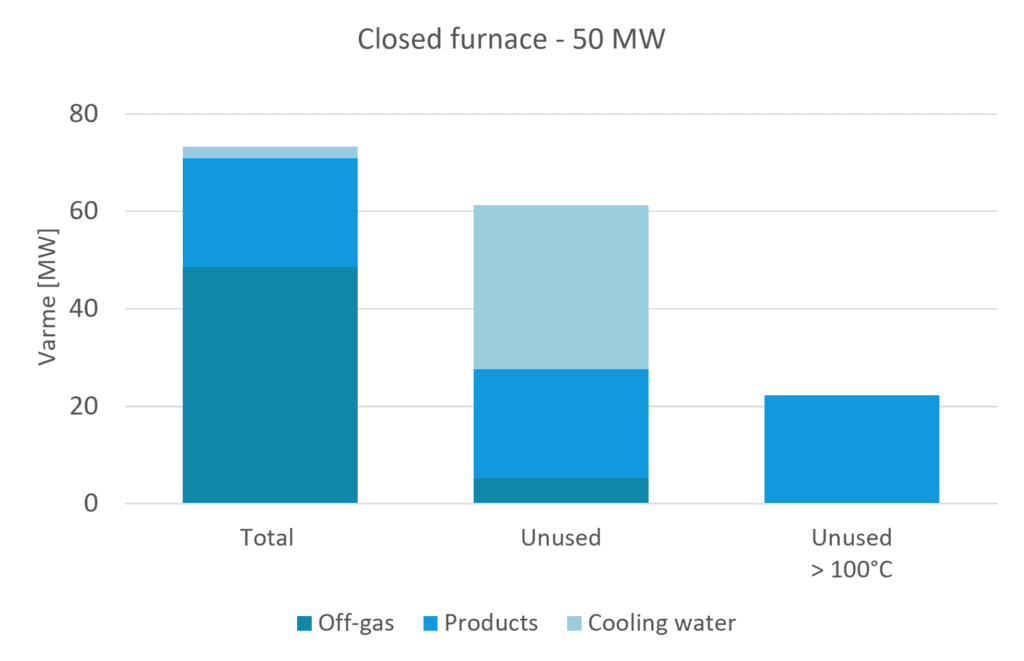
Overall, we see that the industry already recovers a large share of the heat it produces. Nevertheless, substantial amounts remain unused. This remaining heat leaves the process in the form of low-temperature cooling water, diffuse heat losses from off-gas ducts and other surfaces, or hot metal and slag tapped from the furnaces.
For furnaces with an electricity consumption of 50 MW, we estimate that 12-20 MW of excess heat could still be used, even when only considering heat sources above 100°C!
Why don’t we simply recover all this heat?
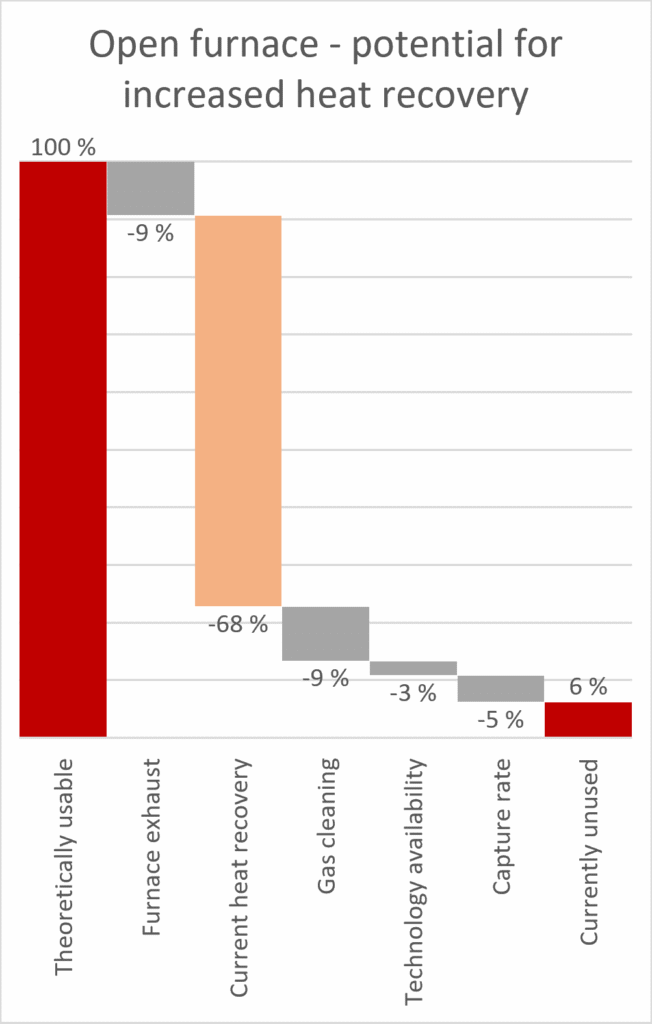
To understand why this heat goes unused, and whether anything can be done about it, we need to take a closer look at the practical realities of smelter operations. Generally speaking, the factors that complicate heat recovery can be grouped into four categories:
Furnace outlet
As mentioned earlier, the off-gas leaving open furnaces has a very high temperature. Given the typical dimensions of smelter facilities, the gas will always need to be transported some distance before reaching an energy recovery plant, even when the plant is located as close to the furnaces as possible. With conventional solutions, significant losses of heat to the surroundings can occur.
We believe that some of these losses can be reduced through improved insulation of off-gas ducts and by locating parts of the heat recovery system closer to the furnaces, though space is often limited. In addition, there are practical limits to the temperatures that today’s equipment can withstand.
Current energy recovery systems can therefore be improved to some extent, but some heat losses at the highest temperatures are, in practice, unavoidable.
Gas cleaning
In addition to heat and CO2, furnace off-gases contain dust, sulphur compounds and other environmentally hazardous substances that smelters are required to remove before releasing the gas into the atmosphere.
A variety of gas-cleaning technologies are used for this purpose, and these systems typically require operation within specific temperature ranges. The cleaning process itself can also result in significant heat losses. Together, these factors create practical constraints on heat recovery that are difficult to overcome.
Immature heat capture technology
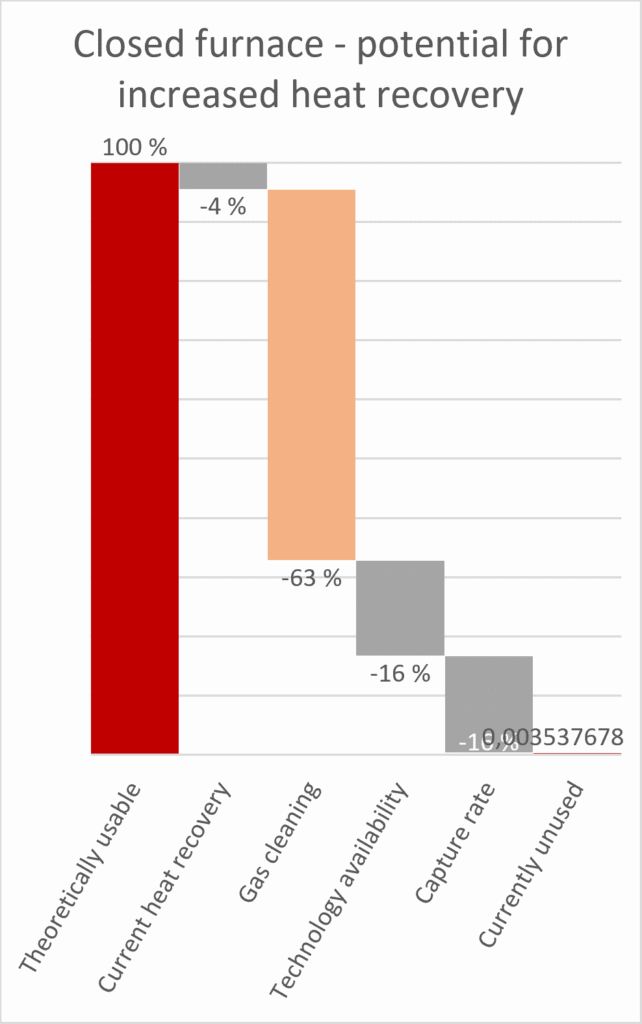
A large share of the theoretical potential for increased high-temperature heat recovery lies in capturing heat from molten metal and slag tapped from furnaces.
However, no technology suppliers currently offer turnkey solutions for this yet, and the most promising concepts would require the smelters to rethink how casting and tapping operations are carried out within their existing facilities.
As a result, the lack of mature solutions means that a significant practical heat recovery potential remains untapped when it comes to molten metal and slag.
Practical levels of heat capture
There is a substantial difference between the effort and equipment required to capture all available heat from a source, and the effort and equipment required to capture most of it. This is especially true when the heat source is distributed across a larger area or fluctuates significantly over time.
We have to accept that some of the heat is unrecoverable because capturing it would require disproportionate additional effort and cost. The exact size of these fractions is difficult to quantify. Therefore, in our studies, we use recovery assumptions (e.g. 75% for off-gas, 50% for cast products) to estimate the amount of heat that is theoretically available before taking other constraints into account.
What can we do better?
All in all, the ferroalloy industry already utilises a lot of the practically recoverable excess heat available today. Smelters also make careful cost-benefit assessments when considering new heat recovery investments.
Every smelter is unique, with different operating conditions and different heat sources. Based on our case studies, we see several directions that could enable increased energy recovery from excess heat.
Improved management of high-temperature off-gas
Plants with open furnaces in particular have the potential for more heat to be recovered from the off-gas while it is at its hottest, immediately after leaving the furnace.
One approach that has been tested by Elkem involves off-gas ducts and hoods with circulating water in the walls. This cools the equipment sufficiently to withstand the extreme temperatures while simultaneously generating additional steam for the energy recovery system.
Previous research conducted by SINTEF has also demonstrated that electricity generation in existing steam plants can be increased through smart control systems that counteract fluctuations in the off-gas stream and maintain more stable temperatures.
The use of thermal energy storage, such as steam accumulators, has also been proposed for managing these fluctuations. However, further research is needed before these solutions can be integrated.
Development of technology to recover excess heat from casting processes
Heat from casting operations is a particularly promising energy source because temperatures remain very high throughout most of the process, and this heat is currently not used for other purposes.
The opportunity is particularly relevant for plants that produce large quantities of metal or slag. In these cases, the potential for heat recovery should be explored further.
However, the research need is considerable; the challenges are complex, and no concept has yet been demonstrated in industrial operations.
A holistic assessment of heat flows
Norwegian smelters vary significantly across the country, and a solution that works well for one plant may not work well for another. While all smelters should probably recover heat from off-gases, factors such as temperature and dust content can strongly influence the choice of technological solution. For this reason, any evaluation of opportunities for heat recovery should begin with a thorough energy mapping task that includes the availability and characteristics of the heat streams. This can also uncover potential heat sources or demands that are not commonly considered in industry, as well as enable system-wide approaches for design optimisation.






Comments
No comments yet. Be the first to comment!