Skip to content

SINTEF Blog Gå til forsiden

  • Energy
  • Ocean
  • Digital
  • Health
  • Industry
  • Climate and environment
  • Building
  • Society
  • EN
  • NO
Energy Ocean

Fiscal metering – the need for traceability

For future large-scale CCS, traceable flow measurements are required.

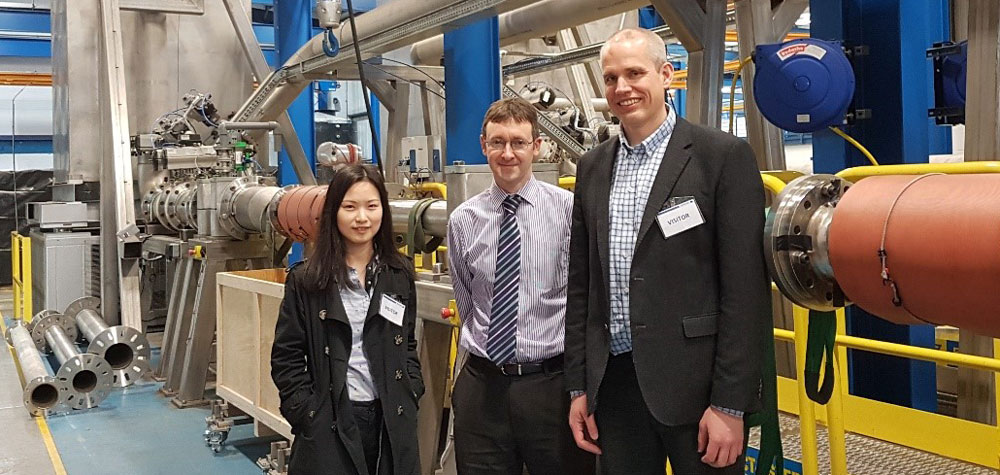
Research scientist Han Deng and Senior research scientist Sigurd W. Løvseth of SINTEF with Technical director Edward Jukes of KROHNE Ltd (middle) in front of the calibration facility. During calibration, tonnes of water are filled in the tank in the background. After a given time-period, the tank is weighed and the result compared with the reading of the flow meter under test.
author
Sigurd W. Løvseth
Published: 20. Apr 2018 | Last edited: 14. Apr 2025
2 min. reading
Comments (0)

For instance, currently, the only pan-EEA/EU incentive for CCS is the emission trading scheme (ETS), where purchase of CO2 certificates under certain conditions are not needed for CO2 that is permanently stored in a geological reservoir. One of the conditions are traceable quantification of the amount of CO2 transferred from the source to the storage site. In addition, traceable flow measurements will most likely be needed for widespread transfer between different legal entities in the future CCS systems.

  • Find out more about our research on CCS here.

Challenges with fiscal metering

At the moment, it is not clear at the moment how traceable mass flow measurement will be achieved. CO2 will be transported in liquid or dense phase, in a state quite different from normal pipeline conditions of e.g. natural gas or a close to incompressible liquid like water. In addition, the high sound attenuation of CO2, and the fact that CO2 properties change quite a lot with varying pressure, temperature and impurity content, may make traceability to e.g. the standards of ETS challenging and will require development of specific procedures. So far, no traceable mass flow measurements have been demonstrated for flows at a scale relevant for CCS.

During calibration, tonnes of water are filled in the tank in the background. After a given time-period, the tank is weighed and the result compared with the reading of the flow meter under test.

SINTEF and KROHNE is working on it

In NCCS Task 8, an activity is devoted to evaluation and benchmarking of candidate technologies for fiscal metering in CCS. KROHNE Ltd is an important partner of this work, and as a kick-start for the first benchmarking of fiscal metering technologies for CCS, scientists Han Deng and Sigurd W. Løvseth from SINTEF Energy Research recently visited KROHNE staff at their production plant and testing facility in Wellingborough outside London. Here, mass flow meters up to a pipe dimension of 400 mm and flow capacity of some thousand tonnes are tested routinely using water at multiple temperatures. This scale, and some of the methodology, will also be relevant for future verification of CO2 metering.
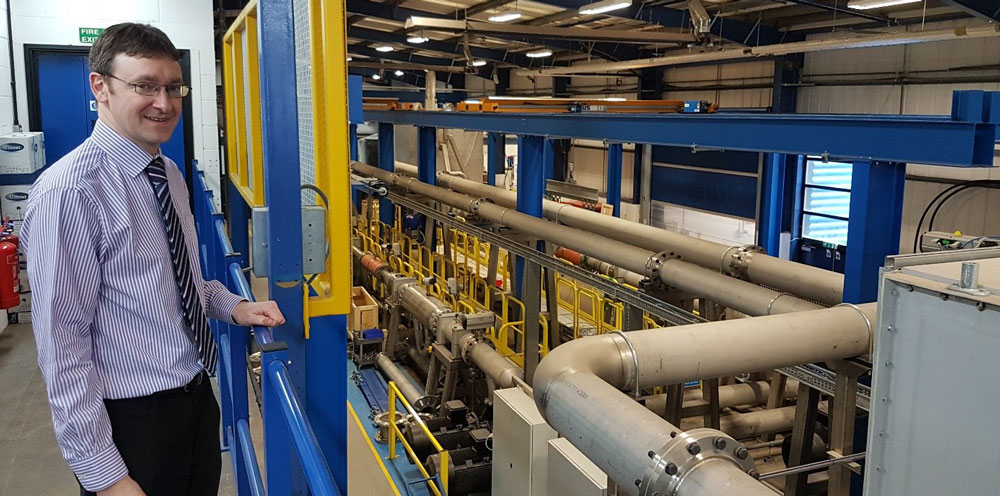
Technical director Edward Jukes and the mass flow meter calibration facility.
Technical director Edward Jukes and the KROHNE mass flow meter calibration facility.

Comments

No comments yet. Be the first to comment!

Leave a comment Cancel reply

Your email address will not be published. Required fields are marked *

More about Energy

How much can energy-efficient voyage planning save? Evidence from 11 months of North Atlantic data

Author Image
Author Image
2 forfattere
Infographic showing the flow of thermal energy storage (TES) from surplus heat or cold to end users. On the left, red and blue thermometer icons represent surplus heat and cooling, accompanied by the text “Surplus heat or cold – Captured and stored for when it’s needed.” In the centre, a large panel titled “Thermal Energy Storage (TES)” presents three storage technologies. The top section, “Sensible TES,” shows a container with a thermometer and the text “Stores heat in one single phase.” The middle section, “Latent TES,” shows a water droplet and snowflake connected by circular arrows, with the text “Stores heat through phase change.” The bottom section, “Thermochemical TES,” shows two connected coloured circles that separate and reconnect, illustrating a reversible reaction, with the text “Stores heat through reversible reactions.” A large pale arrow-shaped wedge points from the TES panel toward the right side of the figure. On the right, three application areas are shown in separate boxes with icons: industrial processes, buildings, and data centres. The layout conveys that surplus heat or cold can be stored using sensible, latent, or thermochemical TES technologies and later supplied to industrial facilities, buildings, and data centres.

Thermal energy storage is already commercial  

Jorge Salgado Beceiro
Research Manager

Burning ammonia cleanly: How timing changes everything 

Author Image
Author Image
2 forfattere

Technology for a better society

  • About this blog
  • How to write a science blog
  • Sign up for our newsletter
  • News from NTNU and SINTEF
  • Facebook
Gå til SINTEF.no
SINTEF logo
© 2026 SINTEF Foundation
Privacy Editorial Press contacts Website by Headspin