Skip to content

SINTEF Blog Gå til forsiden

  • Energy
  • Ocean
  • Digital
  • Health
  • Industry
  • Climate and environment
  • Building
  • Society
  • EN
  • NO
Energy

PilotCCS: Investigating feasibility of applying Carbon, Capture and Storage in the Czech Republic

During a seminar in the beginning of October, SINTEF Energy Research and the project partners in PilotCCS presented preliminary results and answered the questions of interested stakeholders.

author
Karoline Marie Thorvaldsen Aursland
Published: 24. Oct 2016 | Last edited: 16. Apr 2025
2 min. reading
Comments (0)

PilotCCS is one of four projects funded by the EEA Grants and Norway Grants, to promote the implementation of Carbon, Capture and Storage (CCS) in the Czech Republic. More specifically, PilotCCS investigates the technical and economic feasibility of applying CCS in the Czech Republic with a focus on the Vresova IGCC power plant. The project team consists of researchers from the Czech Technical University in Prague, SINTEF Energy Research and Nuclear Research Institute (Řež).

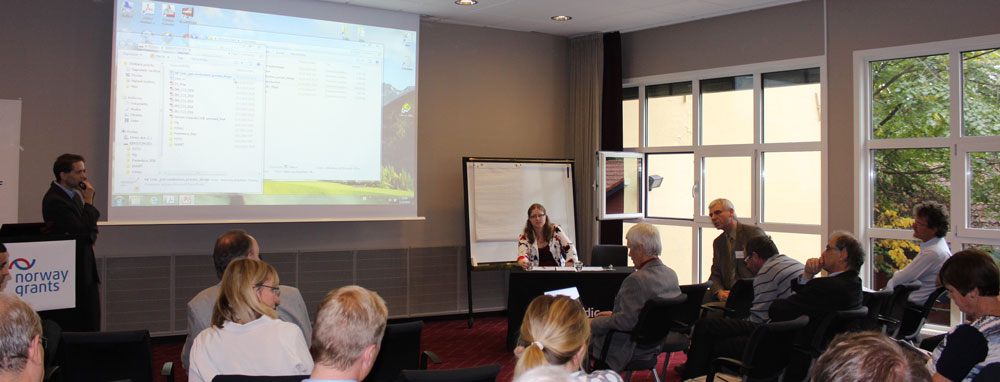
The seminar took place on Wednesday 12th October in Oslo. It was hold with the REPP-CO2 project, and was far from being a one-way communication. Participation from a broad range of interested and dedicated stakeholders from Norway and the Czech Republic allowed for real discussions about the project’s achievements and its possible implications for the future.
bilde2_pilotccs-seminar-okt-2016_utsnitt

The importance of industrial involvement

While PilotCCS is about developing CCS for the power industry, participants also discussed CCS for other industrial processes. To fulfil the project’s objective of promoting CCS in the Czech Republic, we will be involving industry and look at ways to make further use of the project results. In this regards, researcher Monika Vitvarova from Czech Technical University in Prague believes the university’s close contact with the private sector will be an advantage.

Researcher Simon Roussanaly at SINTEF Energy Research also underlines the role of industrial involvement. One must enable knowledge transfer between international CCS actors. According to Roussanaly, in order to bring CCS closer to implementation, it is also important to further developing new CO2 capture technologies for IGCCs. Such as low-temperature and membranes, and to reduce the financial risk associated with CCS deployment.

Transferring knowledge between countries

Both researchers point to the value of cross-border cooperation. Like the other international projects, PilotCCS enables transfer of existing and newly developed knowledge between Norway and Czech Republic. Vitvarova is doing a research visit in Trondheim since September. She welcomes new cooperation projects after PilotCCS ends in December.

The seminar in Oslo was held one week after the Norwegian government launched the state budget for 2017 allocating 360 million NOK to continue the three studies of full-scale CCS, confirming Norwegian commitment to CCS. It seems that a new Czech-Norwegian cooperation for this low carbon technology may very well be a possibility.

Comments

No comments yet. Be the first to comment!

Leave a comment Cancel reply

Your email address will not be published. Required fields are marked *

More about Energy

How much can energy-efficient voyage planning save? Evidence from 11 months of North Atlantic data

Author Image
Author Image
2 forfattere
Infographic showing the flow of thermal energy storage (TES) from surplus heat or cold to end users. On the left, red and blue thermometer icons represent surplus heat and cooling, accompanied by the text “Surplus heat or cold – Captured and stored for when it’s needed.” In the centre, a large panel titled “Thermal Energy Storage (TES)” presents three storage technologies. The top section, “Sensible TES,” shows a container with a thermometer and the text “Stores heat in one single phase.” The middle section, “Latent TES,” shows a water droplet and snowflake connected by circular arrows, with the text “Stores heat through phase change.” The bottom section, “Thermochemical TES,” shows two connected coloured circles that separate and reconnect, illustrating a reversible reaction, with the text “Stores heat through reversible reactions.” A large pale arrow-shaped wedge points from the TES panel toward the right side of the figure. On the right, three application areas are shown in separate boxes with icons: industrial processes, buildings, and data centres. The layout conveys that surplus heat or cold can be stored using sensible, latent, or thermochemical TES technologies and later supplied to industrial facilities, buildings, and data centres.

Thermal energy storage is already commercial  

Jorge Salgado Beceiro
Research Manager

Burning ammonia cleanly: How timing changes everything 

Author Image
Author Image
2 forfattere

Technology for a better society

  • About this blog
  • How to write a science blog
  • Sign up for our newsletter
  • News from NTNU and SINTEF
  • Facebook
Gå til SINTEF.no
SINTEF logo
© 2026 SINTEF Foundation
Privacy Editorial Press contacts Website by Headspin