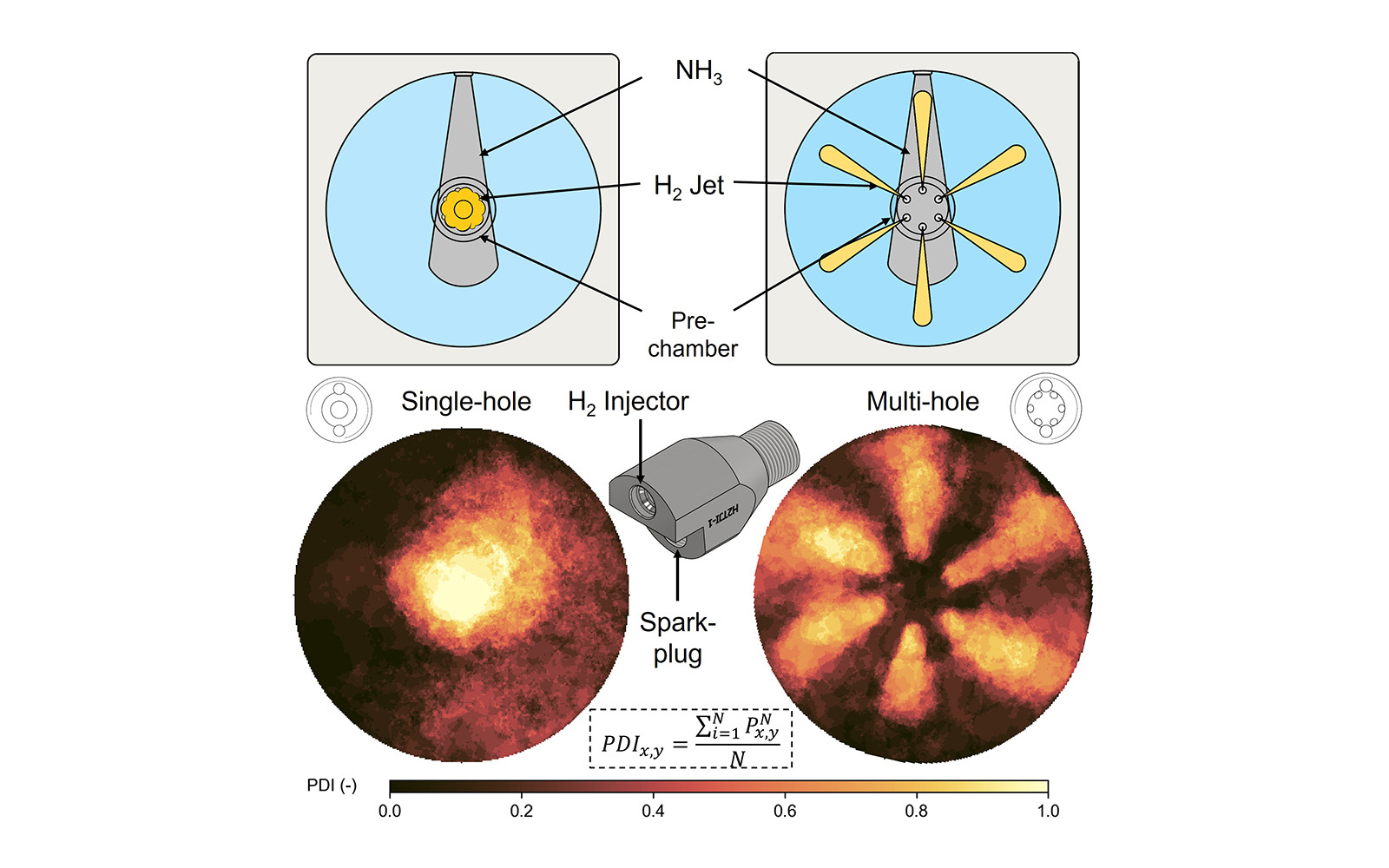


Ammonia produces zero carbon dioxide when it burns — but it burns poorly on its own. Researchers from FME HYDROGENi and NTNU found pairing it with a hydrogen-filled pre-chamber, and injecting the ammonia at just the right moment, is promising in addressing the combustion challenges of ammonia as a zero-carbon fuel for maritime applications.
The problem with ammonia as a fuel
The shipping industry faces mounting pressure to decarbonise. The International Maritime Organization has set targets of a 20% reduction in greenhouse gas emissions by 2030, 70% by 2040, and net-zero by 2050. Ammonia (NH₃) has emerged as one of the most promising zero-carbon fuel candidates as it contains no carbon, can be stored and transported at mild conditions, and existing global infrastructure already handles it at scale.
The catch? Ammonia is a reluctant burner. It has a high auto-ignition temperature, a low flame speed, and narrow flammability limits. Left to its own devices in an engine cylinder, combustion is sluggish, incomplete, and unstable.
Something needs to give it a powerful kick-start.
The solution: Hydrogen and spark in a pre-chamber
The approach from researchers at NTNU and FME HYDROGENi uses a small, separate compartment — a pre-chamber — mounted in the engine head. A tiny shot of hydrogen (just 10% of the total fuel energy) is injected into this pre-chamber and ignited by a spark plug. The resulting high-energy flame jets then punch through nozzle holes into the main combustion chamber, igniting the ammonia-air mixture like multiple blowtorches firing simultaneously.
This concept, known as Hydrogen Assisted Jet Ignition (HAJI), dramatically reduces the amount of hydrogen needed compared to simply blending the two fuels together.
Earlier research required 15–25% hydrogen energy share for stable combustion, while the pre-chamber approach brings that down to just 10%.
“Late ammonia injection creates a stratified, fuel-rich zone right in the path of the hydrogen jets — exactly where you want the fire to start.”
- Duc Duy Nguyen, NTNU
The experiment: Watching through a window
To see what’s happening inside the cylinder, researchers built an accessible combustion chamber, essentially an engine head with fused-silica windows instead of solid metal walls. A high-speed camera shooting at 36,000 frames per second captured every millisecond of the combustion process.
The key variable they tested was when the ammonia was injected into the main chamber. They varied this from very early — 165 crank angle degrees (CAD) before the piston reaches top dead centre, giving the fuel lots of time to mix with air — all the way to very late, just 40 CAD before top dead centre, leaving almost no mixing time and creating a stratified, uneven fuel cloud.
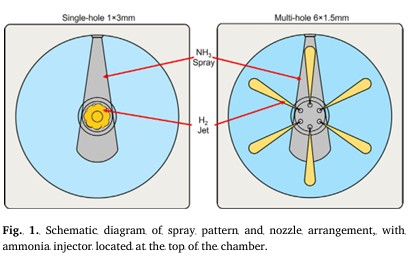
Two pre-chamber nozzle designs were compared: a single 3mm hole that fires one concentrated jet, and a six-hole nozzle (6 × 1.5mm) that fires multiple distributed jets like a sprinkler head.
The results: Timing is everything
The difference was striking. Late injection (40 CAD BTDC) produced nearly double the in-cylinder peak pressure compared to early injection (165 CAD BTDC).
- 80 bar Peak pressure — late injection
- 50 bar Peak pressure — early injection
- 60% Pressure increase with late timing
- 24 m/s Peak flame speed — multi-hole, late injection
Combustion was faster too — the burn duration halved from around 18 crank angle degrees down to just 8 with the multi-hole nozzle under late injection. Ignition delay also dropped from about 10 CAD to 5 CAD.
Why does timing matter so much? Early injection gives the ammonia time to spread evenly throughout the cylinder. That sounds good, but it creates two problems: the lean, homogeneous mixture is hard to ignite and burns slowly, and some ammonia appears to drift into the pre-chamber and dilute the hydrogen, weakening the jet ignition trigger.
The late injection reduced the amount of ammonia that entered the pre-chamber and prevented the combustion of the hydrogen/air mixture in the pre-chamber.
The stratification effect helps maintain proper hydrogen concentration in the pre-chamber while limiting ammonia ingress.
Single hole vs. six holes: Nozzle design matters — but differently at different timings
The multi-hole nozzle excels under moderate-to-late injection by spreading ignition across the chamber, achieving flame propagation speeds up to 24 m/s. But push the timing even later (30 CAD BTDC), where the ammonia is still spraying when the spark ignites and the single-hole nozzle actually wins — its concentrated jet can punch through a still-injecting ammonia spray where the multi-hole jets get confused by the rich, uneven cloud.
The six-hole nozzle created a symmetric star-shaped ignition pattern that filled the chamber more uniformly, resulting in more consistent combustion from cycle to cycle (evidenced by high flame probability values across almost the entire combustion chamber). The single-hole nozzle drilled a deeper, more focused channel but left more of the chamber’s edges less well ignited.
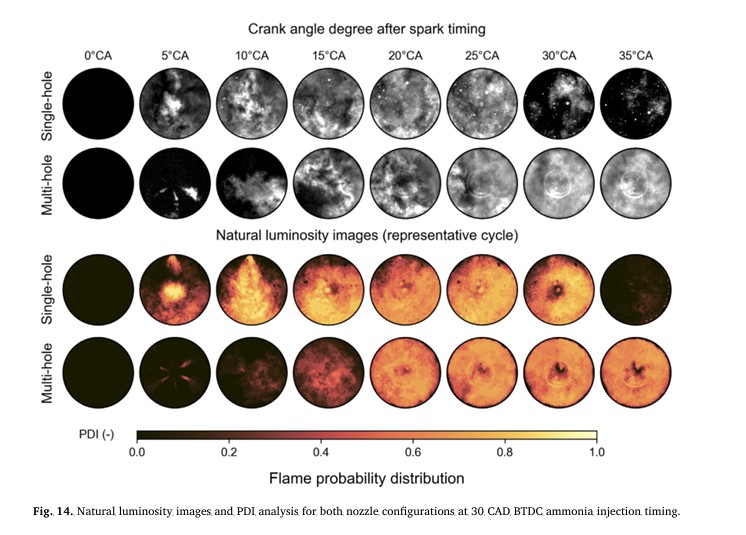
For engines running at the optimal injection window of around 40–90 CAD BTDC, the multi-hole design is clearly superior. For systems where very late injection is operationally necessary, the single hole provides more robust performance.
What this means for maritime shipping
The results are significant for the industry. A 60% jump in peak cylinder pressure translates directly to more power output and better fuel efficiency from the same engine. The ability to run on just 10% hydrogen energy share (the rest being ammonia) matters because producing and storing hydrogen is difficult and expensive — the less needed, the better. And since the hydrogen can itself be cracked from ammonia on board, a ship could in principle carry only ammonia as its primary fuel.
Spark timing will need further optimisation — with late injection, combustion happens so quickly that half the energy is released before the piston reaches top dead centre, which reduces efficiency. Retarding the spark slightly should recover that performance. Future work will also need to quantify NOₓ emissions, which remain a concern with ammonia combustion and a requirement for any real-world maritime deployment.
The bottom line
This study demonstrates ammonia’s combustion weaknesses can be overcome through smart engine design — specifically, by using a hydrogen pre-chamber for ignition and injecting the ammonia late enough to create a stratified, reactive mixture. The optical imaging provides rare visual proof of what’s happening inside the cylinder, showing faster, brighter, and more uniform flame propagation under optimised conditions.
For an industry in need of zero-carbon propulsion solutions that don’t require entirely new energy infrastructure, ammonia engines with hydrogen pre-chamber ignition represent a promising result.

Research conducted at NTNU, supported by SINTEF Energy’s HYDROGENi Research Centre.
Original article:
Nguyen, D., Turner, J.W.G. & Emberson, D.R. (2026). “Optical investigation and combustion analysis of stratified ammonia-hydrogen pre-chamber engine with variable injection timing.” Fuel, 407, 137186. doi:10.1016/j.fuel.2025.137186







Comments
Thanks for sharing the research. It reminds me of an unsolved issue that we are facing on Green Ammonia projects: the flare design for the process. The design requires two flares to handle the emergency releases from the ammonia and hydrogen units. Since we are not able to use natural gas as pilot fuel, NH3 (ammonia) gas must be used as the fuel gas to keep the flame on the burners. How to achieve a detailed mixing and burner design is still a topic under discussion.
Horacio Torres
Senior Process Engineer for Green Ammonia.