

A new article published in the open access journal www.nordicsts.org reveals the complexity of energy efficiency in energy clusters (industry and building complexes).
By analysing the achievements of energy efficient solutions as not only engineering, but also social and political work, the article draws attention to the way technological solutions do not exist in a social and political vacuum.
- Read the article: A question of power – Haavik et al
- This work is a part of FME Higheff.
The total energy of an isolated system is constant; energy can be transformed from one form to another, but cannot be created or destroyed.
The first law of Thermodynamics
Transforming energy forms – and realising an energy central – is just as much a matter of power, trust, and social relations, as it is a matter of heat exchangers, nuts and bolts. In the article, both technical and non-technical work is analysed in terms of transformation, translation and exchange.
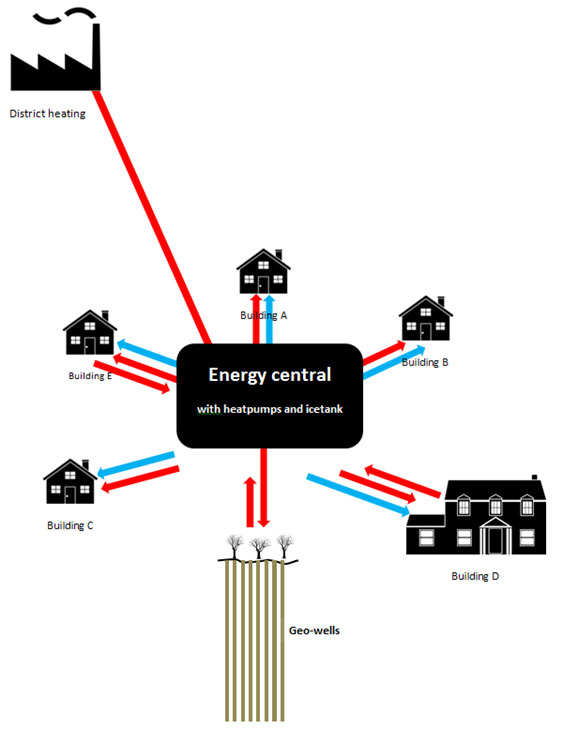
Transformation
Transformation of thermal energy in rocks and radiant energy from the sun into thermal energy captured in water is accomplished not only by technical arrangements, but also through socio-political negotiation processes. The result is both a transformation of energy media, and durable transformation of stakeholder politics.
Translation
Central in the social and political repertoire are translations – the circumvention of controversies and uncertainties associated with the particular materiality of buildings, and their energy usage patterns by articulating built environment in terms of standards and classification schemes. In our case
Exchange
Exchange refers to the process whereby social exchangers – or brokers – ensure that technical solutions are made eligible across different social spheres including mass media and political communities.
Understanding the social and political aspects in which framing and standards play important roles, is vital. By using an energy central as an example, the authors guide you through the main steps to insights of the politics of energy efficiency.
As shown, energy regulations and requirements may be a show stopper for energy efficiency solutions, but by negotiations and compromises between parties, the chance for success increases.
NTNU Social Science has been responsible for the work, which has been performed over a period of time, based on research, extended case studies and interviews of the key stakeholders involved. The main authors are researchers Torgeir K. Haavik, Jens O.D. Røyrvik and Catharina Lindheim.










Comments
No comments yet. Be the first to comment!