This is an international research project on heat pump systems for Nearly Zero Energy Buildings (nZEB) in the Heat Pumping Technologies (HPT) of the International Energy Agency (IEA).
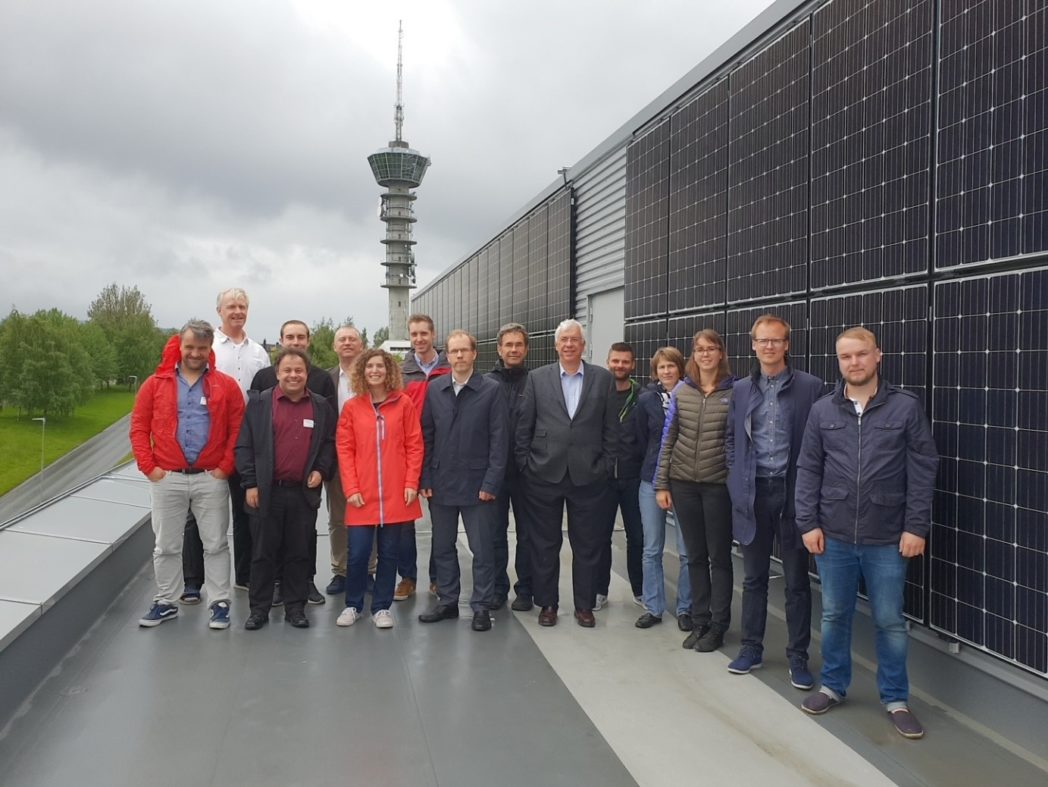
Last 7th and 8th of June, SINTEF Building and Infrastructure, NTNU and COWI hosted the visit in Trondheim of the participants of the IEA HPT Annex 49: Design and integration of heat pumps for nearly zero energy buildings. The visitors were coming from Austria (Universität Innsbruck), Brussels region (Université Libre de Bruxelles – ULB), Estonia (Tallinn University of Technology), Germany (represented by Technische Hochschule Nürnberg Georg Simon Ohm, Technische Universität Braunschweig and TEB – Transferzentrum Energieeffizientes Bauen GmbH), Sweden (RISE), Switzerland (HSR University of Applied Sciences Rapperswil) and USA (Oak Ridge National Laboratory, NIST and University of Maryland).
Each country had their particular approach, but most shared the challenge that with tighter buildings, the heat pump system and storage need to adapt and evolve to perform efficiently and correctly, considering the bigger picture. In Norway, we are lucky enough to have a big share of our electrical demand covered by hydropower, but the electrical grid is not endless. If we reduce consumption during peak hours, the grid power may be used for other purposes. However, to shift the peak of demands, we need flexible heat pump systems and storage that can be modulated accordingly to not only demands, but also other signals such as use of the grid, price, CO2 intensity etc.
We need to see the big picture and our possibilities to free the network!
Enova is helping users to look at the bigger picture, as Monica Berner explained in her presentation “How can we make our thermal (and electrical) systems flexible?” In order to enable this flexibility, storage and photovoltaic electricity at single building level are increasingly relevant. For bigger buildings, one could also think about combined heat and power. Self-consumption and storage are two concepts that become more and more important. PCM, peak shaving, shifting of loads, and use of electrical cars are more and more mentioned. Then, we need to think about control systems that can make everything work together. The FME ZEN will give answers on the “how to”, as Terje Jacobsen from SINTEF Building and Infrastructure explained in his presentation. Through pilot areas, ZEN (Zero Emission Neighbourhoods) will produce reliable data in order to develop solutions for these challenges.
Unfortunately, we see that at the building level there are still many failures. Too little commissioning of buildings and thermal systems, and follow up is often non-existent, or just performed the first year and never again. This is precisely what the participants of the Annex 49 were discussing at this meeting. Jørn Stene from COWI and NTNU presented part of the results for the Norwegian case studies. Øystein Rønneseth and Florent Dulac presented the results from their master’s theses about measurements of Medbroen kindergarten and simulation of Otto Nielsens vei 12 E respectively.
Simulation was another topic well discussed. John Clauss presented simulations of flexibility using CO2 as the control signal to control a heat pump. Finally, a common exercise of a calibrated model simulated in the different participating countries were presented.
The message so far: Heat pumps represent a great technology, but need to be designed correctly to their use. We also need to see how they can fit into the big picture so that they can contribute to achieve not only nZEB, but also ZEN!
My advice; keep posted on the deliveries of IEA HPT Annex 49: Design and integration of heat pumps for nearly zero energy buildings. Norway is going to present the results from monitoring and simulation of the heat pump systems of different buildings. All this information will be given in reports that will be freely available from the end of the annex, but the State of the art analysis from Norway (task 1) is available already today!




Comments
No comments yet. Be the first to comment!