
The goal is to prevent the global temperature from rising by more than 2 degrees by the year 2100.
The climate change agreement should not be regarded as a threat to businesses, industry and researchers, but as a major opportunity to develop new technologies aimed at saving the planet.
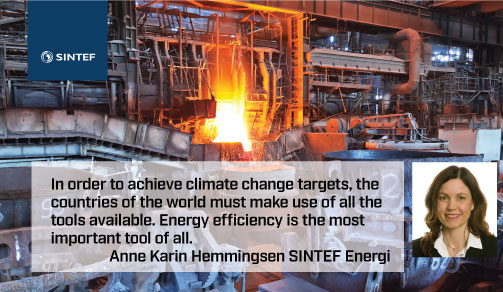
In order to achieve climate change targets, the countries of the world must make use of all the tools available. And, according to the International Energy Agency (IEA), energy efficiency is the most important tool of all.
28 November sees the opening by the Norwegian Ministry of Petroleum and Energy of the world’s largest centre for research into industrial energy efficiency. The centre, called ‘HighEFF’, is being funded by the Research Council of Norway and its industry users.
The HighEFF centre will create a robust team from the world’s 50 most prominent industrial and academic partner organisations in their respective fields.
The team at HighEFF will contribute towards achieving the current domestic and global targets of 20-30 per cent reductions in energy use, and a 10 per cent reduction in greenhouse gas emissions, by 2030.
These activities will help towards promoting significant increases in industrial competitiveness and profitability. The HighEFF centre will also be building on the huge reserves of knowledge and the innovative talents currently found in Norwegian industry.
More of everything …
The HighEFF centre will focus on shaping an even more energy efficient, climate-friendly and profitable industrial sector, based on the fundamental principles of:
- developing energy efficient manufacturing processes
- utilising waste heat generated from industrial sources
- promoting the coordination of energy use within industrial clusters
- educating, training and developing technical experts

Four industrial sectors
The HighEFF centre is divided into four industrial sectors. Some research activities will be cross-sectorial, while others will be sector-specific:
- Oil/gas and energy
- Metals and materials
- Foodstuffs and chemistry
- Industrial clusters
We will be using these exciting industrial sectors to monitor the impact of the research being carried out.
We aim to achieve a great deal during the eight years allotted to the project, and I’m looking forward to heading this work. Keep track of developments at HighEFF on the website.
Facts: Centre for an Energy Efficient and Competitive Industry for the Future The project is being funded by the Research Council of Norway and is a Centre for Environment-friendly-energy Research (FME) Duration: 2016-2024 SINTEF Energy Research will be heading the programme in close collaboration with the Norwegian University of Science and Technology and the SINTEF Group. The project involves about 35 industrial user partners and 15 research partners.







Comments
No comments yet. Be the first to comment!