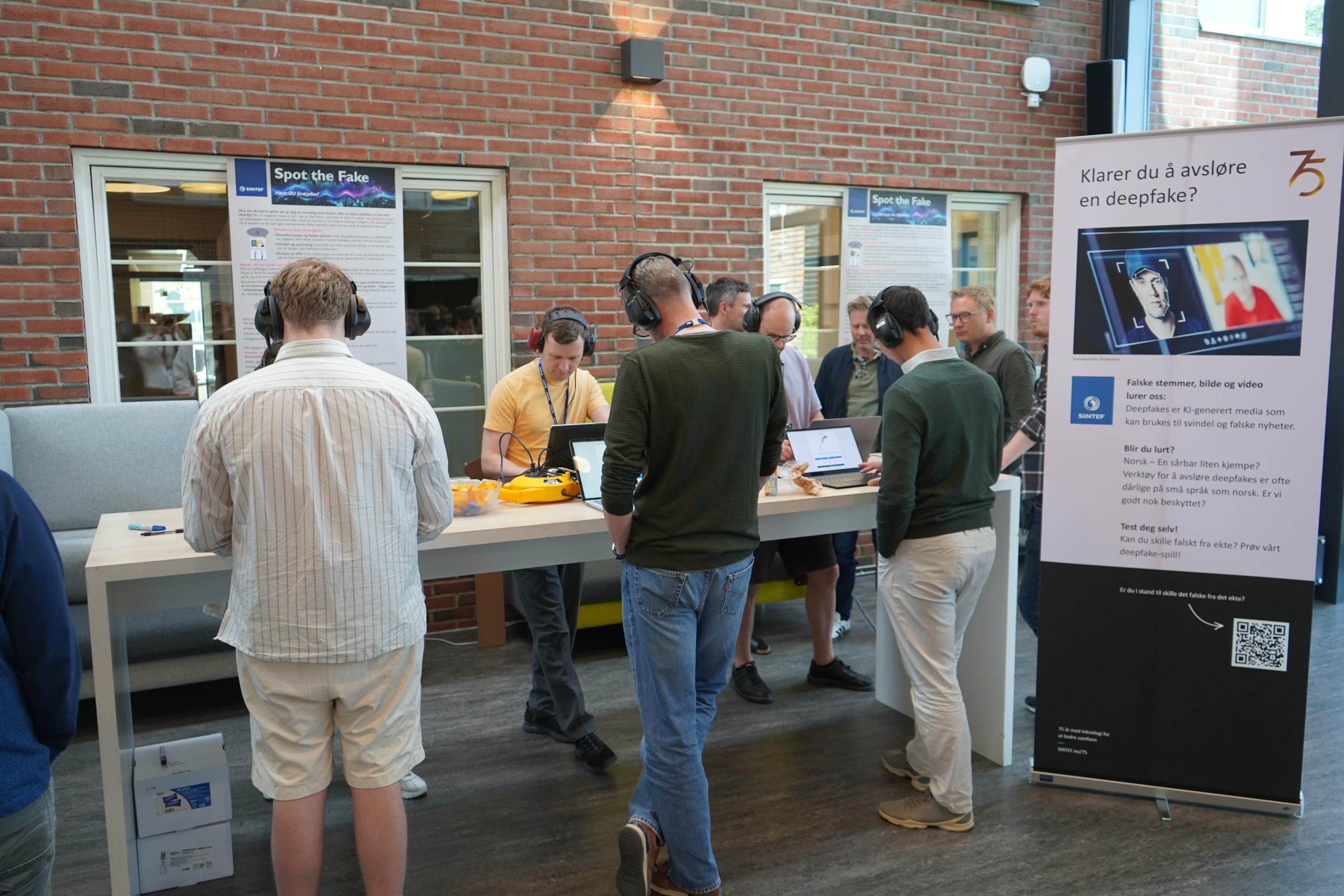

Voice cloning can now copy someone’s voice from a handful of recordings. Norwegian is a small language with a huge range of dialects, so it is tempting to think we are naturally harder to fool. We put that idea to the test: 130 SINTEF employees listened to real and AI-generated Norwegian speech and had to tell them apart. The results suggest we should not count on our dialects to protect us.
We asked Viggo Tellefsen Wivestad behind the research to explain what they did, what they found, and what it means.
Why is voice cloning a growing security concern?
It is a mix of things. The technology is now very powerful, it is wrapped in user-friendly software, and it is easy to get hold of. On top of that, we have seen real cases.
One that got a lot of attention was the fake robocall in the US, where a cloned voice of Joe Biden told voters it was not important to vote in a special election. Then came the Hong Kong case, where audio and video deepfakes were combined and used live, in a video call, to scam a company out of around 25 million US dollars. Most convincing deepfakes before that had to be pre-generated, so a live attack showed how far the technology had come. Similar cases in Norway too, for instance a deepfake version of DNB’s CFO attempt to instruct employees at the bank’s Singapore office to pay out millions of Singapore dollars during an actual Teams meeting.
There are legitimate uses too. Just one example could be a person who is about to lose their voice to illness, who can keep a clone of their own voice instead of a robotic one. But it is fair to ask whether that benefit outweighs a world where anyone can make anyone else sound like they are saying anything.
Why did you study Norwegian specifically?
We had spent a couple years exploring deepfakes across all kinds of media. We built a game called Spot the Fake, where you guess whether images, speech, songs and videos are real. While building it we realized how mature audio had become. Commercial, easy-to-use voice cloning tools had, at that time, no real guardrails, and the results were far more reliable than the images of the time, where you could still spot the six-fingered hand.
That made us curious about Norwegian, because there were two competing expectations. The intuitive one is that Norwegian is a minority language, probably underrepresented in the training data, so AI should perform worse. The opposite view is that minority-language speakers may be more vulnerable. Speech technology in smaller languages used to be terrible, so people carry an outdated picture of what a computer voice sounds like. If your baseline is the robotic voices of a few years ago, a modern clone does not need to be perfect to trick you.
Norwegian also has a lot of dialect variation and no universally adopted spoken standard, which raised a new question: does dialect diversity make synthetic speech easier to detect?
What do we already know about our ability to detect synthetic voices?
That it is poor. In controlled experiments, in English, Mandarin and other languages, even in settings where people know that fakes are present, perform above chance but unreliably. Some studies describe it as close to a coin toss. It also depends on the context, and most experiments use pre-recordings. Detecting a fake live is much harder, which is something we need to research more.
Deepfake detection software is part of the answer, but it is a cat-and-mouse game. The end game looks like fakes that are virtually indistinguishable from real content, so we also need other tools: technical ones related to e.g. authentication, but also social ones and human skills.
How did you test it?
We used speech recordings from the National Library of Norway’s NB Tale corpus. In it, hundreds of people from across the country have read the same sentences, which was ideal for us because we did not want the content of a sentence to influence how realistic it seemed.
We selected 20 speakers from 10 dialect regions, with a balance of men and women, all aged 40 or older, since we assumed they would have more traditional dialect features. For each speaker we kept two recordings secret as the test set and used the remaining 18 to clone their voice with ElevenLabs, a leading commercial tool. We then had each clone read out the two secret sentences. We generated each clip once and used the first result, as a foreign attacker who does not speak Norwegian and cannot judge the quality would do.
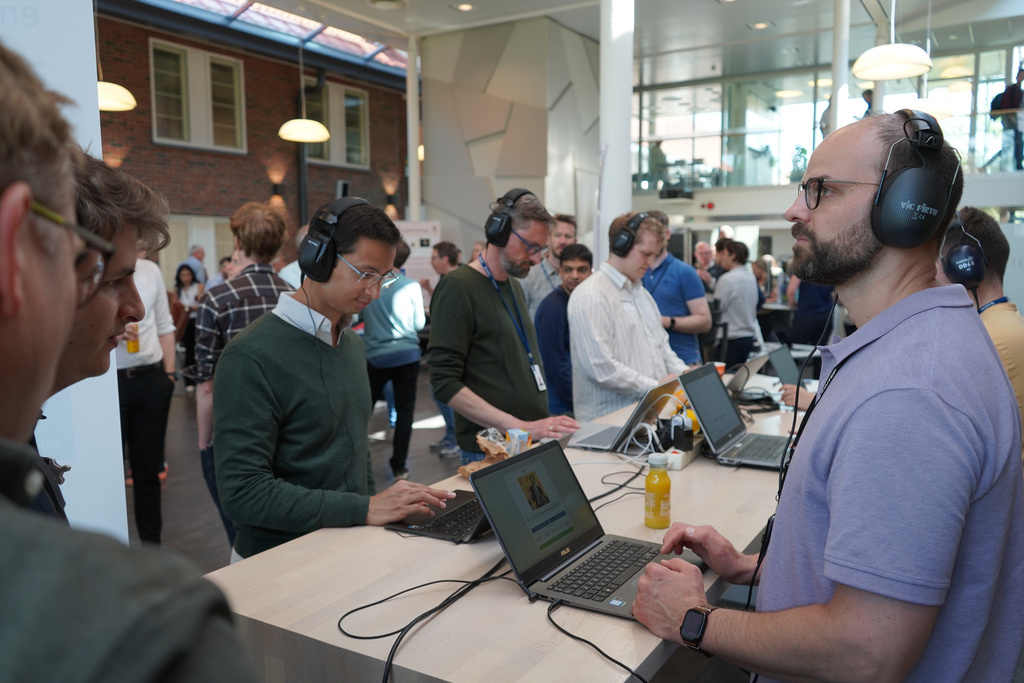
We grouped the regions into five broader ones: North, Central, West, East and South. Each participant listened to 20 clips in random order, 10 authentic and 10 synthetic, with a map showing where the speaker was from. For each clip they decided whether it was real or AI-generated. They were told up front that deepfakes were in the mix. Participants sat at six laptops with high-quality noise-canceling headphones at the anniversary event.
So, how well did people spot the fakes?
Not well. The 130 participants accepted 31.3% of the AI-generated clips as authentic, which means roughly one in three fakes passed as human. Overall accuracy was 69.8%. They caught 68.7% of the fakes, but also wrongly accused 28.9% of the real clips of being AI.
This happened even though the participants were highly educated, technically skilled, had been warned, and were motivated to win. Real-world victims are rarely primed like that.
Did it matter whether the listener was a native Norwegian speaker?
Yes. SINTEF has employees from more than 80 nationalities, so we expected a difference, and we found one. Native speakers were fooled 27.1% of the time, non-native speakers 41.3%. That is a gap of about 14 percentage points.
The non-native listeners were not simply more trusting. They were worse at telling real and fake apart, and they made more mistakes in both directions: they missed more fakes and falsely accused more genuine voices. Knowing the language and its melody gives some protection, but even native speakers were fooled more than one time in four.
Were some dialects easier to fake than others?
This was the biggest surprise. Among native listeners, the share of fake clips judged as authentic was:
- South: 56.6%
- East: 46.4%
- North: 22.5%
- West: 15.7%
- Central: 10.2%
So Southern and Eastern voices fooled people most often. Northern voices gave the best separation between real and fake, followed by Western.
The Central result is the most interesting. We ran the experiment in Trondheim, so we thought the home crowd might do well. Instead, they were very suspicious of Central voices, labelling many clips as fake whether they were or not. Their low susceptibility was not a sign of better detection. It was a bias: they simply did not believe anyone would sound like that. In other words, being suspicious is not the same as being good at detecting.
We also think some of the pattern may come from the clones themselves. After the experiment, we found that some of the northern clones sounded more eastern or southern than northern. Since listeners could see where each speaker was from, some may have flagged them as fake because they sounded like the “wrong” dialect, not because they sounded artificial. If so, familiarity with a dialect can protect you, but only if the cloning tool gets the dialect right.
What are the limitations of the research?
There are several. All participants were SINTEF employees who chose to take part, so the sample is not representative of Norway. Some regions had only two to six cloned voices, so the dialect results are uncertain and hide variation within each region. We tested one commercial tool and short read-aloud recordings, not real phone conversations. And the clips were pre-recorded, not live.
These are emerging results, not a final answer. But they point the same way as other studies.
So, does dialect diversity protect us?
Only partly. Dialect diversity and being a small language are not a strong natural defence against deepfake voice scams. Listeners kept some ability to tell real from fake, but it varied with language skills and dialect, and was shaped by expectations as well as by what people actually heard.
What would protect people, then? More skepticism?
To a certain degree, but too much skepticism is not good either. As the non-native listeners showed, turning up your suspicion mostly moves the problem: you reject more genuine people. Human judgement alone should not be our main defence against deepfake fraud.
There are technical attempts: detection tools, and approaches that work the other way around by proving that content is authentic, such as the C2PA standard and watermarking. But the solution is often manual and human-centered. An insurance company that suspects a fake photo of damage can call the customer, ask more questions, request more photos, or ask to see the car. It is resource-intensive, but it works.
We also need institutions that can help us work out what is true, especially journalists, media organisations and public authorities. Their role will be more important than ever.
What would be the most relevant continuation for this research?
The work has led to new collaborations. Together with the Norwegian Centre for Trustworthy AI (Trust), we are looking at how deepfakes affect key Norwegian actors: the police, the courts, and the banking and insurance sectors. Future studies of voice deepfakes should include more dialects, speakers and voice-cloning systems, and look at live, conversational attacks.
The study, “Does Dialect Diversity Protect Against Deepfake Vishing? Evidence from a Norwegian Listening Experiment” by Viggo Tellefsen Wivestad, Per Håkon Meland, Tron Vedul Tronstad, Femke B. Gelderblom and Marte Høiby, was presented at Nordsec 2026, a Nordic Conference on Secure IT Systems. It was partly funded by the Research Council of Norway through the AI-mar project.


Comments
No comments yet. Be the first to comment!