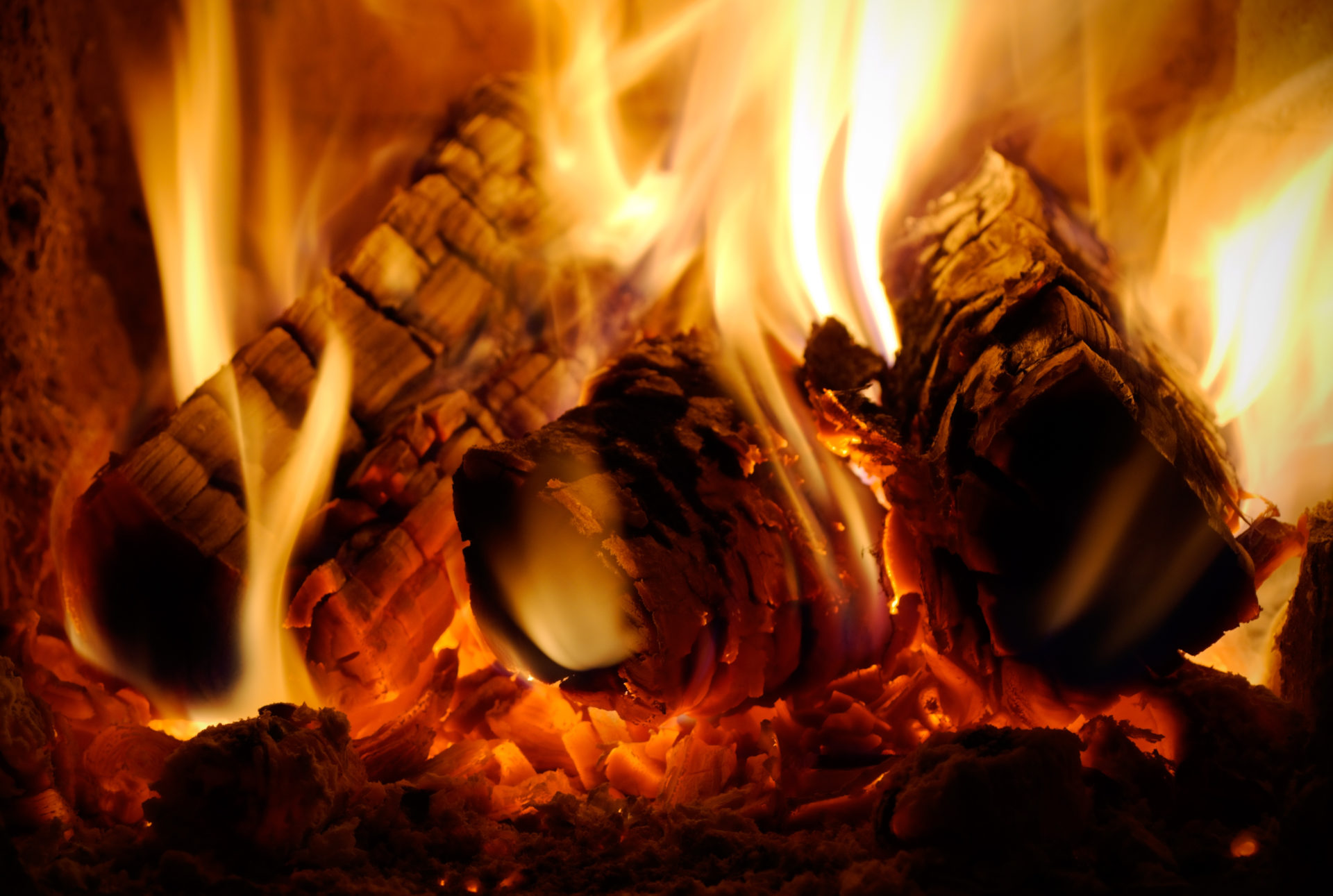

We have yet to demonstrate whether it is better to place small wood chips between the logs. Many combinations of wood chips and logs are open to debate. However, what SINTEF Energy Research and other centres have shown is that if you light the fuel in your stove from above, using clean logs at the base and kindling/chips at the top, particle emissions will be reduced by between 50 and 80 per cent.
The photos below illustrate how lighting a stove from the top is carried out in SINTEF Energy Research’s lab “Nasjonal krok for vedovnsutvikling” (Norwegian Wood Stove Development Lab). Our experiments resulted in emissions reductions of 60 per cent.
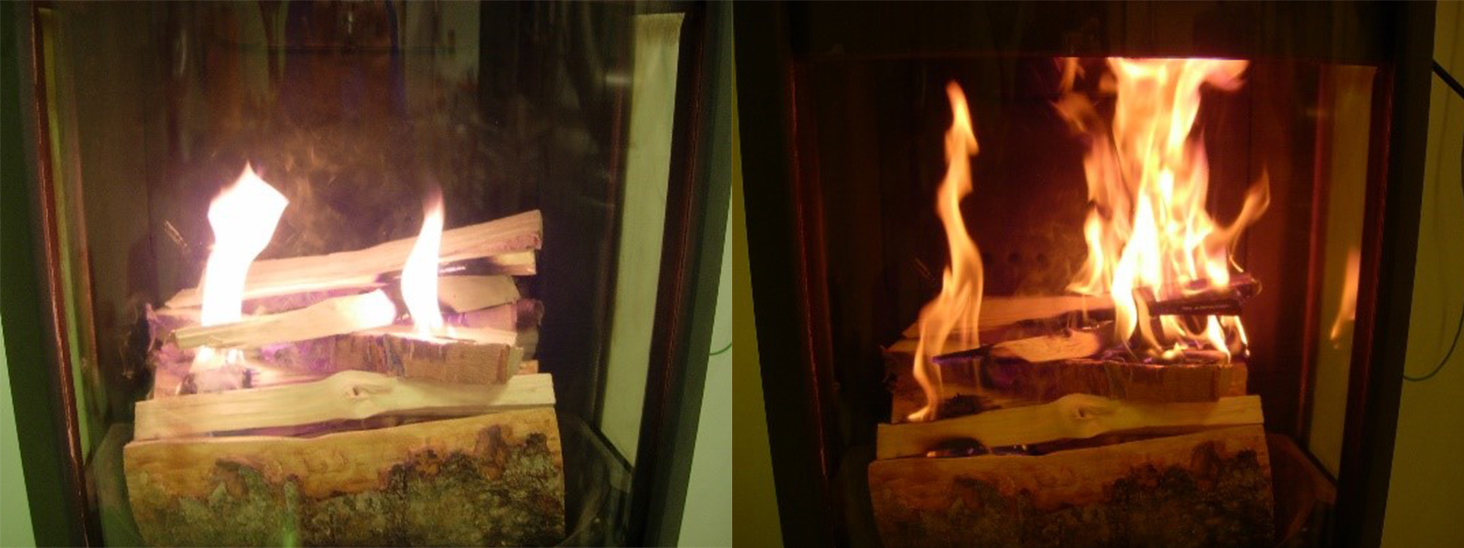
Similar experiments carried out in Switzerland resulted in particle emission reductions of between 50 and 80 per cent.[1]
Logs – lots of air or tightly packed?
Experience indicates that if we want to maintain constant heat output, we should be packing the logs as tightly as possible to let the flames “eat” their way gradually downwards. If the logs are loosely packed, the flames will engulf all the logs more quickly, and heat output will be much more rapid.
- Click here on WoodCFD and StableWood to read more about SINTEF’s research into wood fuels.
Light right for maximum “hygge”
Later tests carried out at SINTEF Energy Research in 2016, involving 20 random participants who were asked to light up their stoves, showed that only 20 per cent did everything right.[2]. Those of us researching in this field are thus hoping that the “hygge” video will encourage more people to light their stoves from the top.
[1] Nussbaumer et al., “Influence of ignition and operation type on particle emissions from residential wood combustion”, 16th European Biomass Conference and Exhibition, 2–6 June 2008, Valencia, Spain
[2] Zachrisson J et al, Goile F, Seljeskog M., Boks CB, «Burning for sustainable behaviour» Journal of Design Research 2016 ;Volum 14.(1) s. 42-65











Comments
Hi Morten,
am the Director for the Guild of Master Chimney Sweeps.in Scotland. associate members of Escfo
Members of the Federation of British Chimney Sweeps
I was kindly passed your name by Tom Galambos of Norsk Brannverforening.
I was looking for actual research which shows that lighting wood from above is far more efficient and by effect produces far lower particle emissions .
Your article backs up the excepted practice in Norway and other Scandinavian countries , parts of The United states etc.
Do you have a copy of the Swiss research I could access?