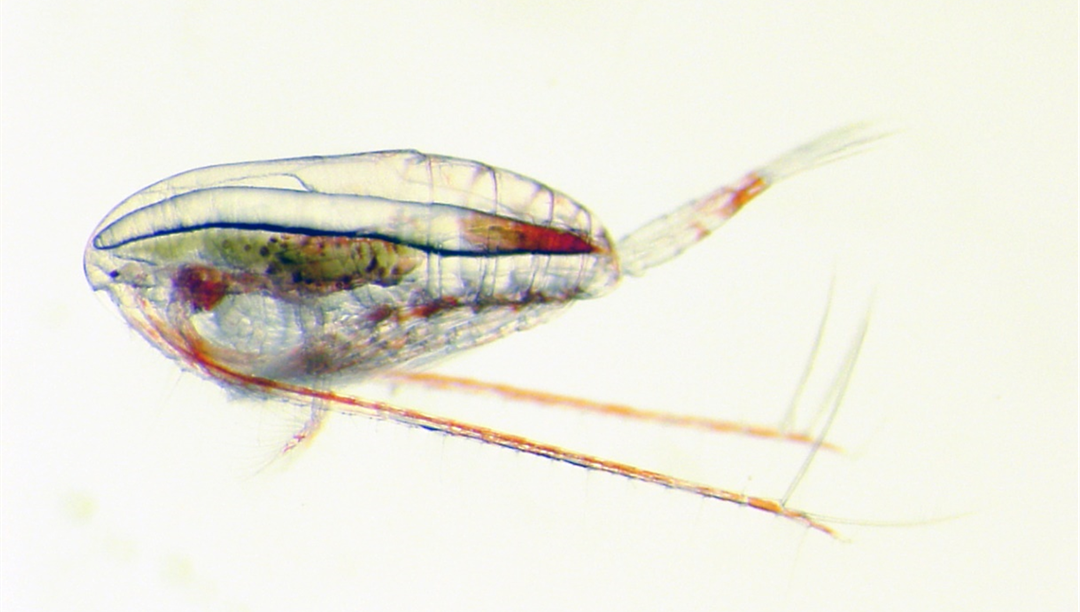
From the smallest fish larvae to huge whales, many species in the North Atlantic depend on the single, tiny crustacean called Calanus finmarchicus for their survival.
Understanding where this species lives and what drives its distribution, and how that will shift under future ocean conditions driven by climate change, is key for ocean ecosystems. Within SFI Harvest, this understanding of ecosystem dynamics is essential to developing a sustainable harvesting industry.
Three findings stand out from my four years of PhD research in the Norwegian Sea and the North Atlantic:
Food and temperature decide depth. Calanus finmarchicus is closer the surface when food is abundant there and retreats deeper under warmer temperatures. Its vertical position in the water column is a direct response to its environment, and it changes with the season and the animal’s life stage.
Ocean currents shape where swarms form. In the Lofoten Basin, one of the most productive areas of the Norwegian Sea, patches of Calanus closely follow the distribution of Chlorophyll-a (food) in the water, both are shaped by ocean circulation.
Wind moves the young Calanus; the older and thus bigger ones fight back. Wind events push surface Calanus across the shelf. But larger individuals can actively swim towards deeper waters against being carried.
Commercial fisheries in Norway depend on the abundance of Calanus to grow. If climate change shifts where and when this copepod specie is available, the entire food web above it can present shifts too.
Meet Calanus finmarchicus
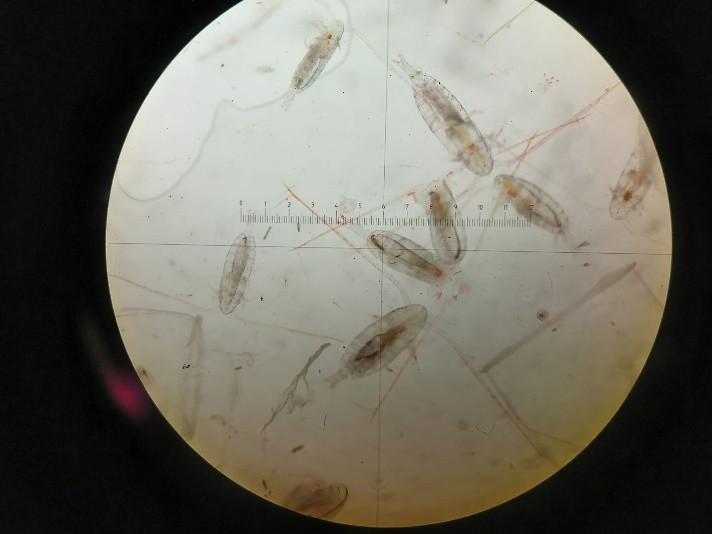
- Calanus finmarchicus is a copepod/ zooplankton, measuring 2-3 mm.
- Despite its size, it is one of the most ecologically important animals in the North Atlantic.
- Its value lies in its omega-3 rich fat.
- It is food for herring, mackerel, capelin, seabirds, and baleen whales, etc.
In the Norwegian sea, the abundance and distribution of commercially important fish species is tightly coupled to where Calanus is found.

How to track Calanus?
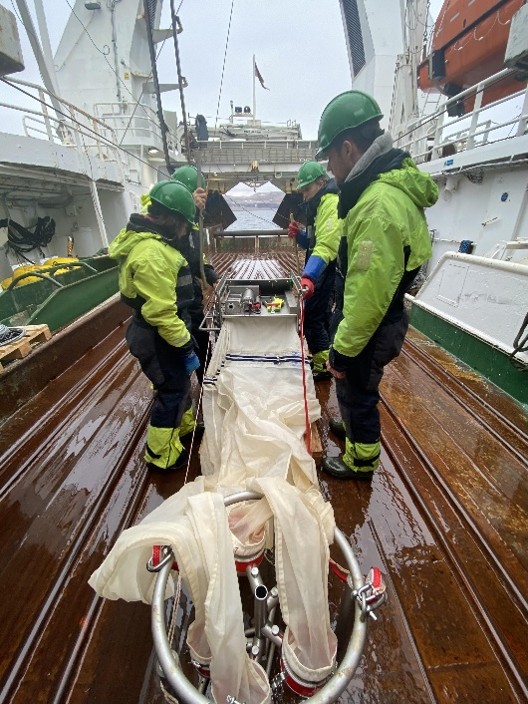
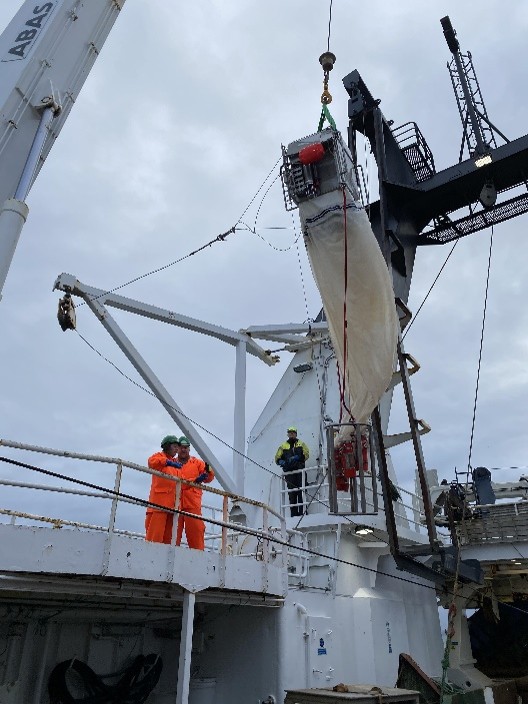
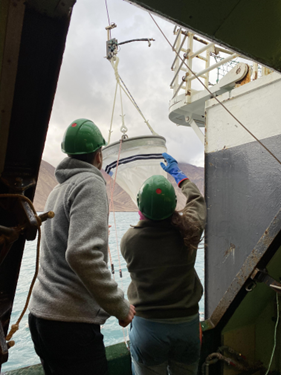
To track Calanus finmarchicus across the water column, zooplankton nets were deployed at different depths to collect individuals directly, and optical instruments which detect and count organisms as they pass through a beam of light allowed us to estimate distributions at finer resolution and across our studied area.
At the same time, we gathered environmental data that might influence the copepods: temperature, salinity, food availability estimated from chlorophyll-a concentrations, wind speed and direction, and ocean current patterns.
These datasets were then analysed using statistical models to identify which environmental variables best explained where Calanus was found and at what depth. We also used numerical ocean–ecosystem models computational simulations of the ocean and its biology to simulate copepod abundance and to understand how patches form and what drives their location.
What we learnt
The vertical position of Calanus finmarchicus in the water column changed consistently with both the season and the animal’s developmental stage. Across the range of conditions sampled, two variables stood out above all others: chlorophyll-a concentration and temperature. When food was abundant near the surface, individuals were found at shallower depths. Temperature, meanwhile, influenced depth preferences across the species’ full distribution range warmer surface waters pushed animals deeper.
In the Lofoten Basin, we found that the spatial patchiness of Calanus was similar to chlorophyll-a distributions. Those distributions, in turn, were shaped by the Lofoten basin mesoscale circulation patterns. Ocean currents concentrate nutrients in particular areas, triggering algal blooms, forming patches that are similar to the most intense blooms.
Wind emerged as an additional driver. Smaller individuals were most vulnerable to being transported horizontally by wind-driven currents carried across the shelf. Larger copepods at more advanced life stages, however, were suggested to present an active swimming behaviour that allowed them to escape from this transport.
Together, these results improve our understanding of the processes controlling copepod distribution and patchiness in the Norwegian Sea. As ocean temperatures rise and circulation patterns shift under climate change, the timing and location of Calanus aggregations will change with consequences up to fish populations, seabirds, and the marine mammals that depend on this region’s productivity.
Better models of copepod distribution are needed to predict and manage these changes, supporting both short-term prediction for sustainable harvesting and long-term prediction for sustainable fisheries management.




Comments
No comments yet. Be the first to comment!