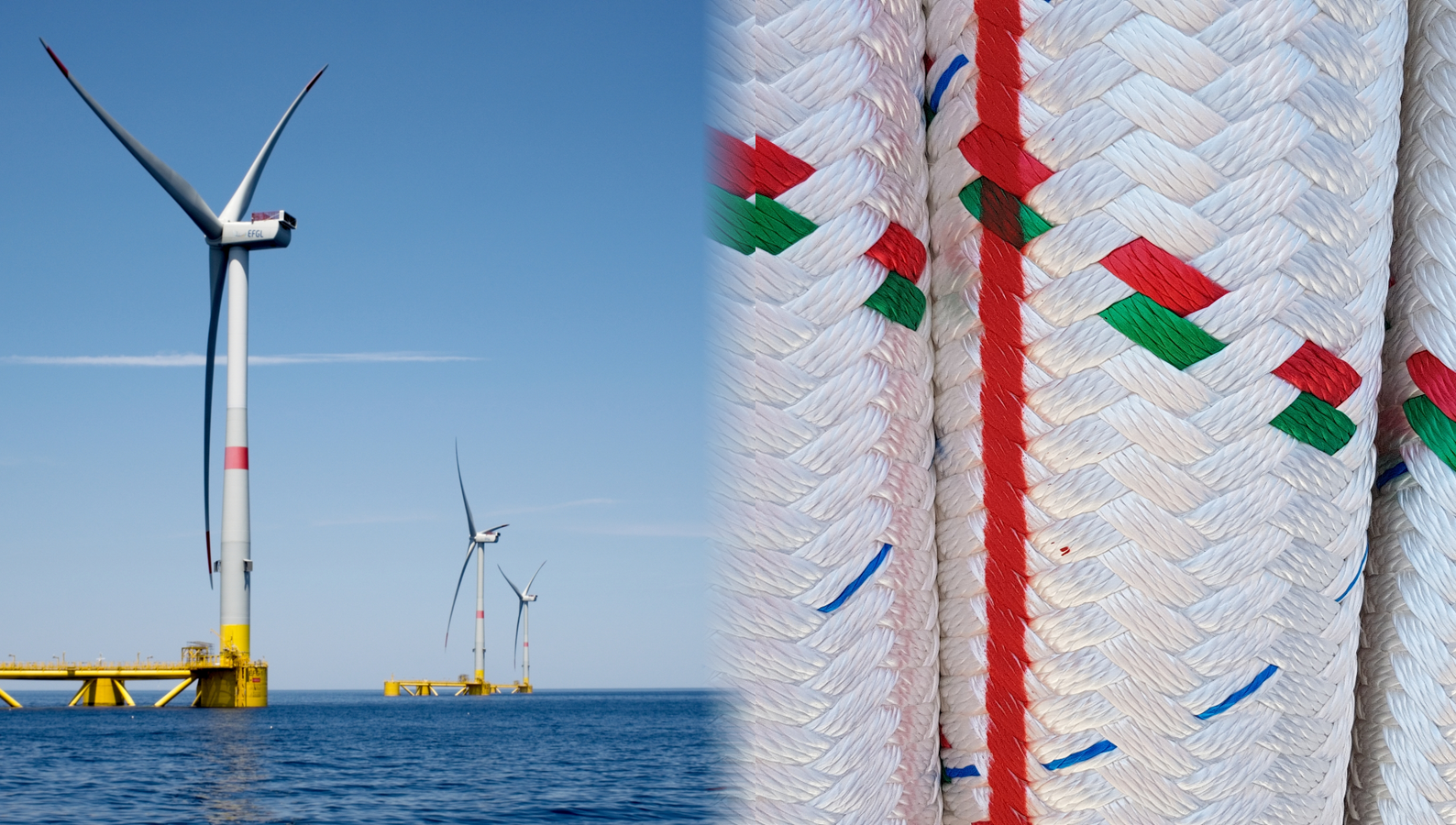


Mooring systems must withstand the loads from wind, waves and current over a 25–30-year period and have typically been made of steel chain.
These steel chains may, however, be too big and heavy as floating wind moves towards shallower water (typically 80-150 m depths), closing the existing gap between floating wind turbines and bottom-fixed turbines.
The existing production capacity for steel chain is also too low to supply the chain needed to support the global ambitions for floating wind development.
How can fibre ropes help solve that problem?
A promising solution is to replace a major part of the chain mooring with fibre rope segments.
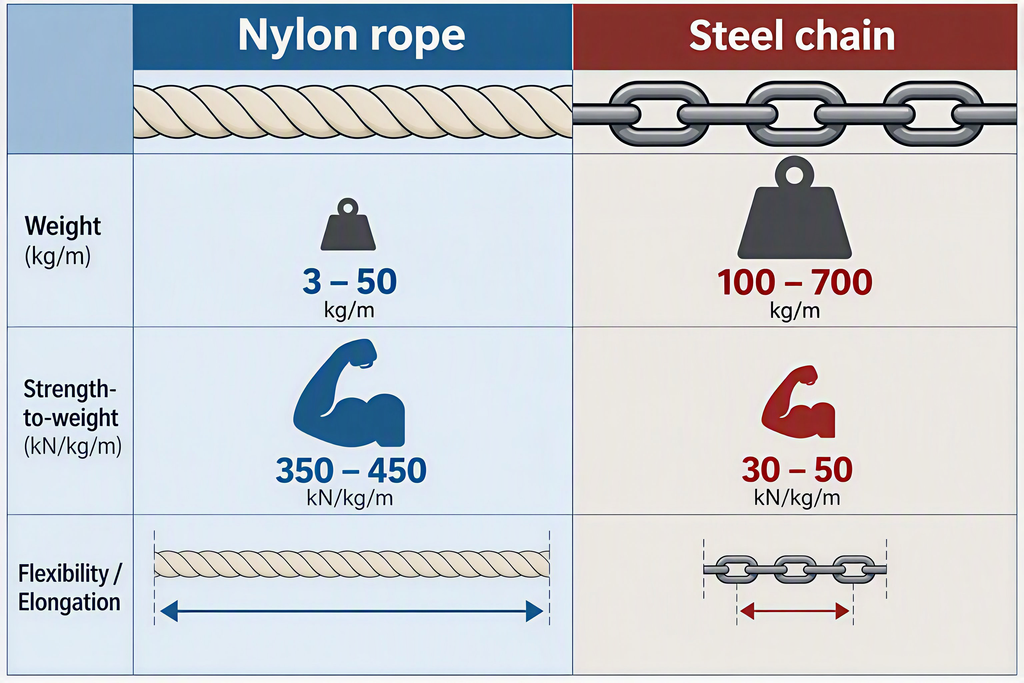
We believe fibre ropes can contribute to cost reduction in several ways. First, the material cost of the mooring system itself is expected to be lower with fibre ropes. Further, fibre ropes are lightweight and offer a high strength-to-weight ratio, with approximately 10 times the strength compared with chain moorings with the same weight. This can significantly reduce the cost of transportation and installation of the mooring system components.
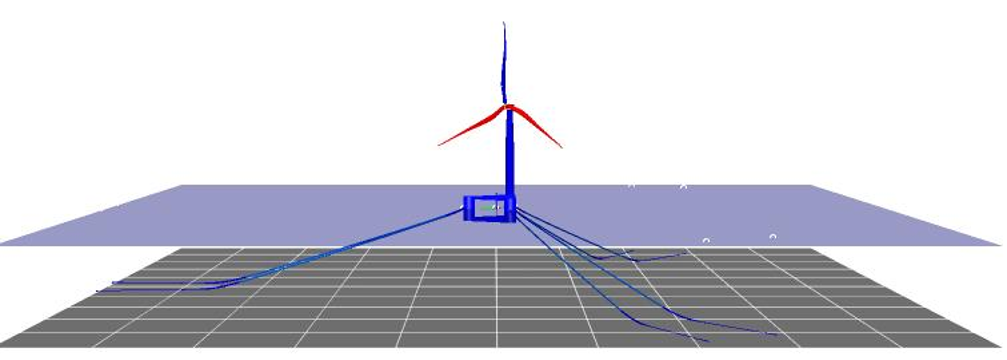
The use of flexible fibre ropes also opens for new possibilities for mooring designs. While a traditional, steel-based mooring system relies on the weight of the chain to keep the turbine in place, a soft fibre rope can be used to design a taut mooring system. These mooring systems use the material elasticity of the fibre rope to keep the turbine in place, and can offer both reduced material usage and a lower seabed footprint than traditional mooring systems.
A particularly promising material for fibre rope moorings is nylon (polyamide). As nylon is much softer than other fibre rope alternatives, it can reduced loads in the mooring system. Reduced loads in turn give the option to reduce the dimensions of the mooring system, ultimately leading to a lower cost of energy.
What are the challenges with nylon ropes?
Although there are many advantages to nylon rope moorings, we are not quite ready for deployment.
As of today, the behaviour of nylon ropes in a mooring system is not yet fully understood. Of particular importance is the understanding of the complex stiffness properties of nylon, which, in contrast to many other materials, depends heavily on the loads the rope is subjected to.
Of equal concern is the long-term behaviour of the ropes. Nylon is known to have temperature-dependent properties, and both the stiffness and strength can vary significantly over the temperature range seen in the ocean. Also, the endurance of lubricants protecting the fibres must be proven for the full lifetime of a floating wind turbine, which can typically be up to 25-30 years.
Concerns are also seen with the environmental impact of floating wind farms, which should be part of the assessment when selecting both the mooring layout and material used in a mooring system.
Related research projects
SINTEF Ocean is involved in two research projects on fibre rope moorings. The TAILWIND project looks into the use of fibre ropes from a holistic perspective, assessing both the engineering and environmental aspects of the polymers PA6, PET, HMPE and aramid fibre ropes.
The NYMOOR project takes a deep-dive into PA6, with the aim of providing sufficient knowledge and models for nylon ropes to become a viable option for floating wind mooring systems.
How can we solve these challenges? Research!
Several research projects are aiming to answer the challenges mentioned above. Key findings from these include:
- Temperature impact: Lower temperatures leads to a stiffer mooring line, but the material strength also increases as the temperature falls.
- Mooring line response: Numerical models are able to capture the most important physics in the mooring line response. Further development is still needed, and practical models for engineering use must be validated.




Comments
No comments yet. Be the first to comment!