Skip to content

SINTEF Blog Gå til forsiden

  • Energy
  • Ocean
  • Digital
  • Health
  • Industry
  • Climate and environment
  • Building
  • Society
  • EN
  • NO
Energy

EEA Grant Project: Workshop on data processing from images gained by Unmanned Aircraft Systems

Since May 2015, researchers from SINTEF, NTNU and NINA together with two Romanian partners have been involved in the EEA Grant Project “Restoration of the aquatic ecosystem complex at Fundu Mare Island near Braila” (Romania).

Ilabekken in Trondheim.
author
Peggy Zinke
Published: 24. Feb 2017 | Last edited: 15. Apr 2025
2 min. reading
Comments (0)
  • Find out more about SINTEF’s expertise on Environmental design of hydropower systems

From February 20-22, an international workshop on data processing from images gained by Unmanned Aircraft Systems (UAS) was held in Trondheim as part of the project, prepared by SINTEF Energy Research and the Department of Civil and Environmental Engineering at NTNU.

Two experts in the field, Christian Haas (IamHydro, Germany) and Jeffrey A. Tuhtan (Tallin University of Technology), held a course on the use of the “Structure from Motion” (SfM) method for riverine engineering applications.

SfM is a photogrammetric range imaging technique that allows estimating three-dimensional structures from two-dimensional image sequences and optionally a network of ground control points. The images can be taken using UAS or just with a normal camera during a terrestrial survey.

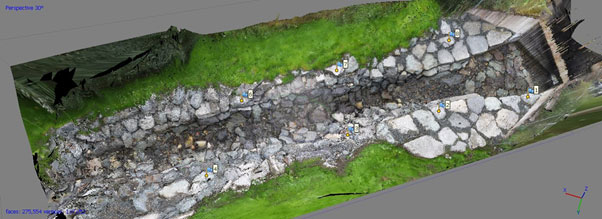
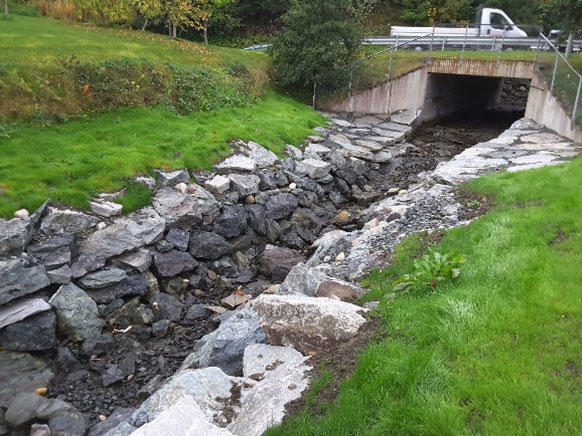
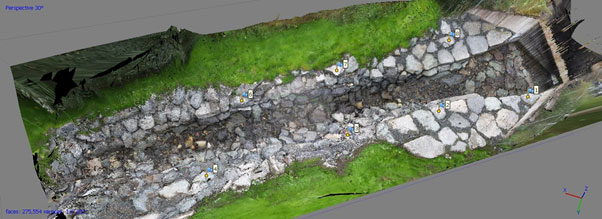
The pictures below illustrates the capability of the method for the reconstruction of the stream morphology for a short reach of Ilabekken (Trondheim).
Ilabekken in Trondheim.
Example for the application of SfM for Ilabekken in Trondheim: One of the photos that were taken by a digital camera (above) and a working version of the 3D model that was derived based on the data.

The course included a theoretical introduction into the SfM method and data processing, the presentation of the data ascertainment and of different technologies and techniques of gaining data in the field, as well as methods to scale, rotate and reference the model.

During the course, the participants ascertained some own data sets in the hydraulic laboratory of NTNU. This data was used for a professional training in sorting, selecting and processing the previously gained data with Agisoft Photoscan Professional Software, together with some pre-prepared test data sets.

The 10 course participants from the University of Galati (Romania), SINTEF, NTNU, NINA and Sweco emphasized that the practical knowledge of the method and the tools gives them new possibilities for effective field surveys in river science and applications.
Meeting
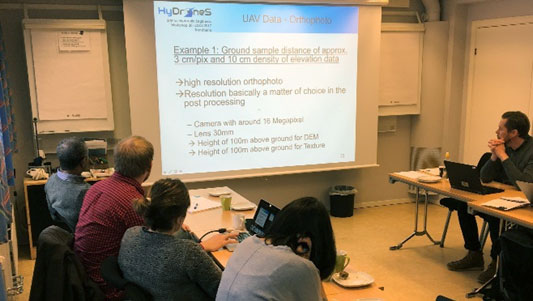
Introduction of the methods by C. Haas during a workshop session with the Water Resources Research Group at Sintef Energy Research.
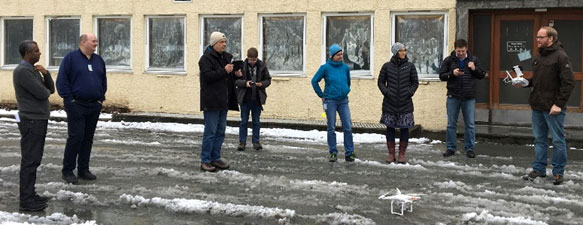
Presentation outside the hydraulic laboratory at NTNU.
Presentation of a drone application (DJI Phantome 3) in front of the hydraulic laboratory at NTNU.

Want to know more?

  • Forskere til Romania for å redde fugl og fisk (in Norwegian)
  • CEDREN-seminar: Implementation of restoration measures in regulated rivers – example Fundu Mare Island

Comments

No comments yet. Be the first to comment!

Leave a comment Cancel reply

Your email address will not be published. Required fields are marked *

More about Energy

How much can energy-efficient voyage planning save? Evidence from 11 months of North Atlantic data

Author Image
Author Image
2 forfattere
Infographic showing the flow of thermal energy storage (TES) from surplus heat or cold to end users. On the left, red and blue thermometer icons represent surplus heat and cooling, accompanied by the text “Surplus heat or cold – Captured and stored for when it’s needed.” In the centre, a large panel titled “Thermal Energy Storage (TES)” presents three storage technologies. The top section, “Sensible TES,” shows a container with a thermometer and the text “Stores heat in one single phase.” The middle section, “Latent TES,” shows a water droplet and snowflake connected by circular arrows, with the text “Stores heat through phase change.” The bottom section, “Thermochemical TES,” shows two connected coloured circles that separate and reconnect, illustrating a reversible reaction, with the text “Stores heat through reversible reactions.” A large pale arrow-shaped wedge points from the TES panel toward the right side of the figure. On the right, three application areas are shown in separate boxes with icons: industrial processes, buildings, and data centres. The layout conveys that surplus heat or cold can be stored using sensible, latent, or thermochemical TES technologies and later supplied to industrial facilities, buildings, and data centres.

Thermal energy storage is already commercial  

Jorge Salgado Beceiro
Research Manager

Burning ammonia cleanly: How timing changes everything 

Author Image
Author Image
2 forfattere

Technology for a better society

  • About this blog
  • How to write a science blog
  • Sign up for our newsletter
  • News from NTNU and SINTEF
  • Facebook
Gå til SINTEF.no
SINTEF logo
© 2026 SINTEF Foundation
Privacy Editorial Press contacts Website by Headspin