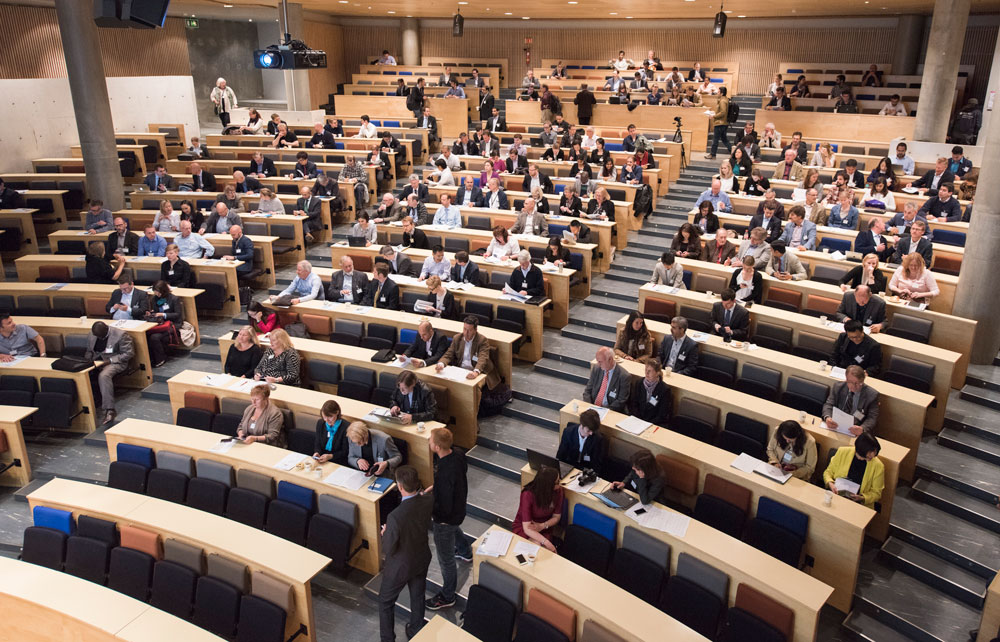
While the 4th conference in 2007 had 46 oral presentations and 215 attendees, the 8th conference in 2015 had 149 oral presentations and 350 participants from 26 countries. Building on the success of the previous TCCS conferences, the TCCS-9 is planned for June 12-14, 2017 in Trondheim, Norway.

Call for abstracts
Selection of oral presentations is based on extended abstracts. Extended abstracts (two pages, font 12) should be submitted to the Conference Secretariat by February 10, 2017. Based on the evaluation by the Scientific Committee reviewers, abstracts will be accepted for oral presentation or as posters. Abstracts and presentations must have high scientific quality and be written in a non-commercial manner. Abstracts are invited to cover the entire value chain of CCS technology development (see Scope and Objective below). Authors will be notified on acceptance by March 25, 2017. See the Conference web for guidelines.
Scientific papers (optional)
Authors are invited to submit a full-length scientific paper for review and publication in a special issue of a selected journal. Submission deadline is June 9, 2017, and accepted peer-reviewed papers will be published during 2017.
Important dates (2017)
- Deadline submission of abstracts: February 10
- Registration opens: February 1
- Notification to authors: March 25
- Early bird registration: April 7
- Final program available: May 15
Scope and Objective
The 9th Trondheim Conference will focus on research and development regarding CO2 capture, transport and storage (CCS). The objective of the conference is to bring forward, present and discuss work undertaken within R&D institutions, universities and in industry. Abstracts are invited to cover the entire value chain of CCS technology development. Potential topics are (but not limited to):
- Pre-combustion capture
- Absorption/adsorption and membranes
- Combustion
- Post-combustion capture
- Absorption/adsorption and membranes
- Other techniques
- Oxy-fuel capture
- Oxygen production
- Combustion
- CCS and hydrogen combinations
- CCUS
- CCS in energy intensive industries
- CO2 negative solutions
- Transport
- Effects of gas impurities
- Corrosion and materials
- Storage
- Site screening and site monitoring
- Leakage detection, mitigation,remediation
- Well drilling and completion
- CO2 EOR
- International R&D activities incl. pilot and large-scale activities
- Novel technologies
- Public acceptance and communication
- CCS whole system issues
- Techno-economic
- Risk and value chain assessment, and system analysis
- Policy
Scientific Committee Reviewers
- Carlos Abanades, CSIC-INCAR
- Bjørg Andresen, IFE
- Karen Lyng Anthonsen, GEUS
- Antti Arasto, VTT
- Giuseppe Barbieri, ITM
- Sally Benson, Stanford Univ.
- Amy Brunsvold, SINTEF
- Avlar Braathen, Univ. of Oslo
- Marie Bysveen, SINTEF
- Susan Carroll Lawrence, Livermore NL
- Gelein De Koeijer, Statoil
- Mario Ditaranto, SINTEF
- Remi Dreux, Engie
- Philip L. Fosbøl, DTU
- Francois Kalaydjian, IFPEN
- Earl Goether, TNO
- Alv-Arne Grimstad, SINTEF
- Eva Halland, Norw. Petroleum Directorate
- Stewart Haszeldine, Scottish CCS Centre
- Hans Aksel Haugen, Tel-Tek
- Karl Anders Hoff, SINTEF
- May-Britt Hägg, NTNU
- Robin Irons, E.ON
- Kristin Jordal, SINTEF
- Alfons Kather, Technische Univ. Hamburg-Harburg
- Inna Kim, SINTEF
- Taek-Joong Kim, SINTEF
- Axel Liebscher, GFZ
- Erik Lindeberg, SINTEF
- Michael Matuszewski, US DOE
- Svend-Tollak Munkejord, SINTEF
- Mona Mølnvik, SINTEF
- Filip Neele, TNO
- Carsten M. Nielsen, GEUS
- Kitty Nijmeijer, TU Eindhoven
- Truls Nordby, Univ. of Oslo
- Ingvild Ombudstvedt Arntzen, de Besche
- Kristin Onarheim, VTT
- Sergio Persoglia, OGS
- Gary Rochelle, Univ. of Texas at Austin
- Nils A. Røkke, SINTEF
- Günter Scheffknecht, IVD
- Wang Shujuan, Tsinghua Univ.
- Åse Slagtern, Research Council of Norway
- Svein Solvang, Gassco
- Roland Span, Ruhr-Univ. Bochum
- Aage Stangeland, Research Council of Norway
- Tony Surridge, South African Centre for CCS
- Jøril Svalestuen, Gassnova SF
- Hallvard Svendsen, NTNU
- Tore Andreas Torp, Retired, Statoil
- Asbjørn Torvanger, CICERO
- Sven van der Gijp, TNO
- Amornvadee Veawab, Univ. of Regina
Scientific Committee
- May-Britt Hägg, NTNU (Chair SC)
- Nils A. Røkke, SINTEF (Chair Conf.)
- Roland Span, Ruhr-Universität Bochum
- Alv-Arne Grimstad, SINTEF
Organizing Committee
- Nils A. Røkke, SINTEF (Chair Conf.)
- Rune Aarlien, SINTEF (Chair OC)
- May-Britt Hägg, NTNU (Chair SC)
- An Hilmo, SINTEF
Conference secretariat:
An Hilmo, Trondheim_CCS.conf@sintef.no
Conference organizer:
For more information on submission of abstracts, template etc., please see the TCCS-9 website
SINTEF and NTNU CCS Award – Call for nominations


Comments
No comments yet. Be the first to comment!