Skip to content

SINTEF Blog Gå til forsiden

  • Energy
  • Ocean
  • Digital
  • Health
  • Industry
  • Climate and environment
  • Building
  • Society
  • EN
  • NO
Energy

Prediktor Instruments received the Bioenergy Innovation Award 2017

author
Alexis Sevault
Published: 19. Mar 2017 | Last edited: 15. Apr 2025
3 min. reading
Comments (0)

This year’s winner of the Bioenergy Innovation Award was Prediktor Instruments, who received the prize during the FME CenBio Final Conference at Ås Campus on 13-14 March 2017.

The Award acknowledged one of the company’s recent innovations: their instrument Spektron Biomass, measuring moisture content in wood chips in an efficient, fast and accurate manner using near infrared spectroscopy (NIR).
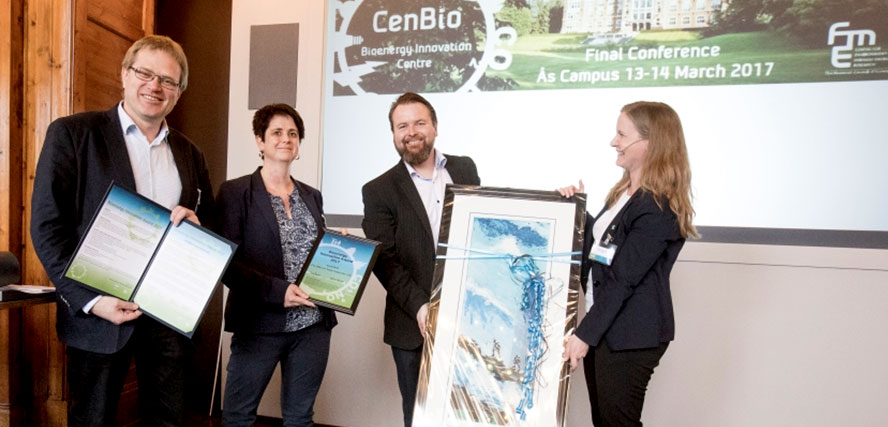
Prediktor Instrument AS receives the Bioenergy Innovation Award 2017 during the CenBio Final Conference at Ås Campus.
Prediktor Instrument AS receives the Bioenergy Innovation Award 2017 during the CenBio Final Conference at Ås Campus. From left: Per-Olav Rusås (Product Manager), Mari-Ann Akerjord (VP Instruments), Bård Hansen (Director of Sales and Marketing) and Head Principal at NMBU, Mari Sundli Tveit. Photo: Håkon Sparre.

In their argument the jury emphazised that “The winner’s effort has given birth to an instrument for the fast and accurate measurement of moisture in biomass fuels. The current 48-hour method can now be replaced by a new procedure that only takes a couple of minutes. This novel technology enables its users to set quality standards, directly contributing to a more professional bioenergy sector“.

Bioenergy Innovation Award

The Award is a Norwegian national innovation prize within stationary bioenergy, introduced by FME CenBio in 2011. The candidates have been assessed by a committee consisting of representatives from the Research Council of Norway, Norsk Bioenergiforening (Nobio), Innovation Norway, Enova, Norwegian University of Life Sciences (NMBU) and SINTEF. Find more information about the Award.

Concluding 8 years of research and innovation

FME CenBio – Bioenergy Innovation Centre – organised its Final Conference at Ås Campus on 13-14 March 2017, concluding 8 years of research and innovations on bioenergy. More than 80 participants attended the event to hear from CenBio’s researchers and industry partners. International experts offered their knowledgeable views on bioenergy in their respective countries and insights on upcoming trends and possible developments.

Eilif Due from the Norwegian Forest Owners' Federation presenting at the CenBio Final Conference on 13 March 2017 at Ås Campus.
Eilif Due from the Norwegian Forest Owners’ Federation presenting at the CenBio Final Conference on 13 March 2017 at Ås Campus. Photo: Håkon Sparre.

As stated in the CenBio Final Report and pinpointed by the conference moderator Trond Værnes from the Research Council of Norway: “Together with key bioenergy user partners, CenBio research laid the foundations for a modern way of utilising biomass that many others will build on for years to come.“

CenBio has created value for industry

Hosted by NMBU and led by SINTEF in a successful collaboration, the FME CenBio launched with 19 user partners and 7 R&D partners in 2009. Partly financed by the Research Council of Norway, CenBio created considerable value for industry thanks to the focus on stationary bioenergy and the main goal to enable sustainable and cost-efficient bioenergy.

The CenBio Final Report and more information on FME CenBio can be found on www.CenBio.no
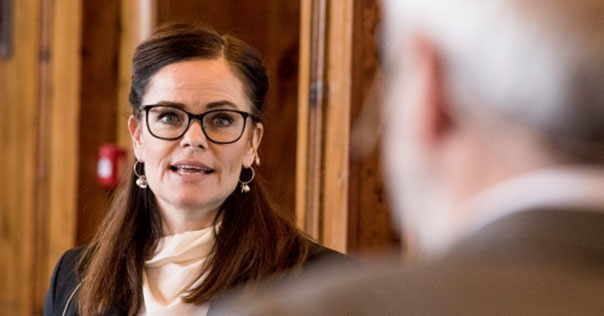
CenBio Centre Coordinator Marie Bysveen from SINTEF and CenBio Centre Deputy Coordinator Odd Jarle Skjelhaugen from NMBU
From left: CenBio Centre Coordinator Marie Bysveen from SINTEF and CenBio Centre Deputy Coordinator Odd Jarle Skjelhaugen from NMBU at the CenBio Final Conference on 13 March 2017 at Ås Campus. Photo: Håkon Sparre.

Comments

No comments yet. Be the first to comment!

Leave a comment Cancel reply

Your email address will not be published. Required fields are marked *

More about Energy

How much can energy-efficient voyage planning save? Evidence from 11 months of North Atlantic data

Author Image
Author Image
2 forfattere
Infographic showing the flow of thermal energy storage (TES) from surplus heat or cold to end users. On the left, red and blue thermometer icons represent surplus heat and cooling, accompanied by the text “Surplus heat or cold – Captured and stored for when it’s needed.” In the centre, a large panel titled “Thermal Energy Storage (TES)” presents three storage technologies. The top section, “Sensible TES,” shows a container with a thermometer and the text “Stores heat in one single phase.” The middle section, “Latent TES,” shows a water droplet and snowflake connected by circular arrows, with the text “Stores heat through phase change.” The bottom section, “Thermochemical TES,” shows two connected coloured circles that separate and reconnect, illustrating a reversible reaction, with the text “Stores heat through reversible reactions.” A large pale arrow-shaped wedge points from the TES panel toward the right side of the figure. On the right, three application areas are shown in separate boxes with icons: industrial processes, buildings, and data centres. The layout conveys that surplus heat or cold can be stored using sensible, latent, or thermochemical TES technologies and later supplied to industrial facilities, buildings, and data centres.

Thermal energy storage is already commercial  

Jorge Salgado Beceiro
Research Manager

Burning ammonia cleanly: How timing changes everything 

Author Image
Author Image
2 forfattere

Technology for a better society

  • About this blog
  • How to write a science blog
  • Sign up for our newsletter
  • News from NTNU and SINTEF
  • Facebook
Gå til SINTEF.no
SINTEF logo
© 2026 SINTEF Foundation
Privacy Editorial Press contacts Website by Headspin