
Guestblogger: Karl Lundqvist, PhD Candidate at Department of Energy end Process Engineering at NTNU.
Not many people are aware that exhaust gasses from engines aboard oil platforms on the Norwegian continental shelf account for about as much CO2 emissions as all road traffic in Norway. These emissions are currently necessary to maintain oil production, but are a large hurdle against meeting emission targets. To make matters worse, many new oil fields are located in areas too far from shore to allow for practical and cost efficient land based power supply.
Alternative solutions to reduce emissions
An alternative solution to reduce emissions is to install heat exchangers on board platforms and production ships that utilizes waste heat from exhaust gasses and converts it to usable electric power or process steam. Today’s equipment are both large, heavy and not sufficiently robust for offshore use. This is something we try to change in the COMPACTS project.
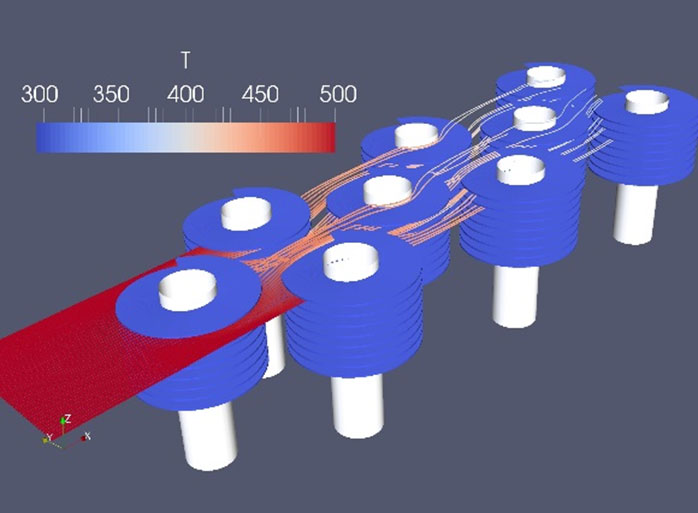
My Ph.D. research for COMPACTS centres on simulating the flow in these exhaust gas heat exchangers in order to determine how effective they are at absorbing heat, and if there is any risk of vibrations that ultimately can cause a leak. The figure below visualize what some of the results can look like. These simulations take relatively long time (about a day) to complete, even with access to NTNUs best computer cluster.
For this reason, I have travelled to Pittsburgh to learn how I can use the simulation results most effectively to reduce the volume and weight of these heat exchangers
Finding expertise
Carnegie Mellon University in Pittsburgh has leading research groups in most things related to computer science, robotics and artificial intelligence. The university was home to the first self-driving vehicle programme, started in the 80’s (check out this thrilling video from 1986 – Robotics Institute History of Self-Driving Cars). It is not a coincidence that Uber has established its Advanced Technologies Centre here and many students travel here for short courses, master theses or longer research stays.
The research group I am visiting has developed a unique software called ALAMO. It creates regression models from data points gathered, typically, from experiments or simulations. The unique feature of ALAMO is that the models have the simplest possible mathematical form, while still capturing important nonlinearities in the data. This makes it much more powerful than regular linear regression (that we all have access to in Excel) yet still useful for later optimization.
My process looks something like this:

ALAMO is incredibly easy to use and it feels almost magical that I, having only a rudimentary understanding of statistics and regression, can use a research level tool.
So coming back to the question: Is this a good enough reason to go abroad? To play with software?
It is always exciting and useful to get acquainted with another culture and see other ways of working. I might have to work a bit on the last step in the figure above before having the full answer.









Comments
Interesting read on how specialized software like ALAMO can simplify complex simulations… As we also review different SaaS tools at TheSoftReview, we found that user-friendly interfaces can make advanced software much more accessible across industries.