
Skip to content

SINTEF Blog Gå til forsiden

  • Energy
  • Ocean
  • Digital
  • Health
  • Industry
  • Climate and environment
  • Building
  • Society
  • EN
  • NO
Energy

Launch of the ISO standards for CO2 pipeline transport and storage.

1 November saw the launch of the new ISO standards for CO2 pipeline transport and storage. These are the first of a series of ISO standards for CO2 capture, transport and storage (CCS).

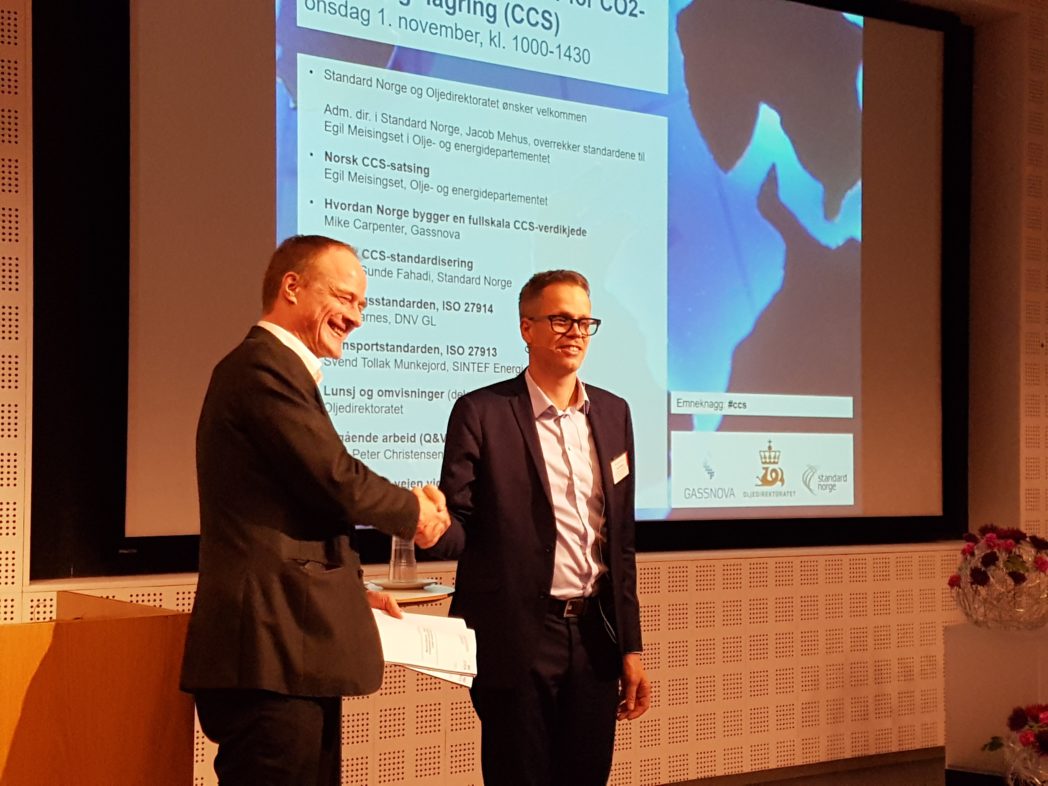
Standardene ble overrakt av administrerende direktør Jacob Mehus i Standard Norge til avdelingsdirektør Egil Meisingset i Olje- og Energidepartementet. Foto: Svend T. Munkejord.
author
Svend Tollak Munkejord
Chief Scientist
Published: 6. Nov 2017 | Last edited: 14. Apr 2025
3 min. reading
Comments (0)

 The launch took place in Stavanger at the offices of the Norwegian Petroleum Safety Authority (PSA) and the Petroleum Directorate (NPD), in front of an audience made up of representatives from the public authorities, industry and the research community.

  • Read more on SINTEFs research on CCS.

– What are we waiting for?

The event was opened by Eva Halland of the NPD. She pointed out that now that the framework for transport and storage of CO2 is in place, there is no reason to wait with the implementation.

“The standards are in place, so what are we waiting for?”, says Eva Halland (NPD). Photo: Svend T. Munkejord.
“The framework is in place, so what are we waiting for?”, says Eva Halland (NPD). Photo: Svend T. Munkejord.

Project Manager Javad Sunde Fahadi at Standards Norway explained that work to prepare the standards within the International Standards Organisation (ISO) takes place in committees made up of experts from the interested countries. The standards are prepared in stages involving several rounds of consultation, after which all inputs is processed in writing. This takes time, but the process ensures that the standards have widespread support. Before a standard can be published, it is voted on by the participating countries. Norway has one vote in this process – just the same as other and larger countries. Work carried out by the Norwegian committee for CCS standards has been funded in part by the CLIMIT programme.
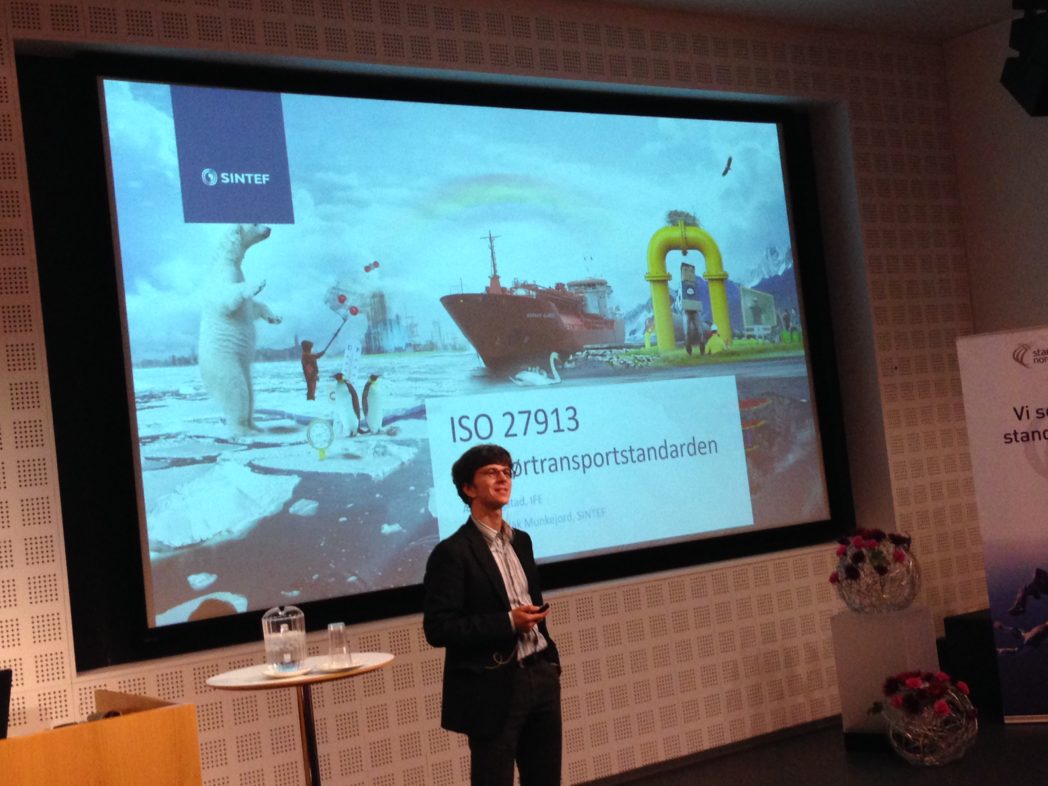
Svend Tollak Munkejord presenting the CO2 pipeline transport standard. Photo: Grethe Tangen.

I had the honour of presenting the CO2 pipeline transport standard. The work to prepare this standard took place during the period 2013-2016, and was coordinated from Germany with active contributions from Norway and other countries. It builds on existing standards and takes factors unique to CO2 into account. When I started working on this project, I had the naive notion that a standard is a kind of instruction manual for engineers – complete with finished formulas and methods. However, this is not the case. Instead, a standard presents a series of questions that users, such as organizations that design, construct or operate pipeline transport systems, ought to pose, and gives directions as to how to find the answers to these questions. In some cases these answers are simple enough, while in others an adequate solution requires further knowledge.

In summary, the ISO standard is an important contribution towards the construction of safe and efficient CO2 transport systems, which are essential for ensuring that CCS becomes an effective climate-change mitigation tool. This in turn is key if we are to achieve the Paris Agreement targets.

Comments

No comments yet. Be the first to comment!

Leave a comment Cancel reply

Your email address will not be published. Required fields are marked *

More about Energy

How much can energy-efficient voyage planning save? Evidence from 11 months of North Atlantic data

Author Image
Author Image
2 forfattere
Infographic showing the flow of thermal energy storage (TES) from surplus heat or cold to end users. On the left, red and blue thermometer icons represent surplus heat and cooling, accompanied by the text “Surplus heat or cold – Captured and stored for when it’s needed.” In the centre, a large panel titled “Thermal Energy Storage (TES)” presents three storage technologies. The top section, “Sensible TES,” shows a container with a thermometer and the text “Stores heat in one single phase.” The middle section, “Latent TES,” shows a water droplet and snowflake connected by circular arrows, with the text “Stores heat through phase change.” The bottom section, “Thermochemical TES,” shows two connected coloured circles that separate and reconnect, illustrating a reversible reaction, with the text “Stores heat through reversible reactions.” A large pale arrow-shaped wedge points from the TES panel toward the right side of the figure. On the right, three application areas are shown in separate boxes with icons: industrial processes, buildings, and data centres. The layout conveys that surplus heat or cold can be stored using sensible, latent, or thermochemical TES technologies and later supplied to industrial facilities, buildings, and data centres.

Thermal energy storage is already commercial  

Jorge Salgado Beceiro
Research Manager

Burning ammonia cleanly: How timing changes everything 

Author Image
Author Image
2 forfattere

Technology for a better society

  • About this blog
  • How to write a science blog
  • Sign up for our newsletter
  • News from NTNU and SINTEF
  • Facebook
Gå til SINTEF.no
SINTEF logo
© 2026 SINTEF Foundation
Privacy Editorial Press contacts Website by Headspin