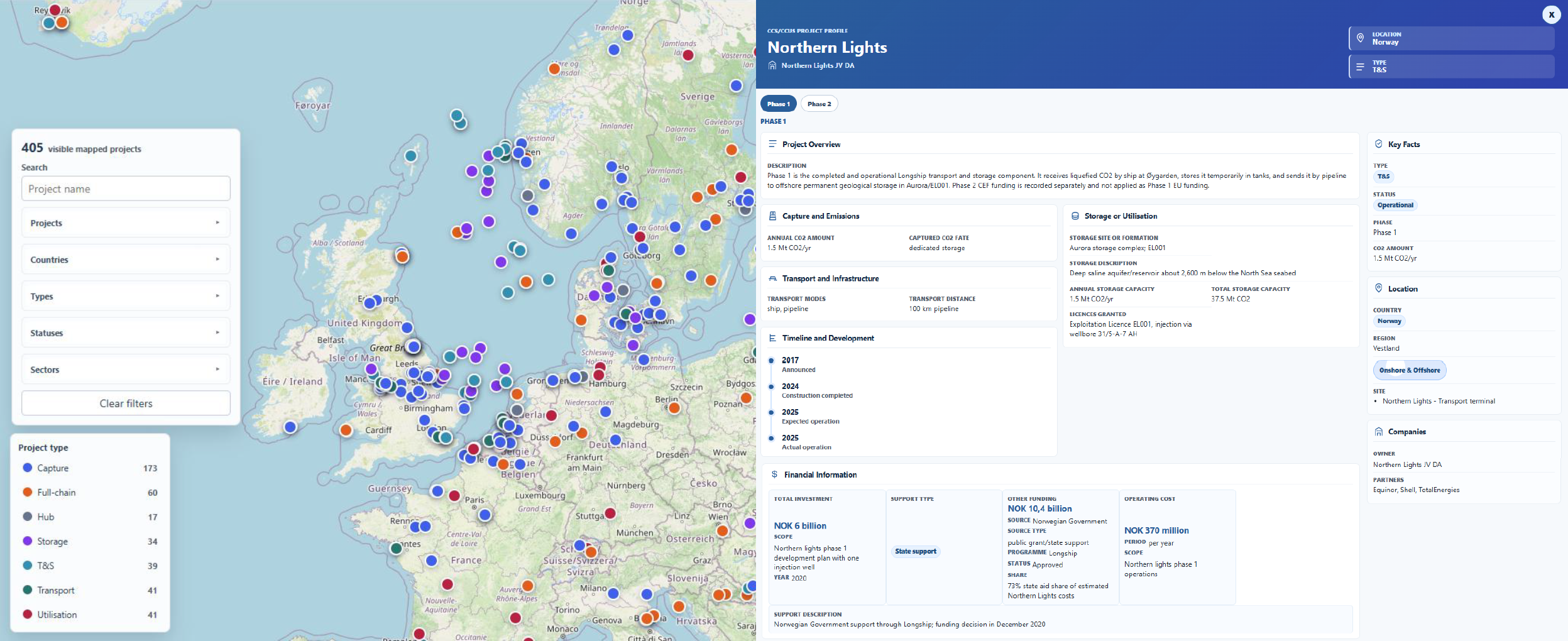

Carbon Capture, Utilisation and Storage (CCUS) is becoming an increasingly important part of Europe’s efforts to reduce CO₂ emissions.
Across Europe, new projects are being announced and existing projects are developing from early plans towards construction and operation.
However, keeping track of this development is not so simple. There is no single place where all information about European CCUS projects can be found.
Relevant information is spread across company websites, government pages, public databases, reports, funding announcements and permits. The information also changes over time. A project may receive new funding, change its planned capacity, move to another development stage, or be delayed or cancelled. At the same time, new projects continue to appear.
Creating an overview is therefore not only about finding information once. It also requires continuously updating and verifying what is already known. And, when hundreds of projects are involved, doing this manually becomes time-consuming.
Without a shared and trusted source, researchers may end up doing the same verification work independently, while decisions risk being based on incomplete or outdated information.
Working with the Industrial Carbon Management Knowledge-Sharing Platform team, Ida Leiknes – a summer researcher at SINTEF Energy Research – explored how a data foundation for a shared European platform could be built and maintained.
What the research found – can AI help?
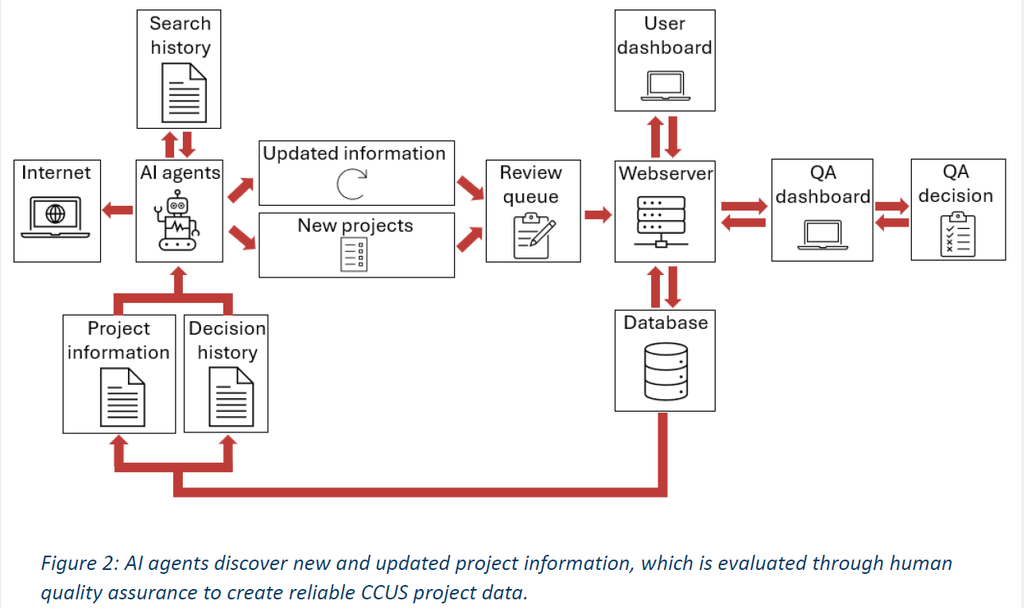
A prototype developed by SINTEF divides work between AI agents and humans, with AI handling much of the searching and information gathering, while people remain in control of what information is accepted.
AI agents search publicly available sources for new information about CCUS projects, and when relevant information is found, the system structures it, links it to the original source and suggests possible updates to the existing project data.
The system can also identify CCUS projects that are not yet included in the shared platform. These are added as candidates that can be reviewed before being accepted as new projects.
People make the calls
A key part of the prototype is that the AI does not automatically decide what is correct.
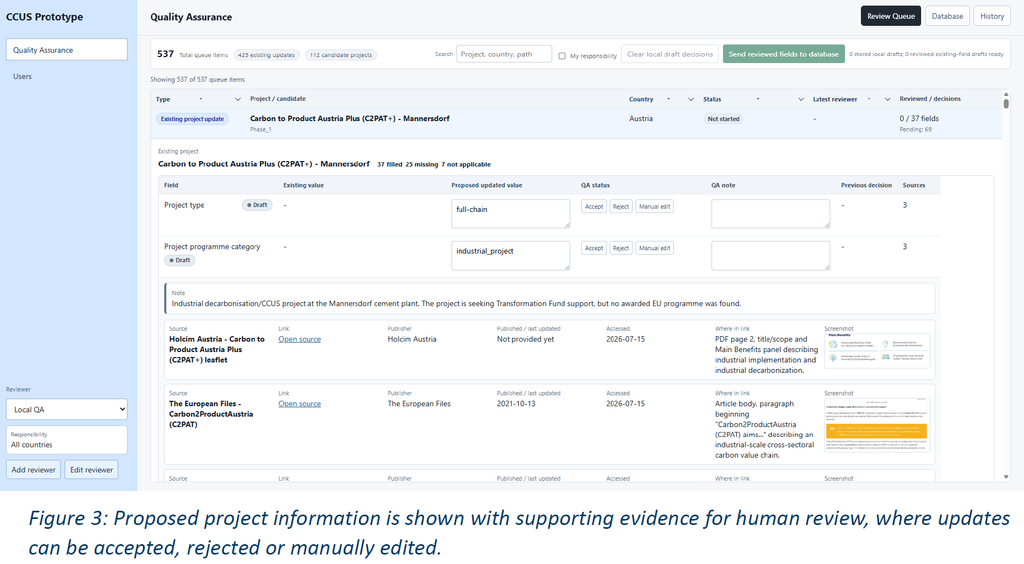
The suggested updates are presented in a review dashboard together with the supporting sources and evidence. A person can then compare the new information with the existing project data and decide whether the suggested change should be accepted.
This creates a workflow where AI can handle large amounts of information, while people remain responsible for the final verification. Once reviewed, the information is brought together in one place, creating a more traceable and reliable overview of CCUS projects across Europe.
Why does this matter?
A reliable overview can help researchers, project developers, industry and public authorities understand how the European CCUS landscape is changing. It can support cross-project and cross-country analysis, making it easier to see how projects are progressing and where further development may be needed.
Using AI agents makes it possible to follow more projects and sources than would be practical through manual work alone. This can reduce the time spent searching for information and allow users to focus more on analysing and using it.
A more complete and continuously updated data foundation also creates possibilities beyond maintaining a shared platform. It can support analysis of trends across countries and projects, help identify gaps in the developing CCUS value chain, and provide a stronger basis for understanding how CCUS is progressing across Europe.
While the work focuses on CCUS projects in Europe, the same principle could be applied to other areas where information is spread across many sources and changes frequently.
Ida Leiknes carried out this work as a summer researcher at SINTEF Energy Research, supervised by Gianluca Tabella, Simon Nyholm, Kristin Jordal and Francesco Finotti.








Comments
No comments yet. Be the first to comment!