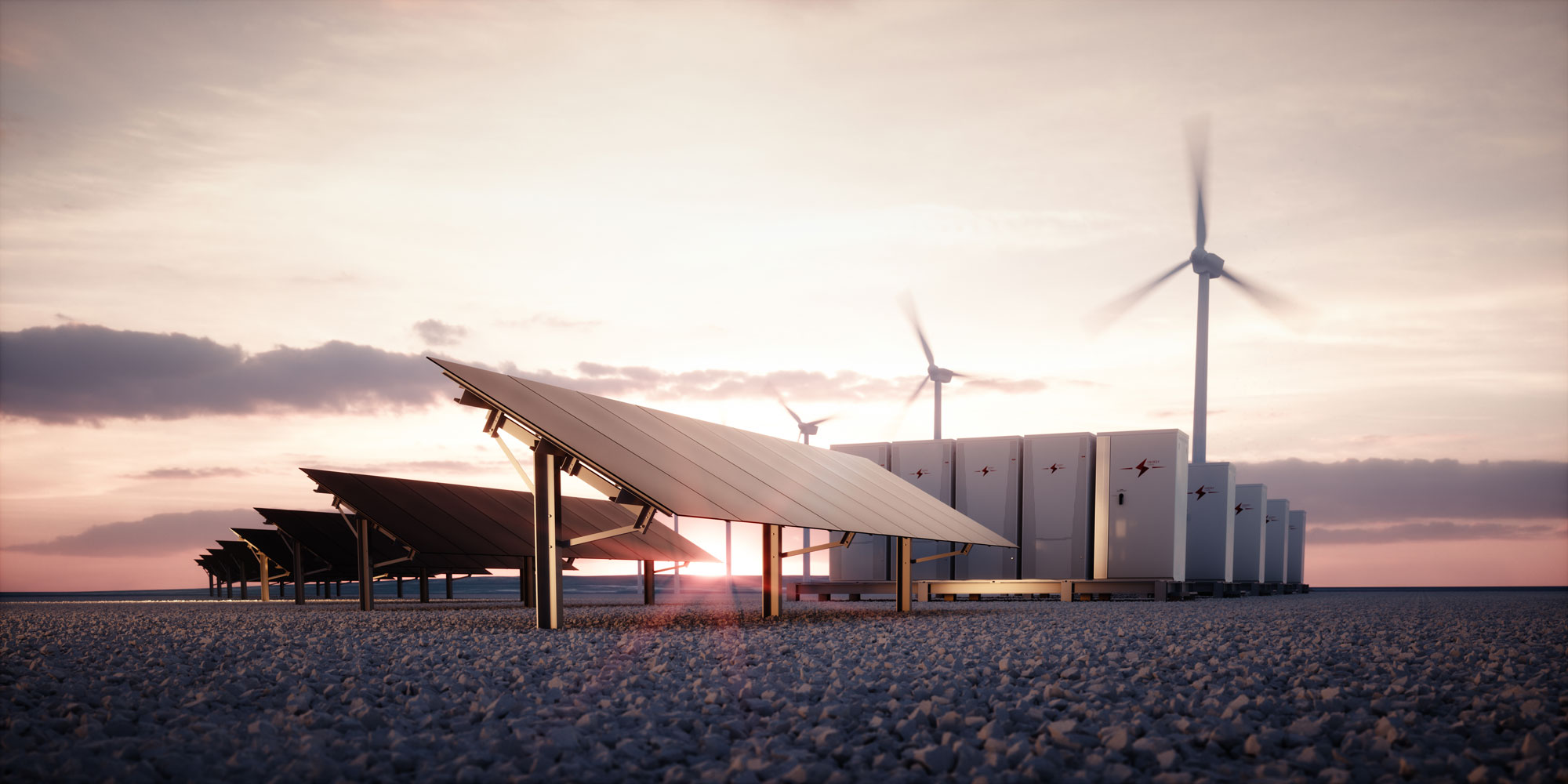

Solar panels generate the most electricity during the middle of the day, while wind turbines may produce large amounts of energy for several days before the wind dies down and production falls. At the same time, we expect electricity to be available whenever we need it, regardless of the weather or time of day.
If renewable energy is to meet more of our energy needs, we therefore need effective solutions that can store energy for longer periods of time.
This is where long-duration energy storage, commonly known as LDES, comes in. LDES includes technologies that can store energy over extended periods and release it when electricity demand exceeds production. In this way, LDES can help make renewable energy more available, stable and reliable.
Flow batteries
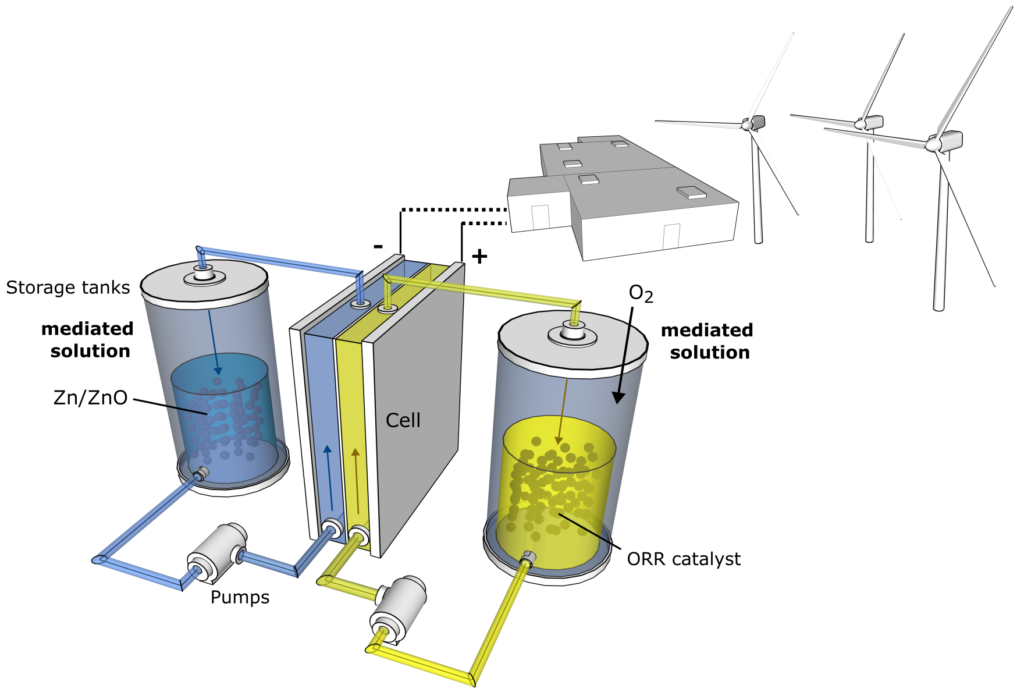
One type of LDES is the flow battery. Flow batteries are stationary, rechargeable batteries in which energy is stored in liquid electrolytes held in two separate tanks. When the battery is charged or supplies electricity, the electrolytes are pumped through an electrochemical cell where reactions that either store or release energy take place.
The most established flow battery technology in use today is the vanadium redox flow battery (VRFB). However, vanadium is included on the EU’s list of critical raw materials, which covers materials with high economic importance and that have a high risk of supply disruption. If flow batteries are to become an important part of future energy systems, it would therefore be beneficial to develop alternatives based on less expensive and more readily available materials.
A new battery based on zinc and air
In the ReZilient project, we are working to develop a new type of flow battery based on zinc and air. The aim is to create a battery technology that could be affordable, more environmentally friendly and well suited to storing energy over longer periods.
Developing an entirely new battery, however, is far from simple. Materials must be selected, components must be designed and the underlying physical processes must be understood.
Among other things, we need to investigate how the battery charges and discharges, how different substances move through the system and where energy losses occur. Even small changes can have a significant impact on the battery’s performance, resulting in many possible combinations that could be explored.
Not everything can be tested in the laboratory
Laboratory experiments are essential when developing new batteries. They allow us to investigate how materials actually behave and determine whether an idea works in practice. However, every experiment requires both time and resources.
Materials must be purchased, and experimental setups must be built, adapted and checked. The experiments then need to be planned and carried out before the results can be analysed. If every possible material, dimension and operating condition had to be investigated in the laboratory, developing the battery would be a lengthy and expensive process. We therefore need a method that can help us select and prioritise the most useful experiments.
A virtual battery
Using modelling, we can create a digital representation of the battery that describes the processes within the system using equations and established physical and chemical principles.
Once the model has been developed, we can perform virtual experiments. We can vary one or more parameters, such as the size of the electrodes, the flow rate or the choice of electrolytes, and investigate how these changes affect the battery’s behaviour. In this way, we can explore the effects of different materials, dimensions and operating conditions with just a few keystrokes.
The model can also provide information about processes and quantities that may be difficult to measure directly in a physical battery. It can help us understand what is happening inside the battery, identify the processes that limit its performance and determine where and how energy is lost.
Modelling therefore allows us to answer more questions in less time, such as:
- Which parameters have the greatest effect on battery performance?
- How can the battery be designed to reduce energy losses?
- Which experiments should be prioritised in the laboratory?
Modelling does not replace laboratory experiments
Although a digital model can provide valuable insight into the theoretical system, it does not necessarily represent reality perfectly. Models are based on assumptions, equations and available data, and must therefore be compared with experimental results.
In the ReZilient project, simulations can be used to identify where energy is lost and which changes could improve the battery’s performance. Researchers in the laboratory can then prioritise testing the most promising solutions. The experimental results are subsequently used to determine whether the model describes the battery accurately enough and to improve it when necessary. This creates a close interaction between modelling and experimental work. The model helps us understand the system and plan more informative experiments, while the experiments provide data that make the model more accurate.
From many possibilities to targeted experiments
The need for new long-duration energy storage solutions is significant, but the journey from an idea to a functioning battery can be long. To develop new technologies more efficiently, we must use our time and resources wisely.
Through the ReZilient project, we are combining the development of a new zinc-air flow battery with digital modelling. Our goal is to explore how the battery works, identify the most promising solutions and make laboratory experiments more targeted.
In this way, modelling can help us learn faster, reduce the number of experiments needed and bring us one step closer to the battery of tomorrow.









Comments
No comments yet. Be the first to comment!