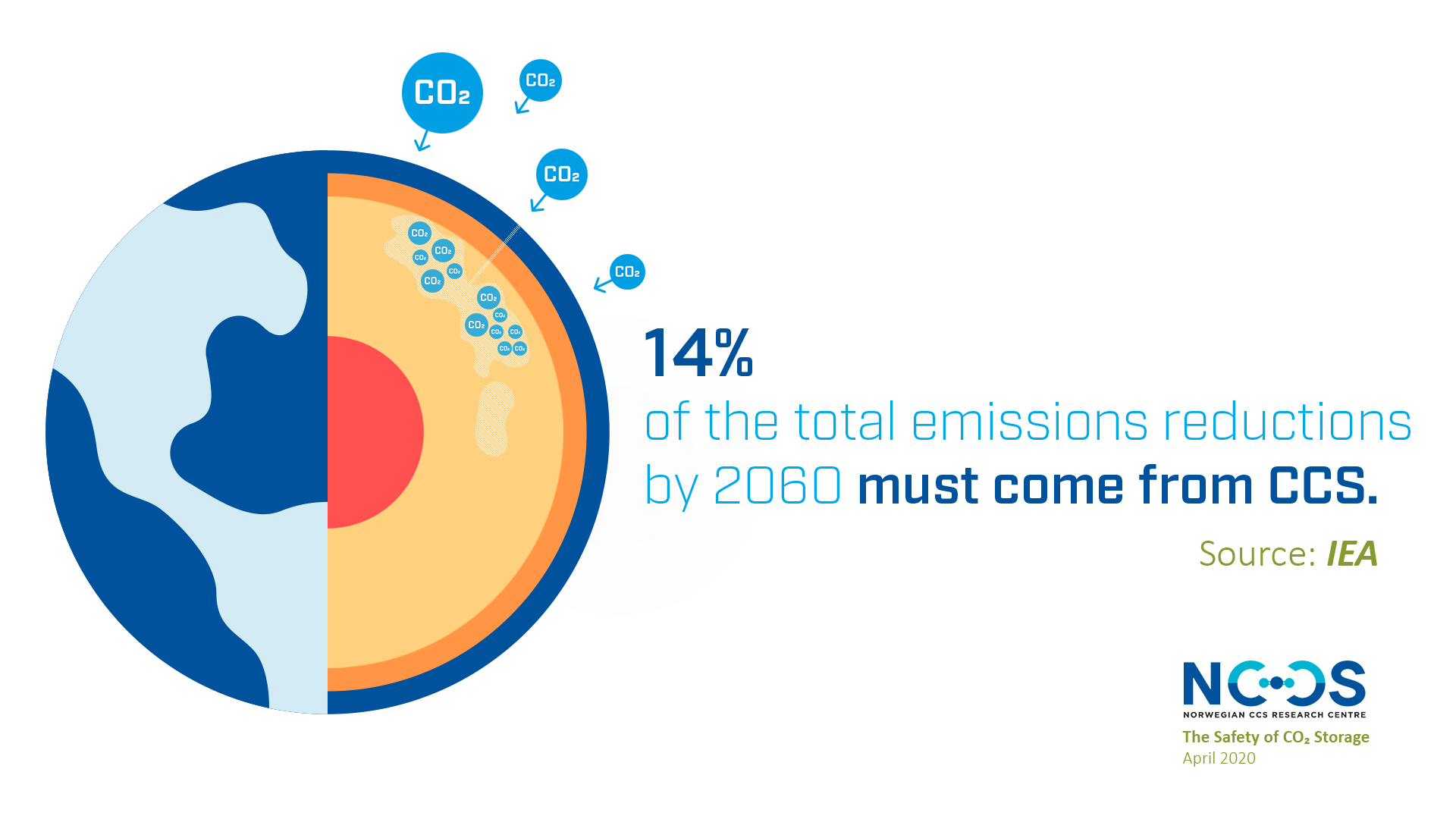

That’s the view of the energy experts at SINTEF, and it’s one shared by the International Energy Agency (IEA) which calls CCS “an important emissions reduction technology that can be applied across the energy system.”
Ongoing industry projects dating back as far as 1996 have proven CCS to work. Since 1996, around one million tonnes of CO2 has been stored at the Sleipner field in the North Sea.
But research is needed to improve the technology and processes to make the technology economically feasible at scale. SINTEF hosts the Norwegian CCS Research Centre (NCCS), which works to fast-track CCS deployment by addressing the major barriers identified within the industry demonstration projects.
Here are some of the latest research blogs from the world of SINTEF and NCCS:
Learn more about CCS
Join our newsletter to stay updated with all the latest research results and news from NCCS: The Norwegian CCS Research Centre.
The Safety of CO2 Storage
Over its years of development, CCS has faced questions about its technical feasibility, which have largely been answered. But many questions have also been asked of its safety, especially for the underground storage element of CCS.
We took a scientific approach to answer these questions with this comprehensive blog post. We draw on scientific research to address the key issues of safety and risk of a full-scale CCS implementation in Norway.
The Liability Regime for CO2 Shipping
One often overlooked area of CCS is transport. Pipelines are an obvious choice on land, but to transport captured CO2 to offshore locations, a shipping solution is also needed. But existing regulatory initiatives are designed to cover pipelines. As shipping is expected to play a central role in the North Sea storage ecosystem, a legal framework covering cross-border shipping issues is required.
DeFACTO: Underground Testing of CO2 Transport and Injection
Injection technology–when the CO2 is pumped into the rock formation to be permanently stored–has come a long way, but many questions on the process remain open.
To help answer some of these questions, the DeFACTO project has built a test facility for CO2 flow assurance and injection at NTNU in Trondheim, that reaches 90 metres underground.
NCCS Interview: Award-Winning CO2 Hydrate Research
NCCS recently announced two joint winners of the Best NCCS Paper award for 2019. To find out more about the work behind award-winning papers, we spoke to one of the co-authors of the second paper, Peter Betlem.
A PhD candidate in (Arctic) Geology at the University Centre in Svalbard (UNIS) and University of Oslo, Peter investigates the multi-physical detection limit of fluid flow through caprock sequences for Carbon Capture and Storage purposes, supplementing proven and traditional workflows with experimental techniques and modern technologies.
We hope this post gives you an idea of the breadth of CCS research taking place both at SINTEF and in NCCS. To keep up to date with all news and new blog posts, join the NCCS Newsletter.






Comments
Nice information for a new blogger…it is really helpful