
Skip to content

SINTEF Blog Gå til forsiden

  • Energy
  • Ocean
  • Digital
  • Health
  • Industry
  • Climate and environment
  • Building
  • Society
  • EN
  • NO
Energy Industry Ocean

Cables aflame at 1100 °C to test fire resistance

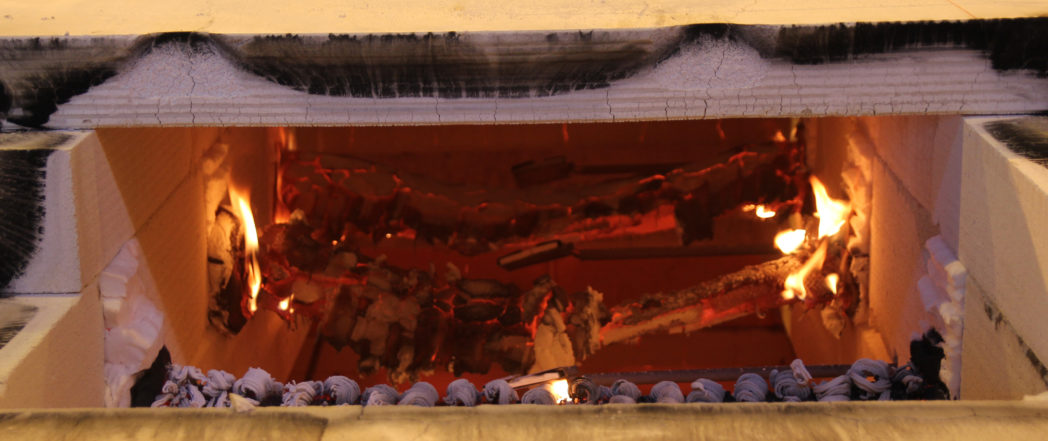
Testkablene etter at branntesten er ferdig og beskyttelsen er ødelagt. Kabelen klarte kravet på 30 minutter i 1100 °C.
author
Are Bruaset
Research Scientist
Published: 12. Feb 2015 | Last edited: 22. Apr 2025
2 min. reading
Comments (0)

SP Fire Research AS (SPFR) and SINTEF Energy have a “hot” cooperation. SPFR start a gas fire in their research stove and SINTEF Energy rigs up a high voltage power supply. A cable manufacturer has developed a novel fire-resistant high voltage cable and wants to test the performance. The cable is supposed to withstand 1100 °C for at least 30 minutes at service voltage…without failure.

Fire-resistant cables are often required and at some locations the requirements include what is called hydrocarbon fire, i.e. risk of burning oil and gas. Typical locations are offshore, ships and processing plants. The usual way to protect cables in such areas is to “box” them in, which is terribly expensive due to extra weight, volume, ventilation and maintenance.

If the cable itself had adequate fire protection, it would revolutionize this market.

Standards for fire protection (e.g. IEC TS 606) only cover low voltage cables. A couple of months ago SPFR and SINTEF Energy probably performed world’s first HC fire test of a cable at 8.7 kV. The test result was promising and this is undoubtedly the future for increasing fire safety in HC zones. As the standards are developed for higher voltages, SPFR and SINTEF Energy are ready to light the fire and contribute with our facilities and expertise!

Development of fire resistant cables is expected to reach for Jet-Fire zones, which is defined to 1300 °C. Fire testing at these levels will not be less demanding, either for the test department or the cable manufacturers…

Comments

No comments yet. Be the first to comment!

Leave a comment Cancel reply

Your email address will not be published. Required fields are marked *

More about Energy

How much can energy-efficient voyage planning save? Evidence from 11 months of North Atlantic data

Author Image
Author Image
2 forfattere
Infographic showing the flow of thermal energy storage (TES) from surplus heat or cold to end users. On the left, red and blue thermometer icons represent surplus heat and cooling, accompanied by the text “Surplus heat or cold – Captured and stored for when it’s needed.” In the centre, a large panel titled “Thermal Energy Storage (TES)” presents three storage technologies. The top section, “Sensible TES,” shows a container with a thermometer and the text “Stores heat in one single phase.” The middle section, “Latent TES,” shows a water droplet and snowflake connected by circular arrows, with the text “Stores heat through phase change.” The bottom section, “Thermochemical TES,” shows two connected coloured circles that separate and reconnect, illustrating a reversible reaction, with the text “Stores heat through reversible reactions.” A large pale arrow-shaped wedge points from the TES panel toward the right side of the figure. On the right, three application areas are shown in separate boxes with icons: industrial processes, buildings, and data centres. The layout conveys that surplus heat or cold can be stored using sensible, latent, or thermochemical TES technologies and later supplied to industrial facilities, buildings, and data centres.

Thermal energy storage is already commercial  

Jorge Salgado Beceiro
Research Manager

Burning ammonia cleanly: How timing changes everything 

Author Image
Author Image
2 forfattere

Technology for a better society

  • About this blog
  • How to write a science blog
  • Sign up for our newsletter
  • News from NTNU and SINTEF
  • Facebook
Gå til SINTEF.no
SINTEF logo
© 2026 SINTEF Foundation
Privacy Editorial Press contacts Website by Headspin