Skip to content

SINTEF Blog Gå til forsiden

  • Energy
  • Ocean
  • Digital
  • Health
  • Industry
  • Climate and environment
  • Building
  • Society
  • EN
  • NO
Energy Ocean Society

2015: New year – new lab!

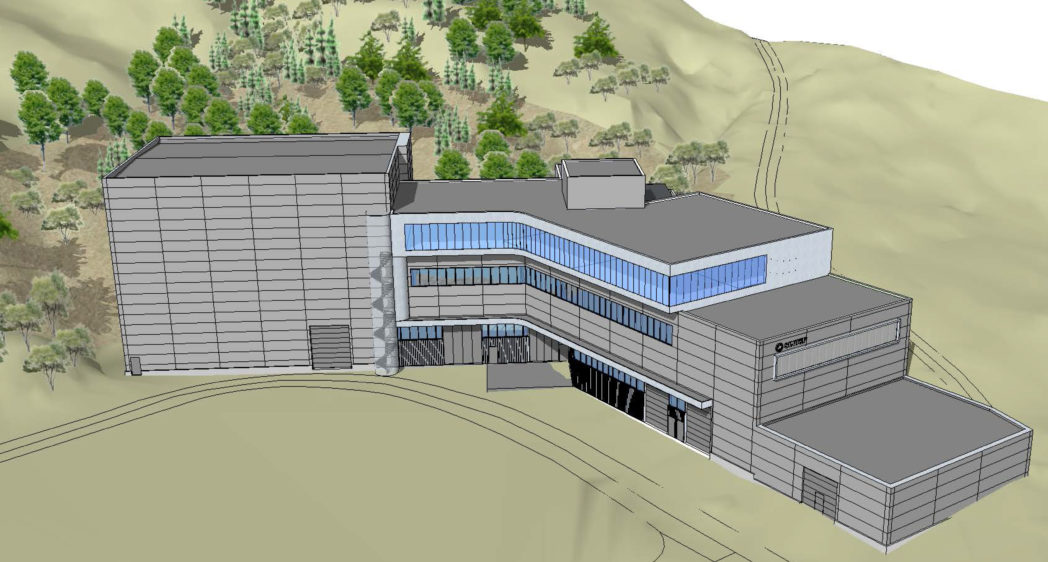
Det planlagte laboratoriebygget på Blakila.
author
Rolf Hegerberg
Published: 21. Jan 2015 | Last edited: 22. Apr 2025
2 min. reading
Comments (0)

After the summer holidays, we will start moving into the new lab on Blaklia!

This development is the largest investment SINTEF Energy has ever done.

From the first sketch on the ‘back of an envelope’ of a high voltage laboratory etc. of approximately 1000 m2  , the project has grown to a total of 5400 m2 including a new high voltage laboratory 24 x 36 meters, with 20 meters net height and six other laboratories totaling approximately 4000 m2 and 800 m2 offices.

The building is designed and built according to new energy savings requirements based on the passive building standard. This implies extra insulation, the use of district heating and an air-to-water heat pump for cooling and heating and automatic control of lighting and ventilation.

This will undoubtedly be the first high voltage laboratory in the world that is built to these requirements.

Enova has so much confidence in the project that they provide partial funding of the extra costs incurred by the passive house requirements with funding associated with passive requirements.
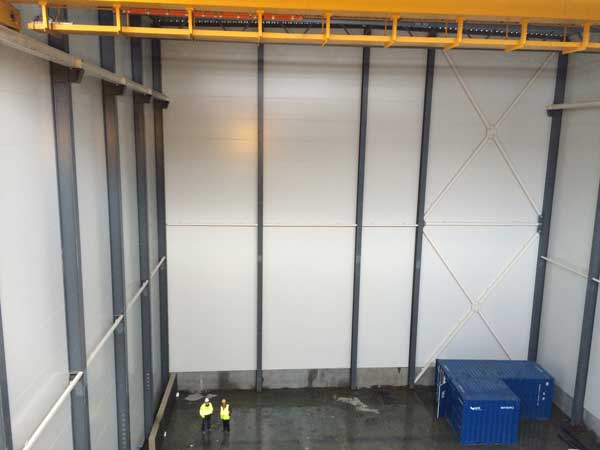
The high voltage laboratory - we see big dimensions. The persons on the floor is not small children but two of the productions workers = grown ups.
The high voltage laboratory – we see big dimensions. The persons on the floor is not small children but two of the productions workers = grown ups. Photo: Rolf Hegerberg

What will we do in the new laboratory?

The high-voltage part of the laboratory is dimensioned and equipped to carry out type- and development tests of power transmission equipment for 420 kV AC and 600 kV DC. We have set aside ample space for long-term tests on both traditional electric power components and equipment for subsea power supply. The project also includes a combustion laboratory of 200 m2 with 12 meters ceilings.

In the new laboratories will we will be able to perform the following:

  • Type anddevelopmenttesting ofelectric powercomponentsfordistribution andtransmission networks
  • Long-term ageing tests on electricityandpower electronicscomponents
  • Mechanicaltesting
  • High current tests upto 10kA/ 25V ; 150kA/230Vfor 5 sec
  • Testing anddevelopmentof equipment forsubsea power supply
  • Pilot scale testing of new combustion concepts
  • High pressure combustion tests

We have emphasized flexibility in the use of new areas and we hope that the laboratories will also be functional for new activities that we currently do not know anything about.

After the opening in September 2015, SINTEF must make the most of the new opportunities the new lab offers and thereby contribute to developing future energy solutions.
Comments

No comments yet. Be the first to comment!

Leave a comment Cancel reply

Your email address will not be published. Required fields are marked *

More about Energy

How much can energy-efficient voyage planning save? Evidence from 11 months of North Atlantic data

Author Image
Author Image
2 forfattere
Infographic showing the flow of thermal energy storage (TES) from surplus heat or cold to end users. On the left, red and blue thermometer icons represent surplus heat and cooling, accompanied by the text “Surplus heat or cold – Captured and stored for when it’s needed.” In the centre, a large panel titled “Thermal Energy Storage (TES)” presents three storage technologies. The top section, “Sensible TES,” shows a container with a thermometer and the text “Stores heat in one single phase.” The middle section, “Latent TES,” shows a water droplet and snowflake connected by circular arrows, with the text “Stores heat through phase change.” The bottom section, “Thermochemical TES,” shows two connected coloured circles that separate and reconnect, illustrating a reversible reaction, with the text “Stores heat through reversible reactions.” A large pale arrow-shaped wedge points from the TES panel toward the right side of the figure. On the right, three application areas are shown in separate boxes with icons: industrial processes, buildings, and data centres. The layout conveys that surplus heat or cold can be stored using sensible, latent, or thermochemical TES technologies and later supplied to industrial facilities, buildings, and data centres.

Thermal energy storage is already commercial  

Jorge Salgado Beceiro
Research Manager

Burning ammonia cleanly: How timing changes everything 

Author Image
Author Image
2 forfattere

Technology for a better society

  • About this blog
  • How to write a science blog
  • Sign up for our newsletter
  • News from NTNU and SINTEF
  • Facebook
Gå til SINTEF.no
SINTEF logo
© 2026 SINTEF Foundation
Privacy Editorial Press contacts Website by Headspin