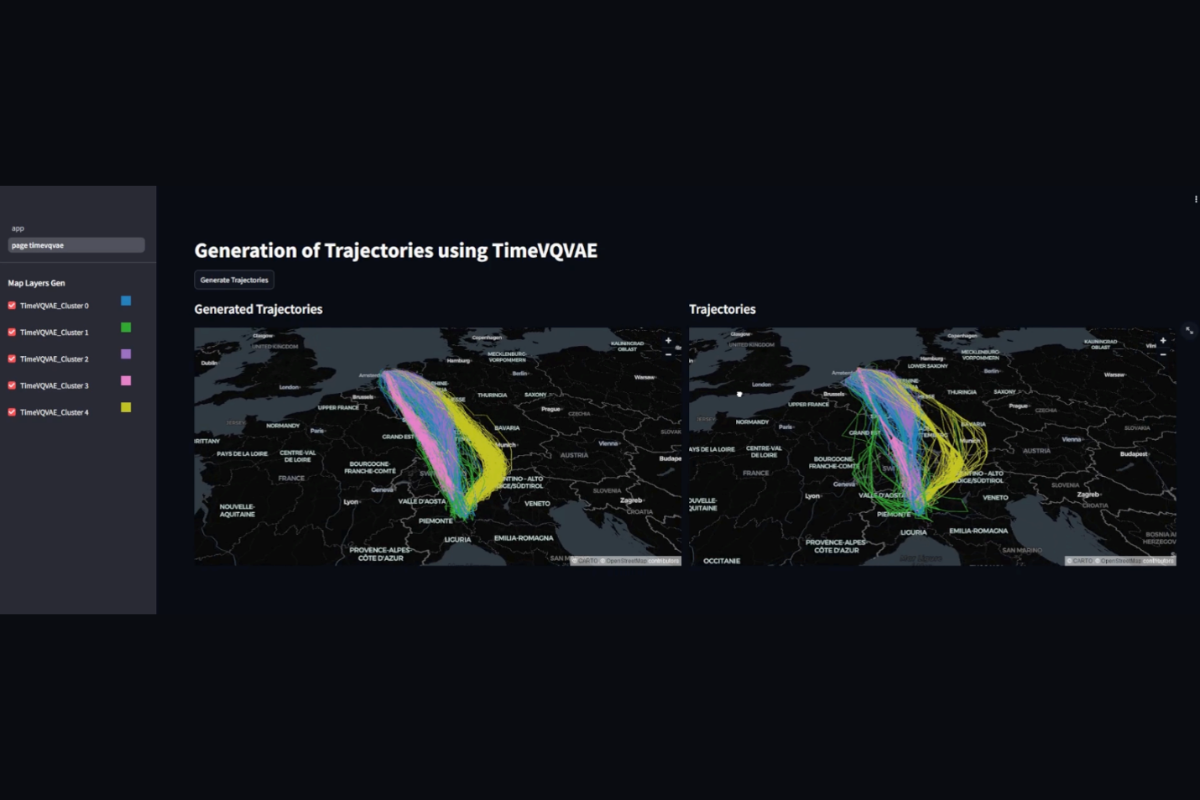



AI in aviation is not bottlenecked by algorithms. It is bottlenecked by data. Airlines guard their schedules. Rare events like diversions are scarce by definition. And privacy rules make sharing across organizations a legal headache. Regional airports simply do not accumulate enough traffic to train a model reliably.
The SynthAIr project, a three-year exploratory research project funded by the SESAR Joint Undertaking and coordinated by SINTEF, set out to close that gap using generative AI — models that learn the statistical structure of real data and produce new records that were never observed.
The headline result: across several operational tasks including delay prediction, turnaround time forecasting, and approach trajectory generation, AI models trained on synthetic data came close to — and in some cases matched — the performance of models trained on real data. In one experiment on a US domestic flight dataset, a model trained entirely on synthetic records predicted departure delays more accurately than the real-data baseline — a single result, not a general conclusion, but one that points to what becomes possible when generative models fill gaps that sparse historical records miss.
These are exploratory results at Technology Readiness Level 1 — scientific findings, not operational tools. But they establish that the research direction is sound.
The same technology — a different problem
When most people hear “generative AI” today, they think of large language models. The models at the core of SynthAIr belong to the same architectural families: transformers, diffusion models, and flow matching. REaLTabFormer, the best-performing model for flight record generation is built directly on GPT-2.
But instead of generating sentences or images, these models generate rows of operational flight data — departure delays, turnaround times, passenger loads — and four-dimensional approach trajectories. The domain is less glamorous. The technical bar is higher. A language model can produce a plausible-sounding sentence that is factually wrong at low cost. A generative model producing trajectory data for air traffic simulation needs to reproduce the physical dynamics of real flight — and the cost of getting it wrong is not a hallucination, but a simulation that leads to incorrect safety conclusions.
Recent surveys show synthetic data is now used across every stage of the AI development pipeline — from pretraining to fine-tuning to evaluation — and its role is expanding rapidly. SynthAIr is an early, careful investigation of what it means when the domain does not tolerate errors.
Three results worth knowing
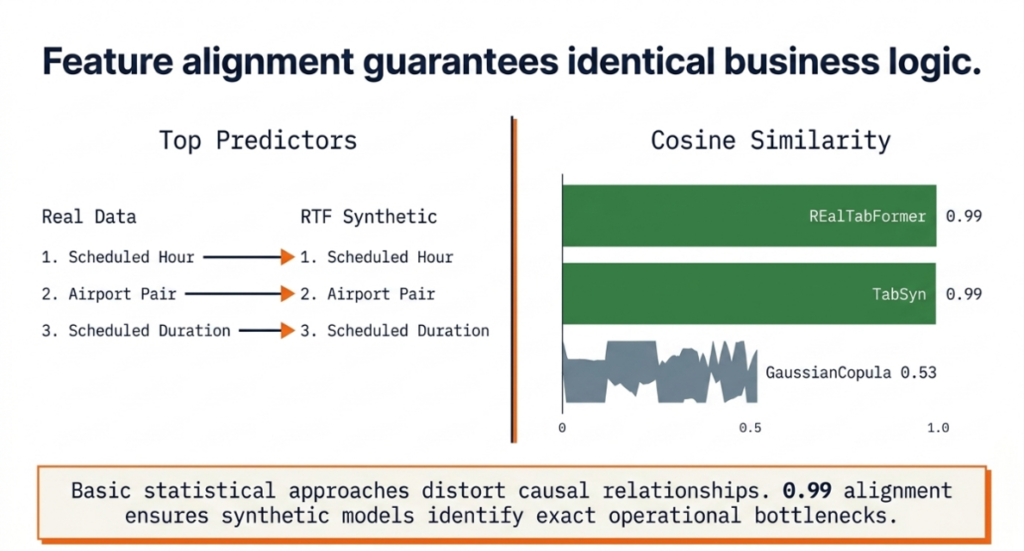
Synthetic tabular data that captures causal structure, not just surface statistics. The top-performing model for structured flight records — REaLTabFormer, a transformer adapted for tabular data — achieved 97% of real-data predictive accuracy across 1.74 million European flights. More significant: models trained on synthetic data identified the same operational predictors as models trained on real data, with a feature importance alignment of 0.99. The synthetic data preserves the same predictive structure as real data — a promising indicator of operational faithfulness, though not a formal proof of it [1].
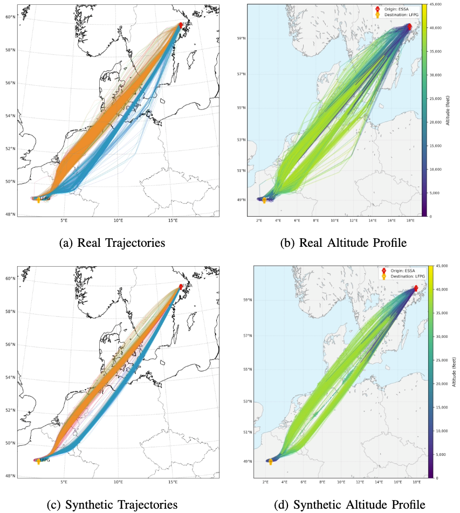
A new trajectory generation architecture, validated in simulation. For approach trajectories — four-dimensional sequences of altitude, speed, latitude, and longitude — the project developed TimeVQVAE, an architecture that combines spectral decomposition, discrete encoding, and a bidirectional transformer. To the best of our knowledge, it is the first application of this combination to aviation. It achieved a realism score (Fréchet Inception Distance) 274 times better than the previous state of the art. Generated trajectories were validated in BlueSky, an open-source air traffic simulator. The paper received the Best of Session award at ICNS 2025 [2].
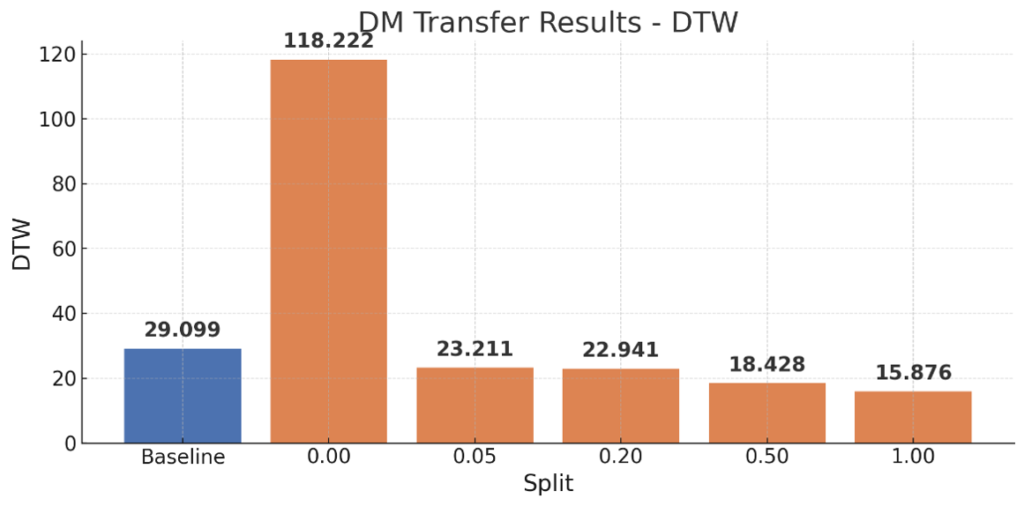
One week of local data may be enough. The most practically relevant finding: a trajectory model pretrained on data from Zurich Airport can be fine-tuned for Dublin Airport using just 5% of Dublin’s data — roughly one week of landings — and still outperform a model trained from scratch on the full local dataset. This was tested across four generative architectures, including the first application of diffusion models and flow matching to cross-airport transfer learning in air traffic management. Diffusion-based models transferred reliably; flow matching showed weaker generalization — an open architectural question [3].
Beyond Data Generation: One model, two uses
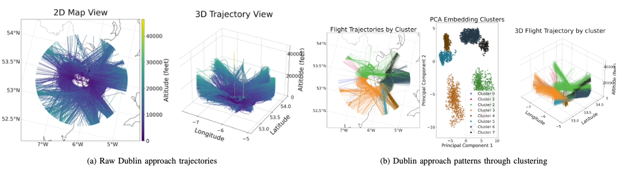
A finding that surprised us: once trained, generative models can be repurposed as analytics tools — without generating any new data [4]. Using only the encoder, we extracted compact representations of real trajectories and clustered them. At Dublin Airport, this revealed seven statistically distinct approach pattern groups — without any manual labelling. At Heathrow, thousands of arrivals were compressed into ten representative paths with potential use in fast-time simulation. Whether these groupings are operationally meaningful in practice is a question for domain experts and operational testing — the finding is that the structure is recoverable from the model’s internal representation.
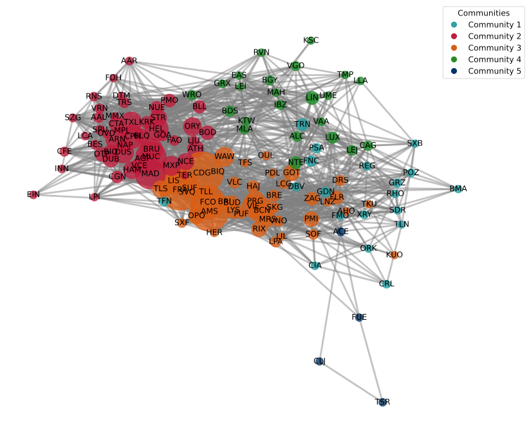
Applied to European tabular flight data, it revealed five operational airport communities — groups of airports that behave similarly in ways that raw geography does not predict.
The central finding of SynthAIr can be stated in one sentence: generative models that learn aviation data well become multi-purpose operational analytics engines. Generate. Transfer. Understand.
What remains open — and what comes next
All results are at TRL1 and require validation in operational simulation environments. The main open engineering challenges: physics-constrained generation (models learn statistics but not aircraft performance envelopes), weather conditioning, systematic rare-event modelling, and formal privacy guarantees beyond Distance-to-Closest-Record before regulated data sharing. The transfer learning results need extension beyond one airport pair.
These are not limitations to overlook, but clearly defined research challenges. They are a defined research agenda, and SynthAIr has provided evidence that the agenda is worth pursuing seriously.
Beyond aviation
The structural challenge that motivated this work — sensitive data, rare events, a sharp gap between data-rich hubs and data-poor peripheries — is not unique to aviation. Urban and road transport face the same asymmetry between well-instrumented cities and sparse rural coverage. Maritime operations deal with AIS coverage gaps in coastal waters; transfer learning from busy shipping lanes to quiet port approaches is structurally identical to the Zurich-to-Dublin experiment. Rail would benefit from synthetic simulation of rare disruption cascades that historical records barely capture.
SynthAIr studied aviation only. Application to other domains requires domain-specific validation. But the methodology is open, the code is public, and these are questions worth investigating — together.
All results are open
All code, synthetic datasets, and publications are publicly available at synthair.github.io and github.com/SynthAIr. Seven peer-reviewed papers, all open access via Zenodo.
Working on synthetic data, operational AI, Generative Models, AI for timeseries or spatiotemporal data, or privacy-preserving data sharing in any domain? We would be glad to hear from you.
Publications
[1] Murad, A. & Ruocco, M. (2026). Pre-tactical flight-delay and turnaround forecasting with synthetic aviation data. CEAS Aeronautical Journal. doi.org/10.1007/s13272-026-00941-7
[2] Murad, A. & Ruocco, M. (2025). Synthetic Aircraft Trajectory Generation Using Time-Based VQ-VAE. ICNS 2025 — Best of Session Award. doi.org/10.1109/ICNS65417.2025.10976929
[3] Larsen, O.F.P., Ruocco, M., Spitieris, M., Murad, A. & Ragosta, M. (2025). Learning to Land Anywhere: Transferable Generative Models for Aircraft Trajectories. SESAR Innovation Days 2025. doi.org/10.5281/zenodo.18186881
[4] Murad, A., Ruocco, M. & Spitieris, M. (2025). General Time Series Embeddings for ATM Operational Analytics. SESAR Innovation Days 2025. zenodo.org/communities/synthair
[5] Aly, R. & Sharpanskykh, A. (2025). Synthetic Flight Data Generation Using Generative Models. ICNS 2025. doi.org/10.1109/ICNS65417.2025.10976960
All publications open access: zenodo.org/communities/synthair
SynthAIr (2023–2026) is funded by the SESAR 3 Joint Undertaking under grant agreement No. 101114847, within the European Union’s Horizon Europe programme. Partners: SINTEF (coordinator), TU Delft, EUROCONTROL, Deep Blue.

AI @ SINTEF
SPIN – Software Product Innovation
We specialize in the human and societal implications of digitalization, the development of system architectures and models, the innovation of data-based solutions, and the application of AI, ML, and data-driven analytics.







Comments
No comments yet. Be the first to comment!