
The EERA DeepWind’2021 offshore wind conference was successfully arranged 13-15 January hosted by SINTEF and NTNU and organized in association with the European Energy Research Alliance (EERA) joint programme on wind energy. The conference has been developing every year since 2004 and this year, for the first time, it was arranged as a fully digital event with participants and speakers interacting through a dedicated on-line portal. This allowed for a safe arrangement of the conference in line with global coronavirus regulations, but also removing the need for travel, whilst ensuring a good meeting arena with global participation for addressing the latest and best science on offshore wind.
The programme included excellent presentations by invited keynote speakers, and dedicated specialist sessions addressing the following topics:
- New turbine and generator technology
- Grid connection and system integration
- Met-ocean conditions
- Operation & maintenance
- Installation and sub-structures
- Wind farm optimization and control
- Experimental testing and validation
- Energy transition perspectives
Keynote speakers included:
 | Tina Bru, Minister of Petroleum and Energy, Norway |
 | Nils Røkke, Executive Vice President Sustainability, SINTEF |
 | Carlos Eduardo Lima da Cunha, Policy Officer, European Commission |
 | Peter Eecen, Coordinator, EERA JP Wind |
 | Amy Robertson, Principal Engineer, The National Renewable Energy Laboratory |
 | John Olav Tande, Chief Scientist, SINTEF Energy Research |
 | Lena Kitzing, Head of Section for Society, Markets and Policy at DTU Wind Energy |
 | Trond Kvamsdal, Professor, NTNU |
 | Katherine Dykes, Head of Section, Systems Engineering & Optimization, DTU Energy |
 | Yves Perignon, Manager of the SEM-REV infrastructure, Research engineer at CNRS |
In total, more than 100 presentations were given at the conference. These are all available online for registered conference participants throughout 2021 with recorded video and presentations in pdf format.
The papers submitted for the conference are now in peer-review for publication in the Journal of Physics: Conference series. These are expected to be on-line with open access by fall 2021.
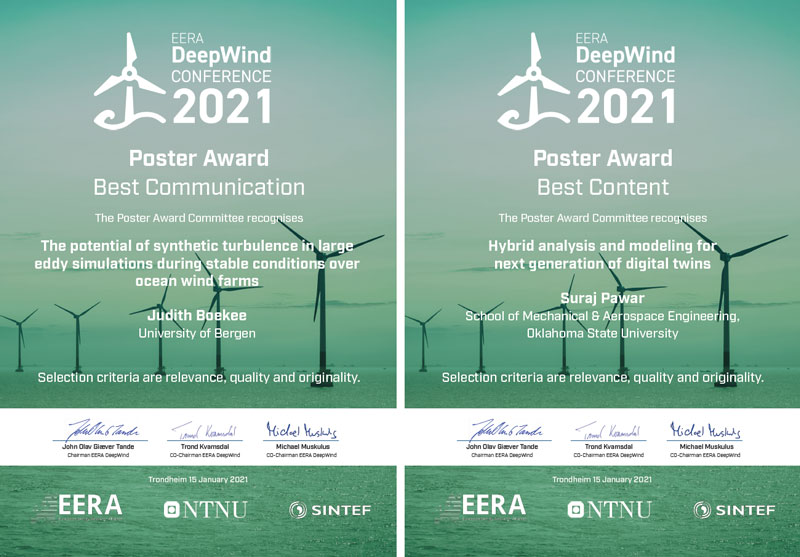
EERA DeepWind’2021 was concluded by the poster award ceremony:
- The poster award for best scientific content was given to Suraj Pawar, Oklahoma State University for his excellent work on “Hybrid analysis and modeling for next generation of digital twins”.
- The poster award for best communication was given to Judith Boekee, University of Bergen for her excellent poster on “The potential of synthetic turbulence in large eddy simulations during stable conditions over ocean wind farms”.
Mark your calendars: The next EERA DeepWind conference will take place in Trondheim, 19 – 21 January 2022.







Comments
No comments yet. Be the first to comment!