Skip to content

SINTEF Blog Gå til forsiden

  • Energy
  • Ocean
  • Digital
  • Health
  • Industry
  • Climate and environment
  • Building
  • Society
  • EN
  • NO
Energy

Electricity supply security – N-1 isn’t always enough

I, Gerd Kjølle, and Einar Jordanger have just returned from a couple of hectic days at Norway House in Brussels, where we’ve been attending meetings with the EU Commission in order to assess the European project called GARPUR. The project addresses the development of new risk-based methods for transmission grid operation.

authors
Oddbjørn Gjerde
Research Manager
Gerd Kjølle
Chief Scientist
Published: 20. Jan 2017 | Last edited: 15. Apr 2025
2 min. reading
Comments (1)

GARPUR emerged from the assessment very well, and the experts appear to have understood the importance and value of the results produced so far. We’re now looking forward to the exciting final eight months of the 4-year project term.

What is N-1?

The GARPUR project is looking into the development of risk-based methods that can supplement or replace the current “N-1” criterion for transmission grid operation. “N-1” means that the grid shall be capable of experiencing outage of a single transmission line, cable, transformer or generator without causing losses in electricity supply. N-1 takes no account of the probability of such outages, and fails to distinguish between which, and the magnitude of, areas that may be impacted by power losses.

“N-1” means that the grid shall be capable of experiencing outage of a single transmission line, cable, transformer or generator without causing losses in electricity supply.

In the light of increasing contributions from variable and unregulated renewable energy production, such as solar and wind-power, the power system is experiencing increasing levels of operational uncertainty and complexity. N-1 has turned out to be inadequate in coping effectively with this. For this reason, risk-based methods will come to the fore as a means of safeguarding supply security linked to the operation of tomorrow’s power system, and at the same time contribute towards keeping a lid on socio-economic costs.

The GARPUR project is coordinated by SINTEF Energy Research and involves 20 European partners comprising mainly transmission grid operators and research institutes.
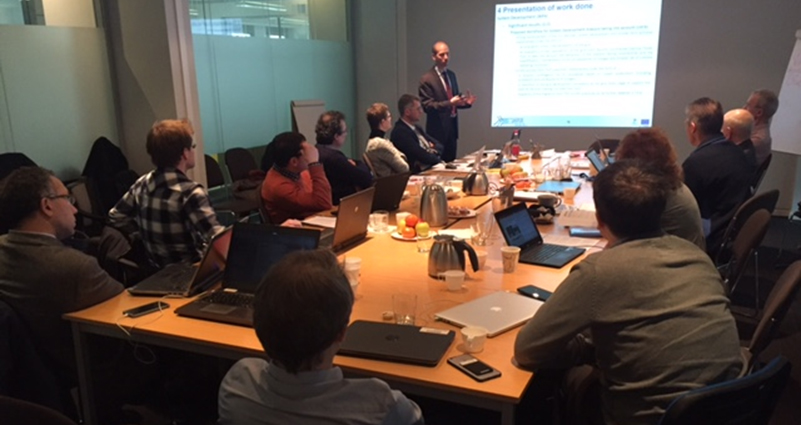
Participants at the meeting at Norway House in Brussels.
Participants at the meeting at Norway House in Brussels. Photo: Iris Baldursdottir

Comments

David Dolezilek says:
1. April 2025 at 16:34

I am interested to learn more about your risk based approach to improve upon N-1. I have been looking into several processes including iRIDM. I am curious if you have a metric for how long a failure can persist. Assuming that N-1 reliability is essential and must be present at the initial startup of a system, if during operation a failure occurs, the system will continue in an N-0 state. What is the permissible time until the system is returned to N-1? I do not find any discussion of this. I feel that if it is essential for the initial design, it remains essential and the fault should be detected and repaired immediately. The length of time for this repair is an important metric to compare alternatives.

Reply

Leave a comment Cancel reply

Your email address will not be published. Required fields are marked *

More about Energy

How much can energy-efficient voyage planning save? Evidence from 11 months of North Atlantic data

Author Image
Author Image
2 forfattere
Infographic showing the flow of thermal energy storage (TES) from surplus heat or cold to end users. On the left, red and blue thermometer icons represent surplus heat and cooling, accompanied by the text “Surplus heat or cold – Captured and stored for when it’s needed.” In the centre, a large panel titled “Thermal Energy Storage (TES)” presents three storage technologies. The top section, “Sensible TES,” shows a container with a thermometer and the text “Stores heat in one single phase.” The middle section, “Latent TES,” shows a water droplet and snowflake connected by circular arrows, with the text “Stores heat through phase change.” The bottom section, “Thermochemical TES,” shows two connected coloured circles that separate and reconnect, illustrating a reversible reaction, with the text “Stores heat through reversible reactions.” A large pale arrow-shaped wedge points from the TES panel toward the right side of the figure. On the right, three application areas are shown in separate boxes with icons: industrial processes, buildings, and data centres. The layout conveys that surplus heat or cold can be stored using sensible, latent, or thermochemical TES technologies and later supplied to industrial facilities, buildings, and data centres.

Thermal energy storage is already commercial  

Jorge Salgado Beceiro
Research Manager

Burning ammonia cleanly: How timing changes everything 

Author Image
Author Image
2 forfattere

Technology for a better society

  • About this blog
  • How to write a science blog
  • Sign up for our newsletter
  • News from NTNU and SINTEF
  • Facebook
Gå til SINTEF.no
SINTEF logo
© 2026 SINTEF Foundation
Privacy Editorial Press contacts Website by Headspin