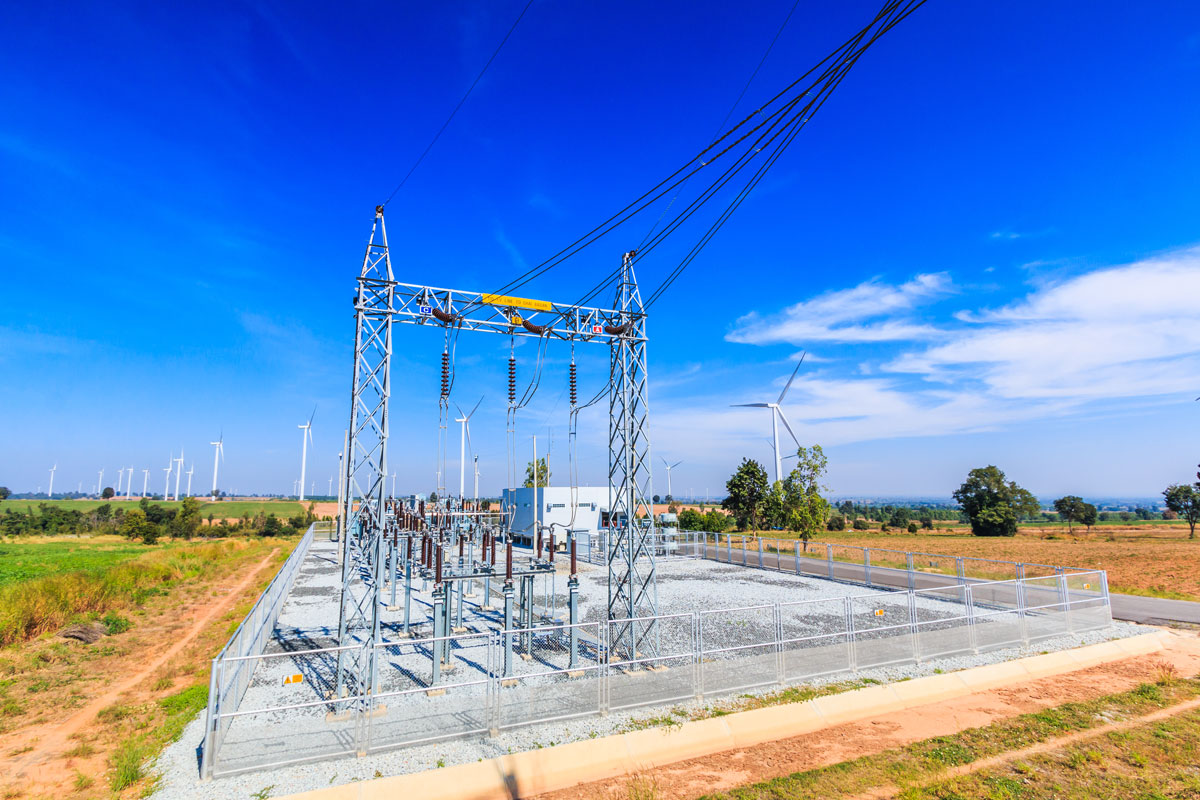



A study led by SINTEF shows the effect of different pathways to lower emissions. Here, we compare various strategies for phasing out SF₆-based circuit breakers and calculate future emissions and component needs.
Most circuit breakers in the distribution and transmission grids (above 11 kV) contain a gas called sulfur hexafluoride – SF6. For decades, this gas has been widely used in the power system due to its excellent insulating and arc-quenching properties.
However, SF₆ is a potent greenhouse gas, and the EU has set deadline for thecommissioning of new switchgear containing SF6. From January 2026, new switchgear in medium-voltage systems up to 24 kV must be SF₆-free, with a deadline of 2032 for higher voltages.
Development of SF₆-free alternatives to replace the current technology is therefore well underway. In the EU project MISSION, led by SINTEF Energy Research, partners will both develop and demonstrate new SF₆-free technology and assess system-level and climate impacts of adopting the new breaker technologies. Together with research and industry partners from several European countries, we have also analysed what the transition to an SF₆-free power system may look like.
Circuit breakers are needed everywhere
Circuit breakers protect both users and components in the power system and are essential for security of supply. They are used to switch components such as power lines, cables and transformers in and out of operation, and are therefore needed throughout the entire grid.
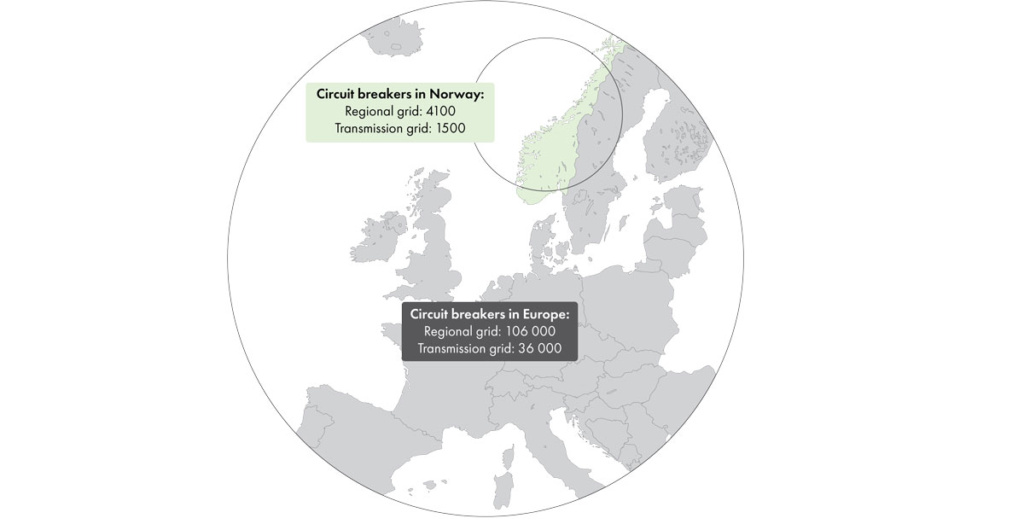
As part of the MISSION project, we estimated the number of circuit breakers currently in operation in Norway and Europe. As the figure below shows, Norway has around 4,100 breakers in the regional grid and 1,500 in the transmission grid. For Europe, the total number is estimated to be roughly 25 times higher.
Circuit breakers as a source of SF₆ emissions
SF₆ emissions from circuit breakers come from small, continuous leaks as well as larger releases caused by failures or accidents. Some emissions also occur during handling and recycling of the gas at end of life.
Over the last 10–15 years, emissions from the Norwegian power system have remained consistently low, according to the Norwegian Gas Insulated Substation (GIS) User Group. In 2023, SF₆ emissions were around 500 kg, corresponding to 0.13% of the total installed gas volume. This is very low in an international context, where emission rates of 0.5%–1% are typical.
The amount of SF₆ in each circuit breaker also affects the scale of emissions. This varies significantly depending on voltage level, age and installation type – from 2–3 kg to more than 1,000 kg per bay. Technological development in recent decades has contributed to lower gas volumes and reduced leakage rates.
Different pathways to lower emissions
In exploring the transition to a future power system, we defined and compared two strategies for eliminating SF₆ emissions:
- Gradual phase-out – existing SF₆-based breakers remain in operation until they reach their technical end of life, while all new breakers are SF₆-free once available.
- Accelerated phase-out – all SF₆-based breakers are replaced by 2050. Both Statnett in Norway and National Grid in the UK have set targets for an SF₆-free fleet by 2050.
We also analysed a third option based on continued use of SF₆-based breakers. With this strategy, emissions still decrease somewhat compared with today, because modern breakers contain less SF₆ and have lower leakage rates than many ageing units currently in operation.
The figure below shows cumulative future emissions up to 2100 for the three strategies.
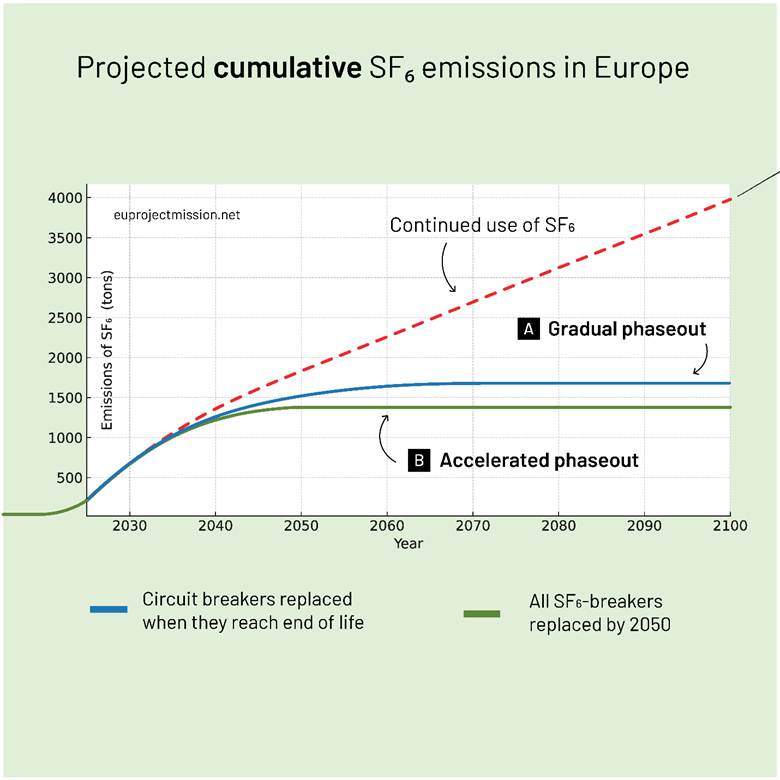
As expected, the accelerated phase-out results in the lowest emissions. Our calculations show that all SF₆-based circuit breakers will reach end of life and naturally be phased out during the 2070s (assuming SF₆-free alternatives become available soon). Thus, total emissions with the gradual phase-out are only 15% higher. Most emissions for both phase-out strategies occur before 2050, and compared with continued use of SF₆, both pathways deliver substantial emission reductions.
A SF₆-free system by 2050 does not come without extra cost…
The need for new components is significant, even with a gradual transition. This strategy still requires commissioning more breakers by 2050 than are currently in operation.
Circuit breakers typically have a lifetime of 35–40 years. An accelerated transition means replacing many fully functional units, requiring roughly 30%–50% more circuit breakers to be commissioned by 2050 compared with the gradual phase-out.
…Nor without practical challenges
There are also practical challenges in achieving an SF₆-free power system by 2050. Surrounding equipment often needs to be taken out of service to replace circuit breakers, which demands resources from grid operators and reduces transmission capacity. In areas with limited operational margins, upgrades must wait until conditions allow, delaying the transition.
Another uncertainty is the impact of the shift to SF₆-free technology on suppliers, in terms of availability and price. Demand for SF₆-free breakers will be high across Europe in the coming years, and only a handful of suppliers currently offer such technology.
SF₆-free circuit breakers will reduce emissions
The work in the MISSION project highlights the value of developing and rapidly deploying SF₆-free alternatives.
When looking ahead, we see differing views among European grid operators: while companies like Statnett and National Grid have ambitious goals, others face economic and practical barriers that limit their ability to reach an SF₆-free grid by 2050.
At the same time, development of SF₆-free technology is progressing well, and our analyses show that most future emissions will be eliminated by 2050 even with a gradual phase-out.
Even if the goal of eliminating all SF₆ by 2050 is not reached, the power sector will still have come a very long way toward a zero-emission grid.
References
Treider, T. & D’Arco, S. (2025). Estimating the Norwegian circuit breaker population towards 2050. CIGRE 2025 Symposium Trondheim, 1329
D’Arco, S. et al. (2025). Scenarios and vulnerabilities related to introducing SF6– free technologies in the grid. MISSION Deliverable D1.1.




Comments
No comments yet. Be the first to comment!