

Serious games are games that have the dual goal of entertaining people while at the same time achieving a purpose – be it exploring various possible scenarios, advocating for a particular outcome, or even just creating awareness about an issue. This technique can be particularly useful due to its immersive nature – the player is submerged in a gaming reality and tasked with a goal. The sights, sounds and interactions help to make the player feel invested and the situation to feel more real.
Exploring the world of GoJelly
This is one of the methods used by the Horizon 2020 project GoJelly, with partners all across Europe, including SINTEF Ocean. The GoJelly project examines the issue of an increasing jellyfish population that is disrupting the natural flora of our oceans and looks at how we can turn this problematic surplus into a resource, using biological material from jellyfish in applications ranging from microplastic capture to cosmetics. One of the goals of the GoJelly project is to make people aware of these many ways in which jellyfish can be used and to reduce their fear of contact with them.
To achieve this, the project has created a digital, socio-ecological strategy game for people to play, where they through active participation can learn how these ancient creatures can be a resource for our planet. Here, the serious game helps to create awareness of the issue and the complexity of its ramifications and solutions. The underlying idea was to create a strategy game for the public as well as for educational purposes that showed the tradeoffs between social, economic and ecological management decisions in a playful and understandable manner.
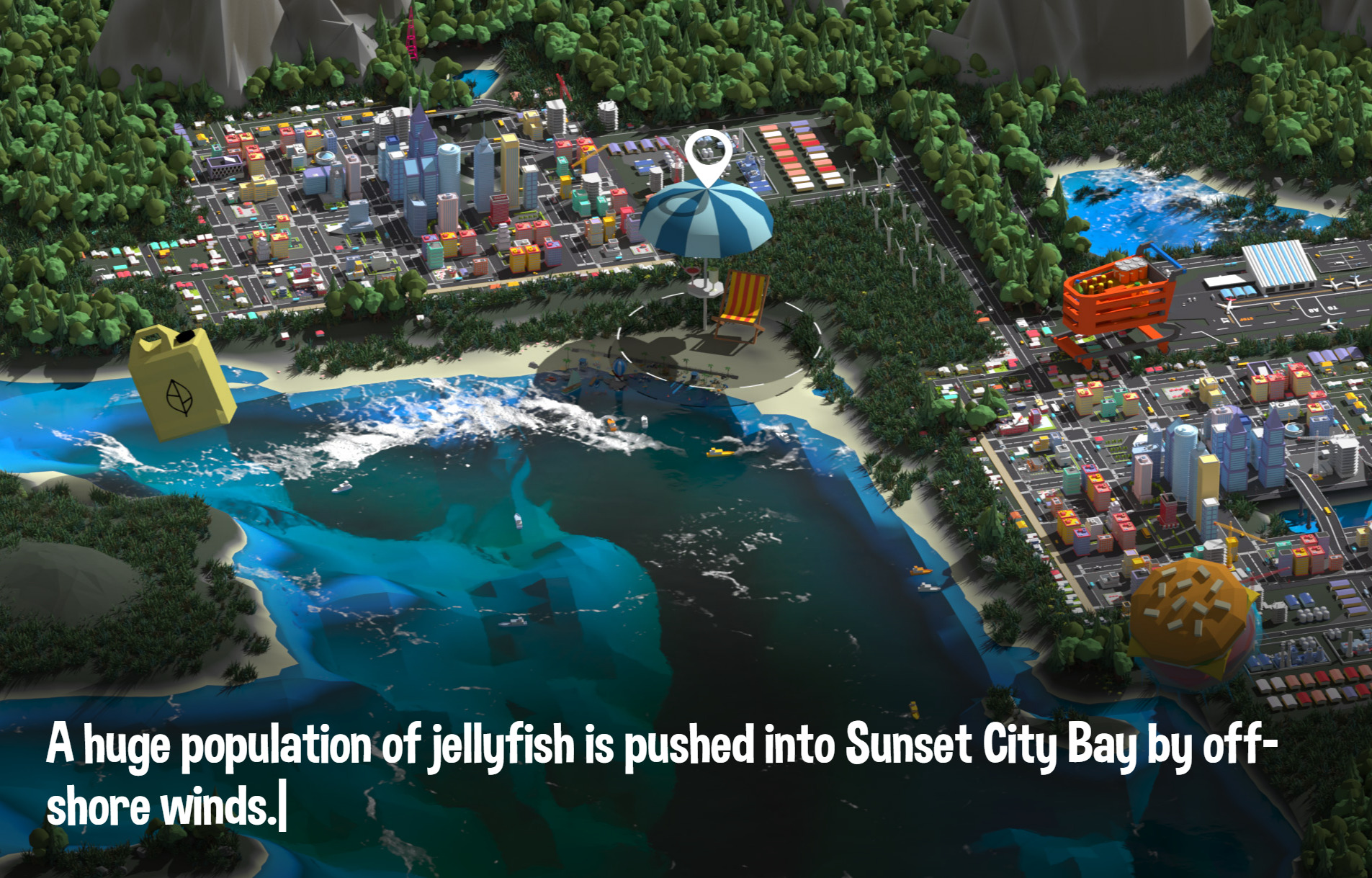
In the game, which is now live through the project’s website, the player slips into the role of the mayor of Sunset City, who is supported by a highly capable research team. In each mission, the player must make choices to protect their beautiful city, while always having an eye on the nearby sea. Environmental factors and good or bad decisions influence the course of the game as well as the score, and the final goal is to reach a sustainably balanced system with the jellyfish.
The single-player, browser-based game takes about 15 minutes to play and can be used in various educational settings to dive deeper into the topics of the project, or just serve as a first overview of sustainable marine-ecosystem management and its many aspects. For the best gaming experience, it is recommended to play in the Chrome browser on a desktop PC or tablet, and to be connected to Wi-Fi due to the large size of the videos used.
You’re invited to participate in the research!
GoJelly is all about exploring possibilities, and now you have the possibility to participate in the research process! The project invites everyone who is interested to play the game and asks that players take the time to complete a two-minute survey afterwards to collect players’ thoughts. You can find the survey here.
This feedback will help researchers to streamline their data collection and gather important insights into the methodology. Help us to raise awareness and build knowledge on an important biological issue, while having fun at the same time.
To play the game, visit go-jelly.com or access it through the project’s website by clicking on the Online Game icon on the right-hand side of the top banner. And don’t forget to take two minutes to fill out the survey once you’re done with the game.
Happy playing, and thank you for contributing to this important research!





Comments
Quite interesting. I also want to try this game. It’s just sad that it can’t be played without wifi. But anyway, thanks for sharing the game.
Excellent article! Your post is essential today. Thanks for sharing, by the way.If you are looking for coupon codes and deals just visit coupon plus deals dot com