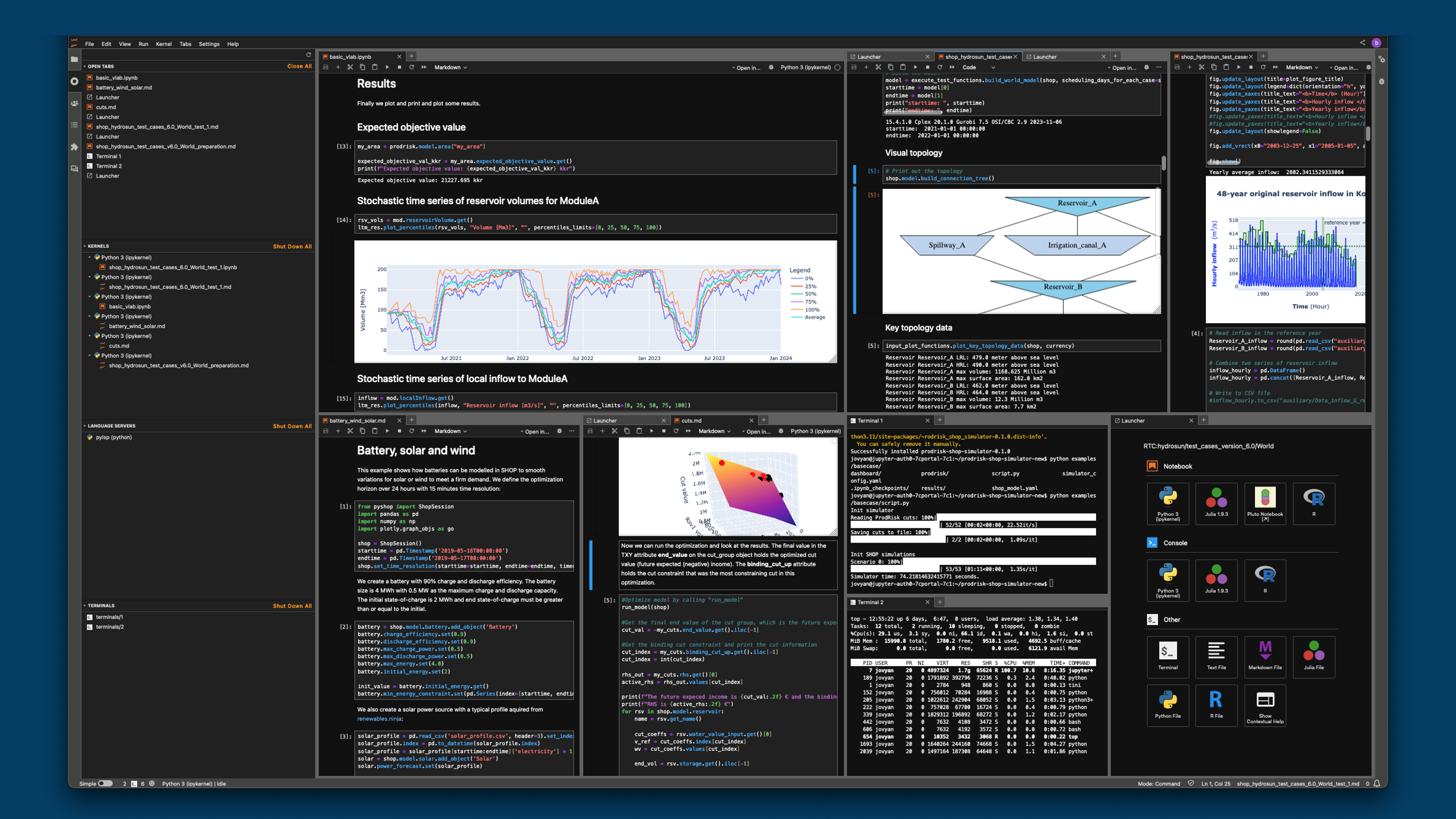

The SINTEF Virtual Lab (vLab) is a state-of-the-art platform, toolbox and digital laboratory for SINTEF’s research scientists who want a hassle-free experience when testing, sharing and collaborating on their work with partners in the industry and academia – be it applications, models, projects, analyses or anything data science-related that requires code to be ran in a contained, virtual environment.
Watch this video presentation of vLab:
It all began with hydropower
vLab was born out of the desire to instantly share and deploy the latest version of one of our hydropower scheduling tools with customers and partners without them having to worry about time spent on compatibilities, installations, updates, environment variables or other requirements.
For us it meant minimizing overhead and tedious tasks that could be automated, freeing up time for our core work tasks. For them it meant time spent on testing out new features, not hammering on the keyboard in vain.
Over time, it has evolved to be used by numerous models and projects internally and externally and has become a vital part of our daily workflow and routines.
Digital twins, floating solar panels and predictive grid resilience
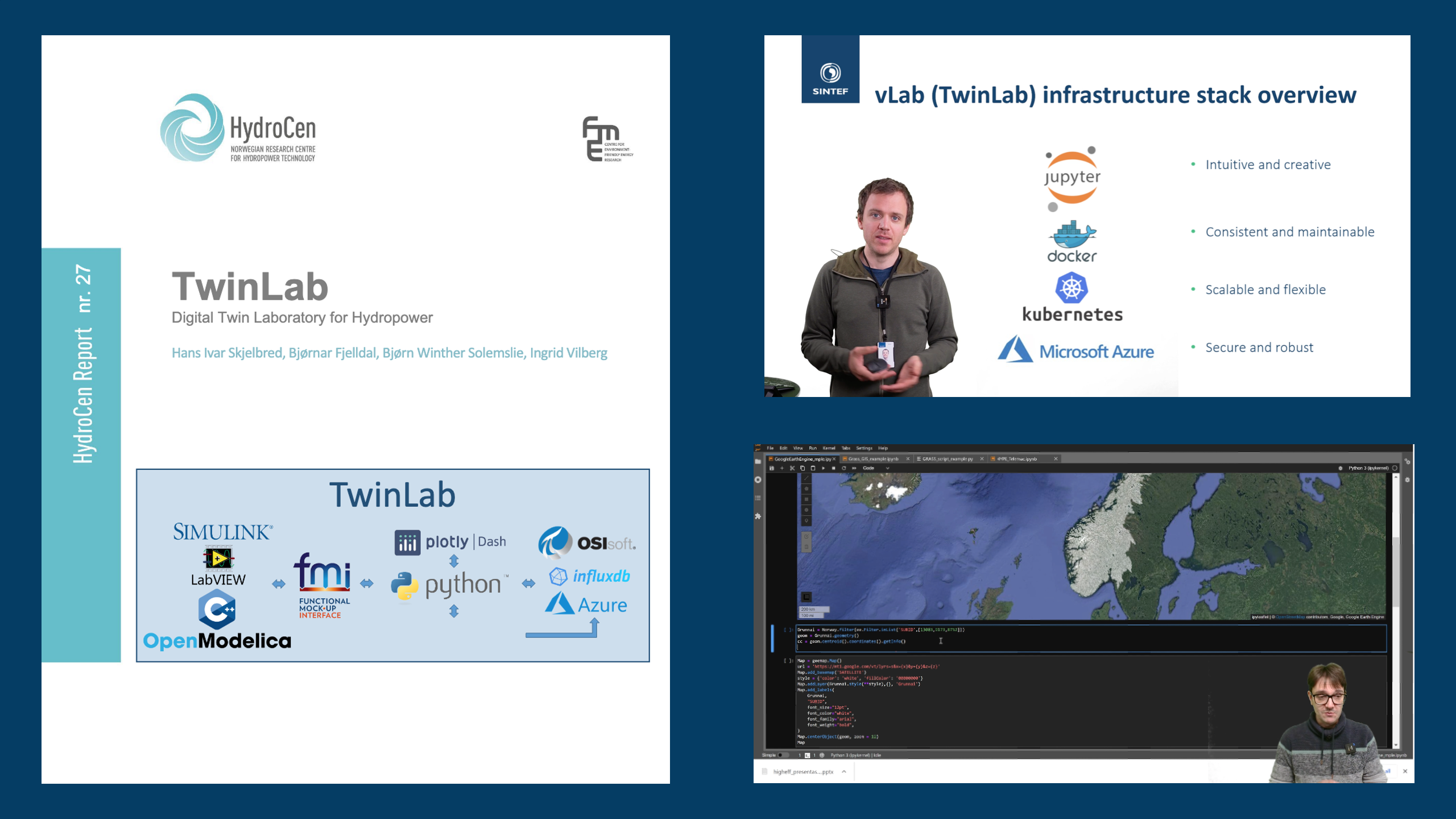
When we built a digital twin of a hydropower system through data-driven modeling and cross-disiplinary research in HydroCen’s TwinLab project the vLab was used to collaborate with a diverse pool of partners.
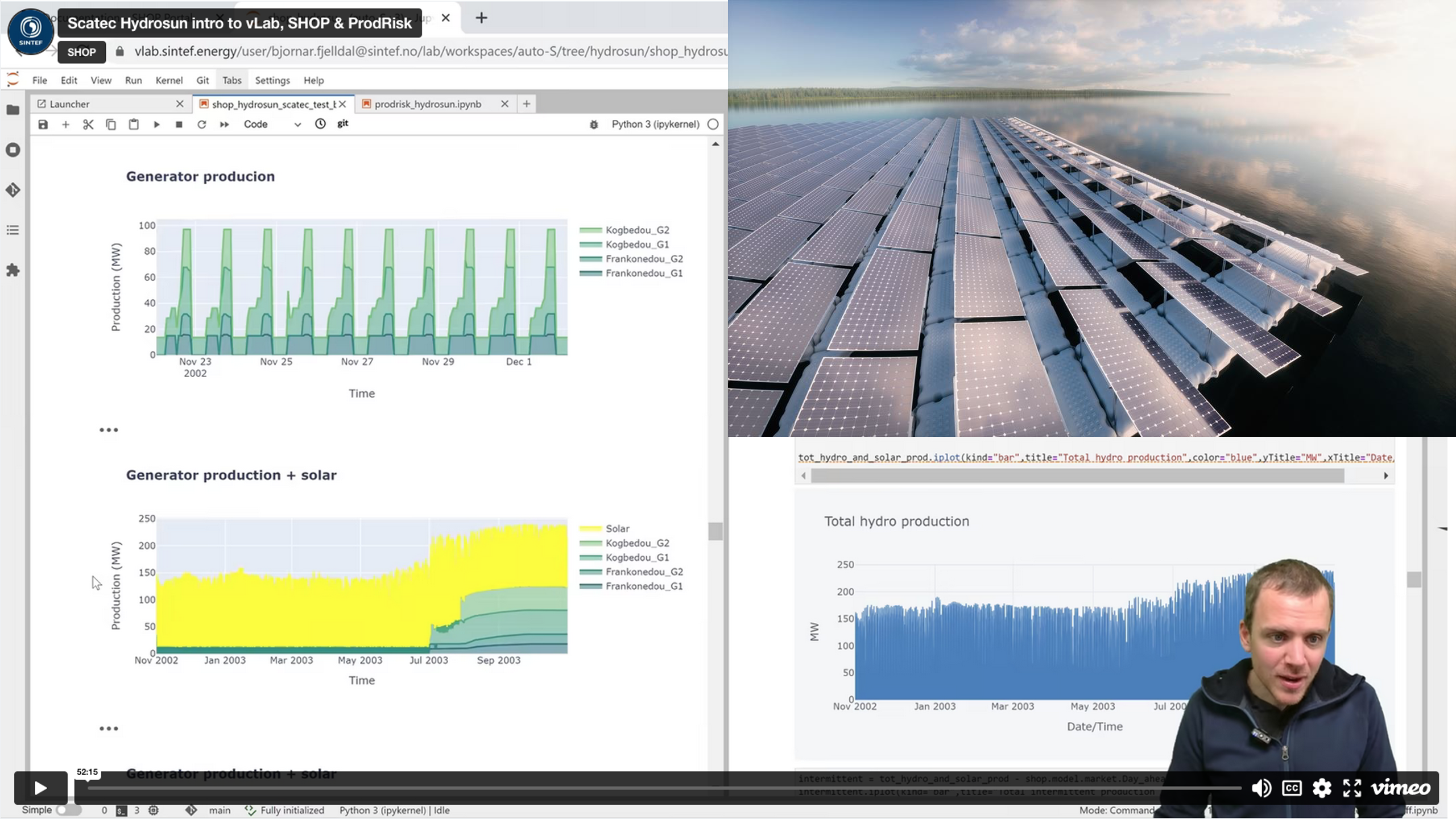
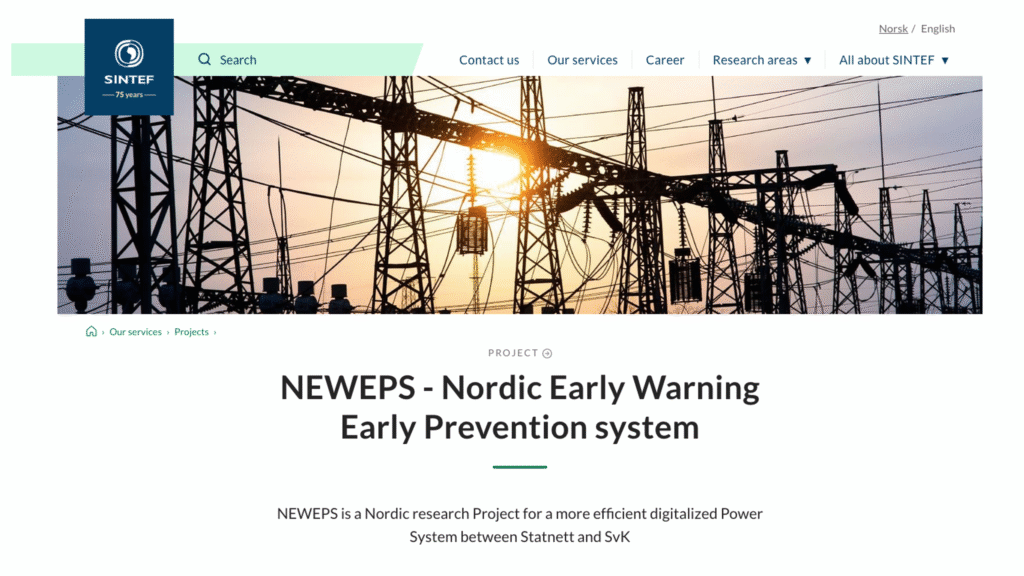
In the Green Platform project HydroSun we explored how hybrid power plants that combine floating solar panels with hydropower could boost renewable energy production by modeling these scenarios in the vLab together with tenfolds of research and industry partners. And when NEWEPS was developed as a real-time monitoring and control tool to prevent power system failures across the Nordic grid, it was tested and deployed on SINTEF’s Virtual Lab.
Plug and play
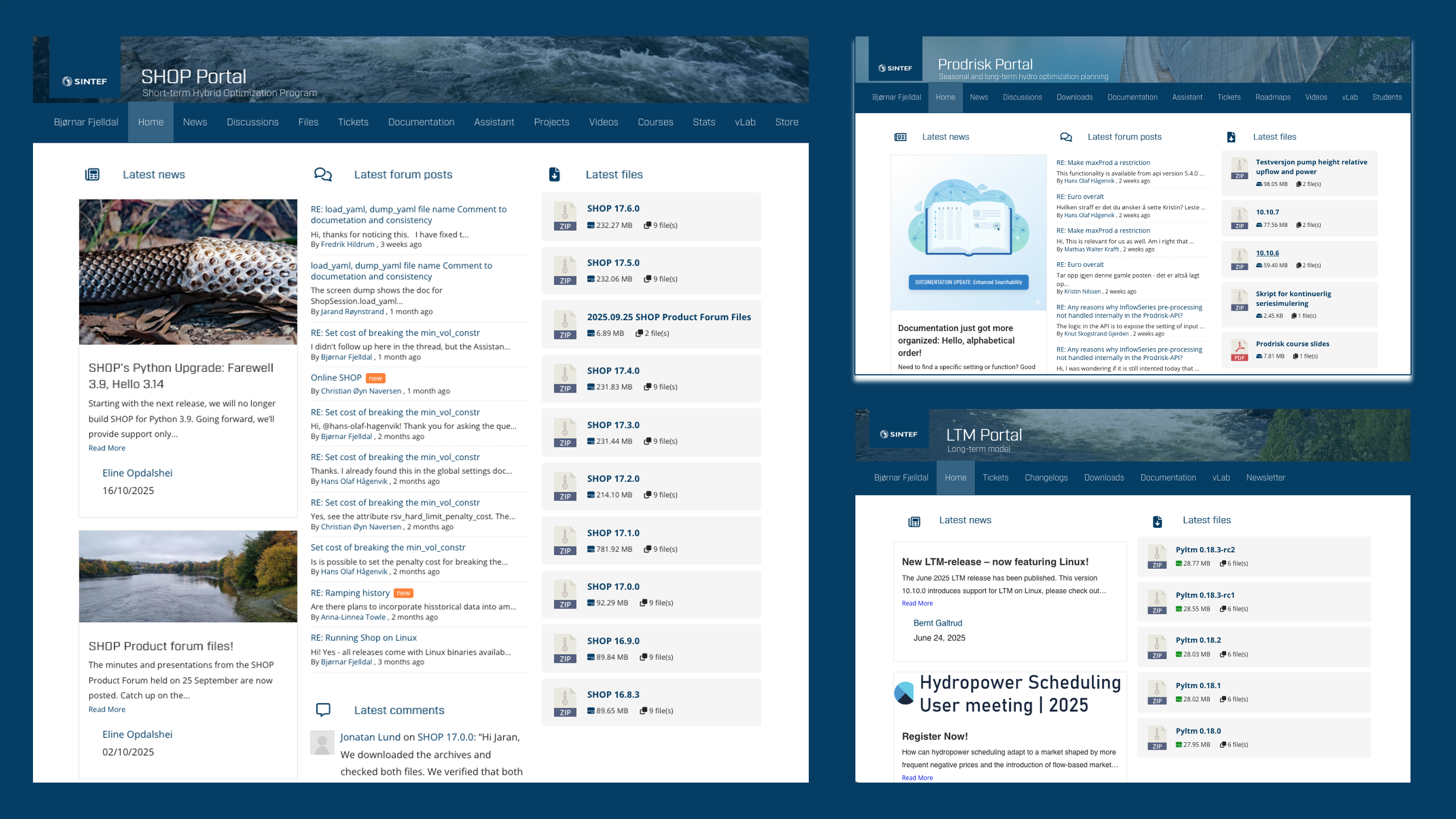
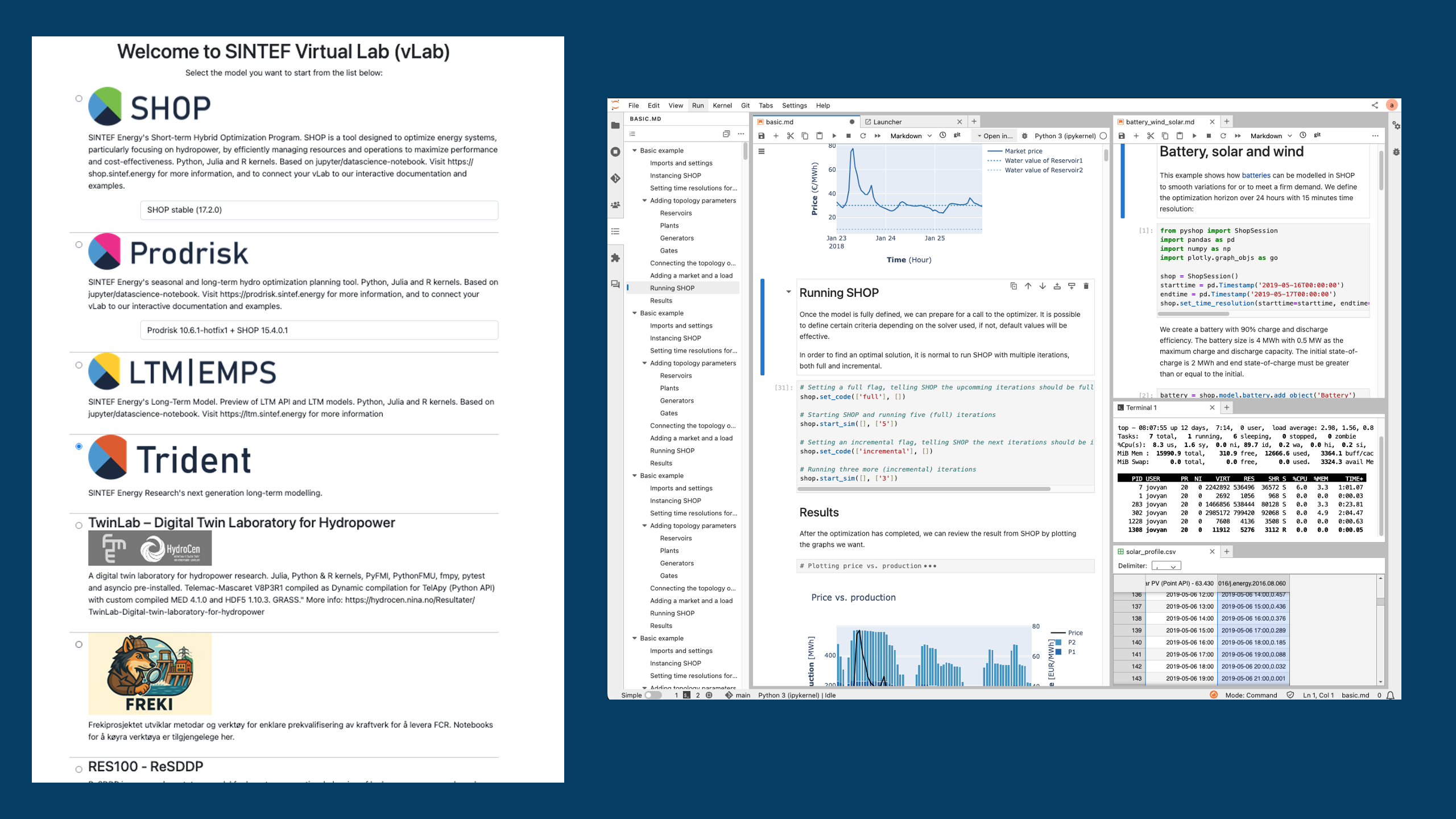
So how does it work? In seconds – simply by logging on using your web browser – you are ready to go. You can instantly test the latest versions of our hydropower optimization models such as SHOP, ProdRisk, LTM or Trident, or you can access your current research project or data analysis with your toolset and requirements at hand.
This is all done in an always up-to-date environment based on the open-source Project Jupyter with the latest kernels for the programming languages Julia, Python and R at hand, depending on your need. Guess a good abbreviation of these languages while you are at it!
If you are familiar with Jupyter Notebooks and JupyterLab this is it, on steroids.
Long gone are the days of installation guides and endless hours of support. It’s plug and play.
Secure, robust, scalable and flexible
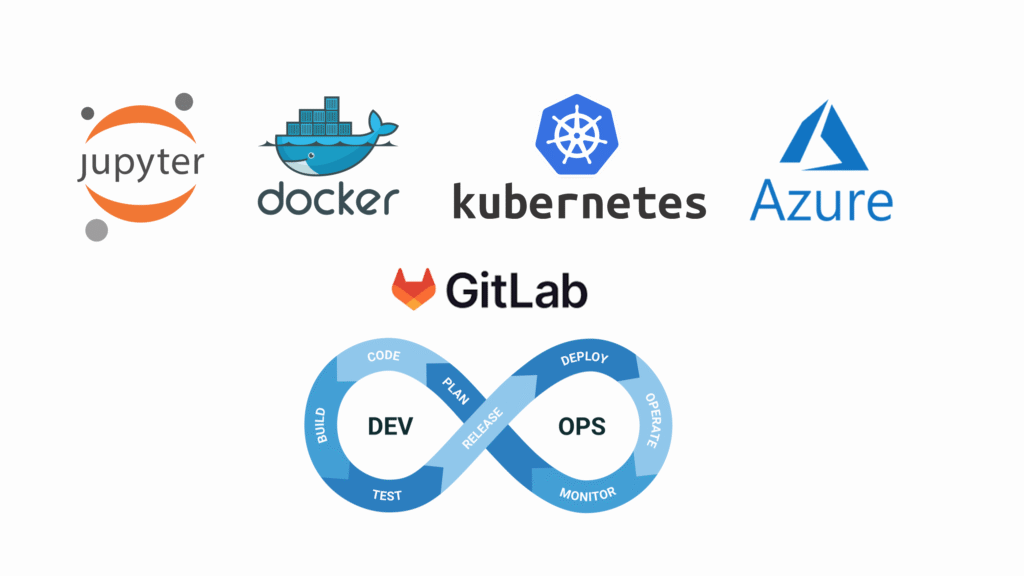
The platform is built on a sophisticated backend solution using a tech-stack based on (Docker) containers, (Kubernetes) clusters and (Azure) cloud services located on Norwegian data centers. It is secure, robust and scalable – ensuring any number of users will get proper resources allocated their way. It is infrastructure as code, and with sophisticated DevOps routines and pipelines in GitLab it’s highly flexible.
Pre-defined combined with personal adjustments
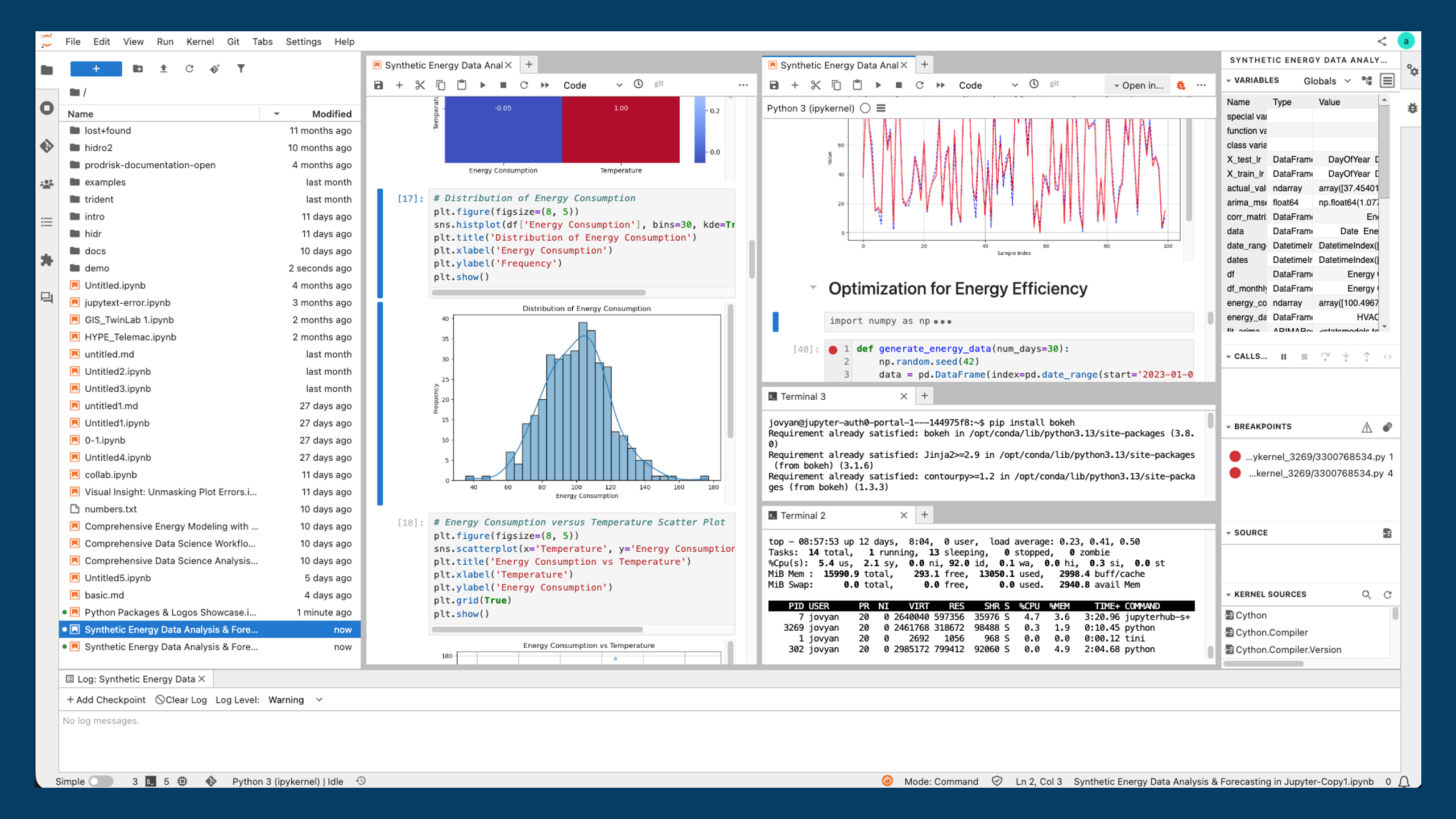
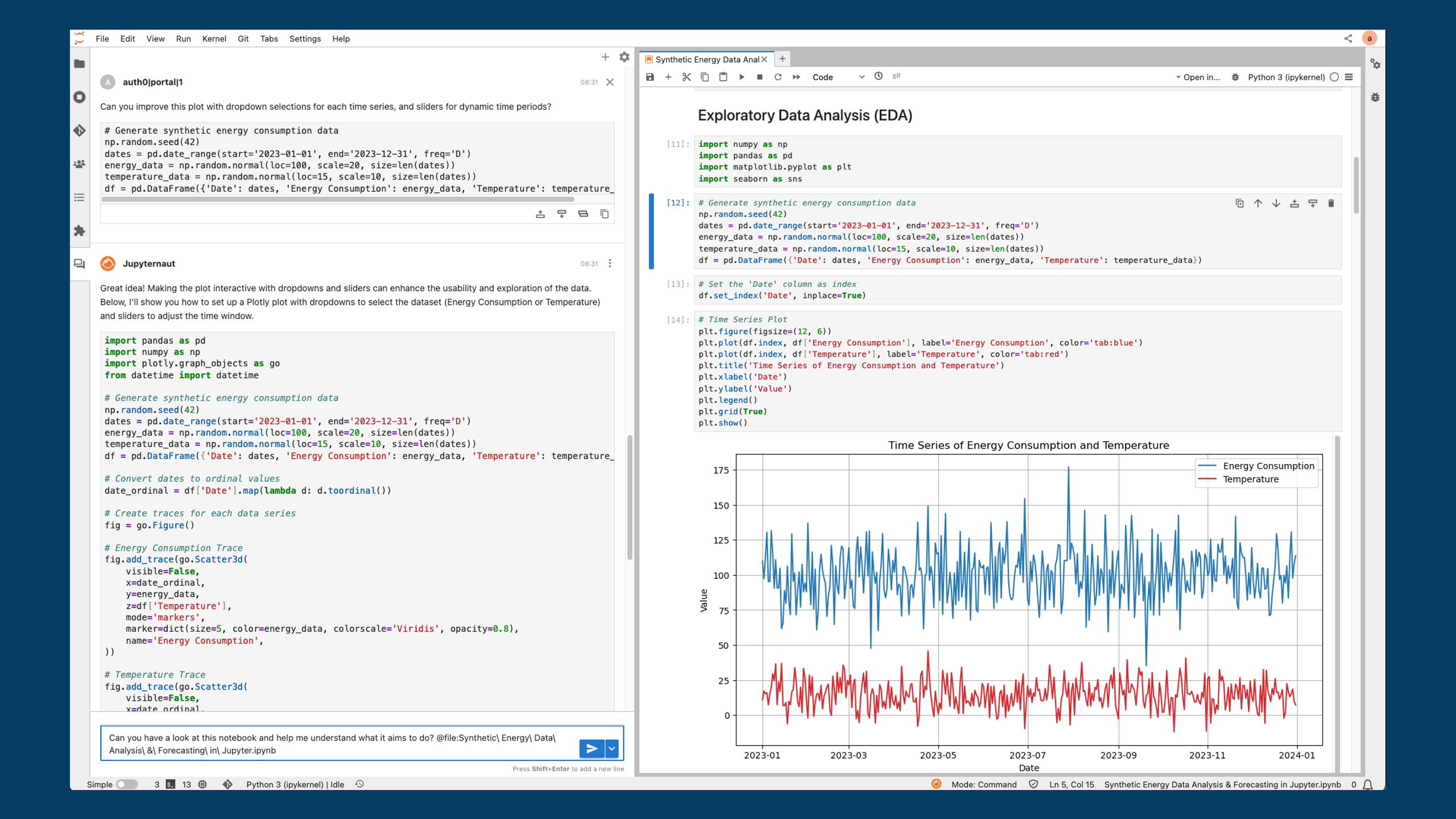
Alongside a pre-defined, pre-configured and pre-installed environment comes any files or examples that you need to get going, instantly available in your own personal storage area. Oh, did I mention you also have your own full-fledged terminal where you can almost do anything you want, say if you’re missing some tools, packages or other applications? And your experience is fully isolated, meaning that what you do doesn’t interfere with what other users do.
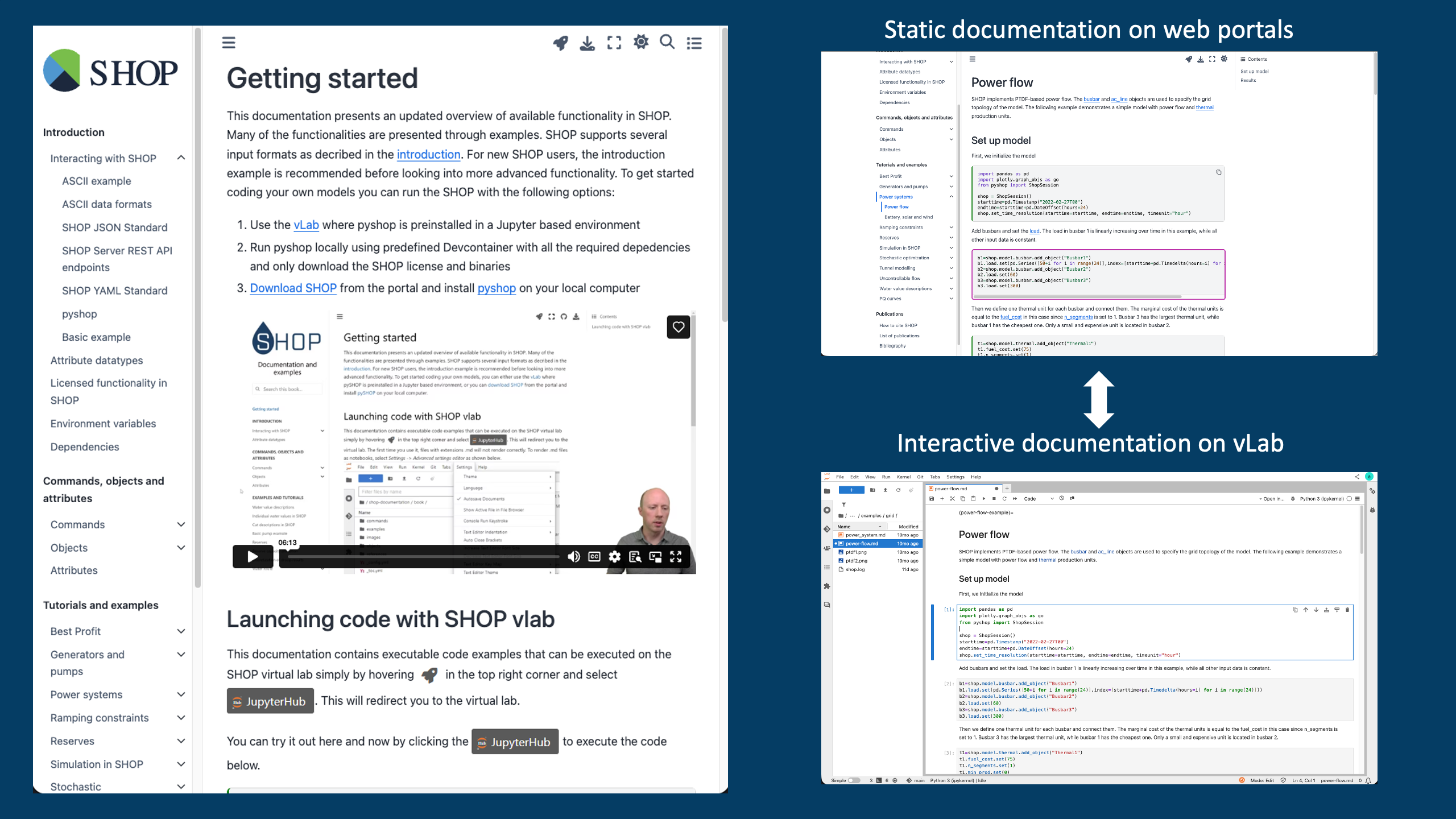
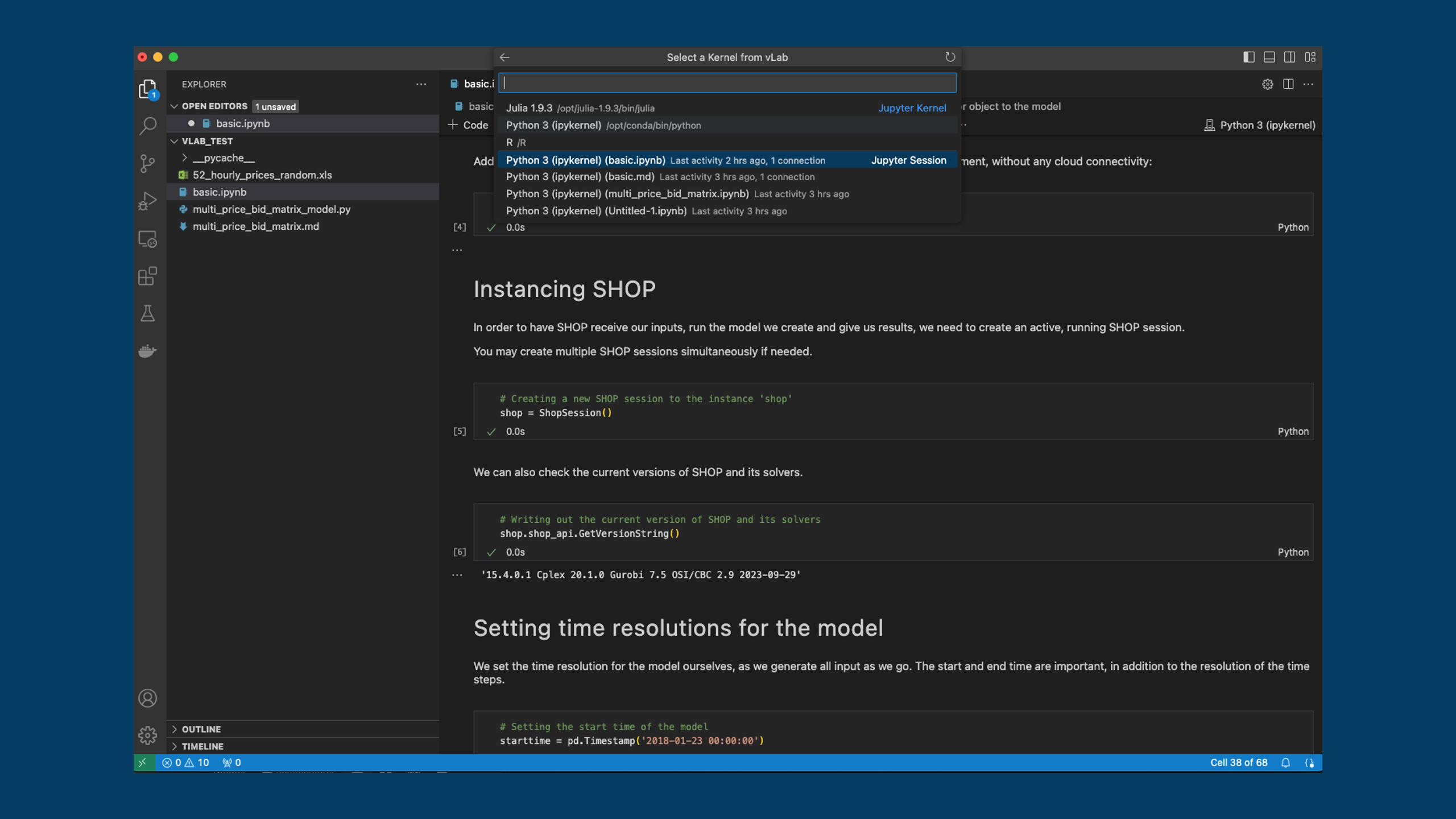
We have also integrated the vLab with web-based documentation, closing the gap between static content and interactive experimentation. And if you prefer using VS Code as your IDE, you can connect directly to the vLab and get the best of both worlds!
Real-time collaboration, version control and artificial assistance
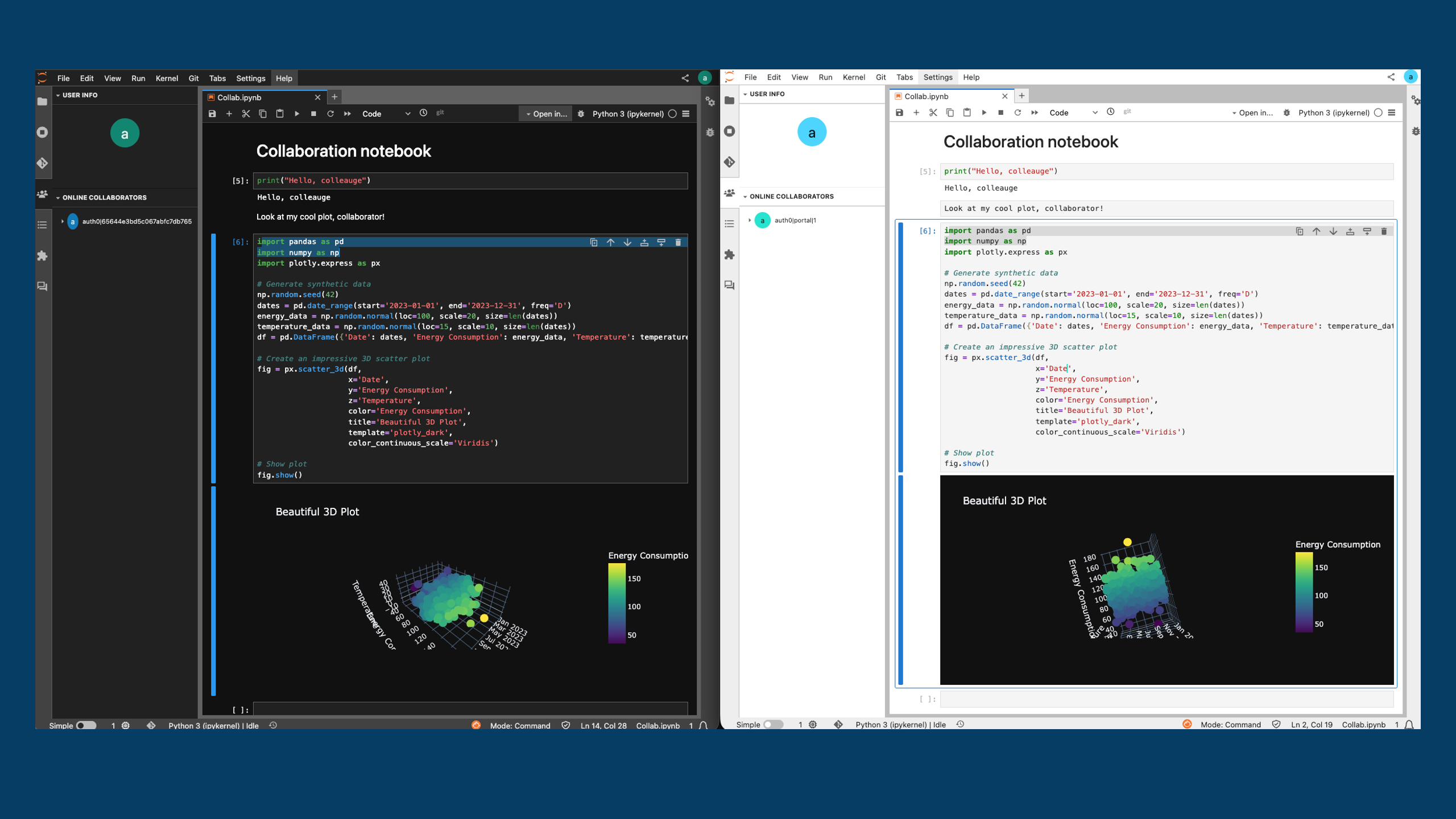
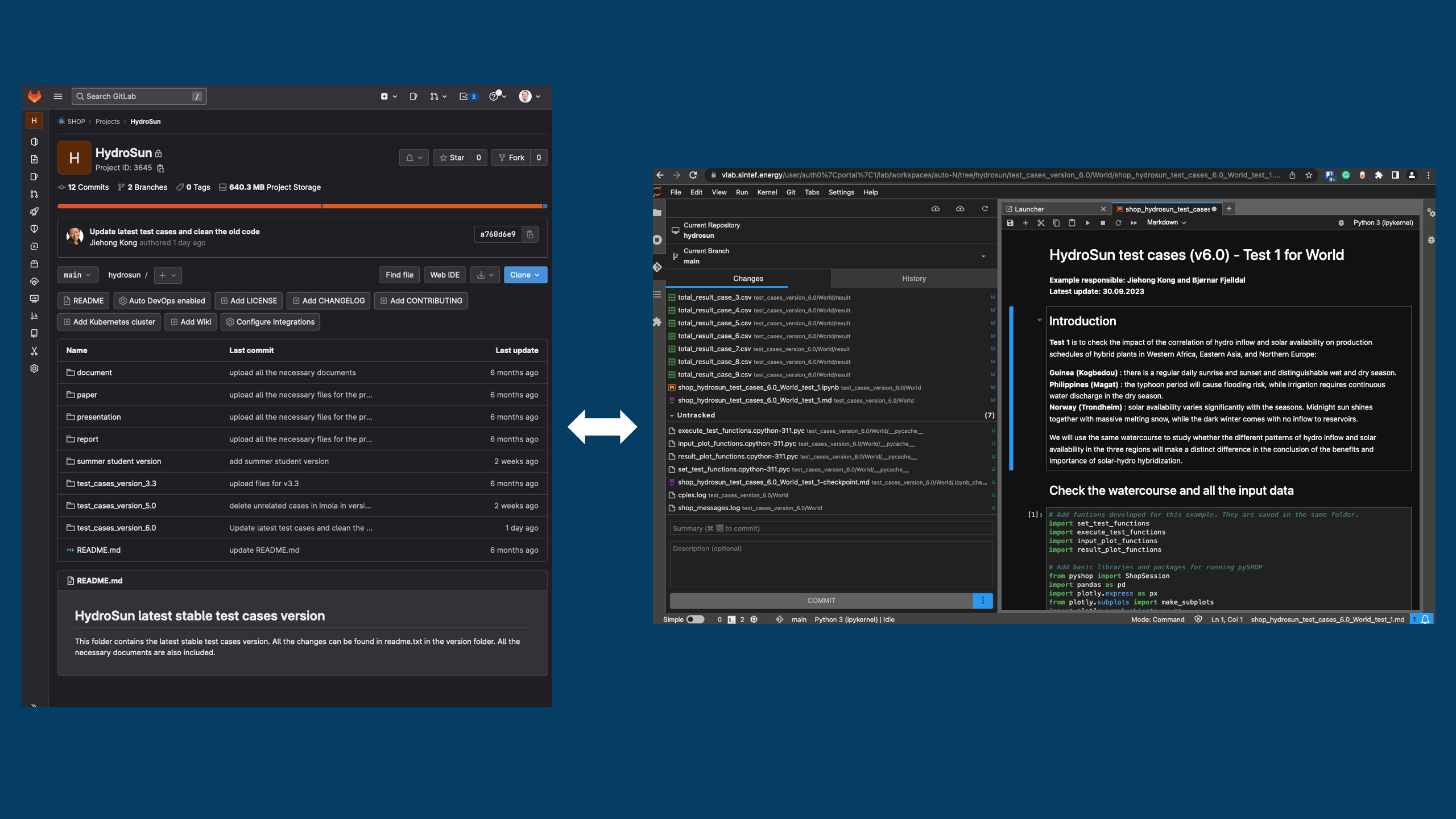
The vLab supports real-time collaboration in code the same way as you are used to in traditional office applications. It fully supports version control using git both in the GUI and by CLI so you can push, pull and commit your code to GitLab or other repositories making sure your code is never lost.
Should you require any AI assistance along the way, the vLab is ready to communicate with both public and private tenants. No copy-pasting between web browsers or applications, the interaction with your virtual counterpart happens inside the vLab itself, and it can even be trained on your own files if you allow it to.
Educating, onboarding, and engaging the industry — with a marketing edge
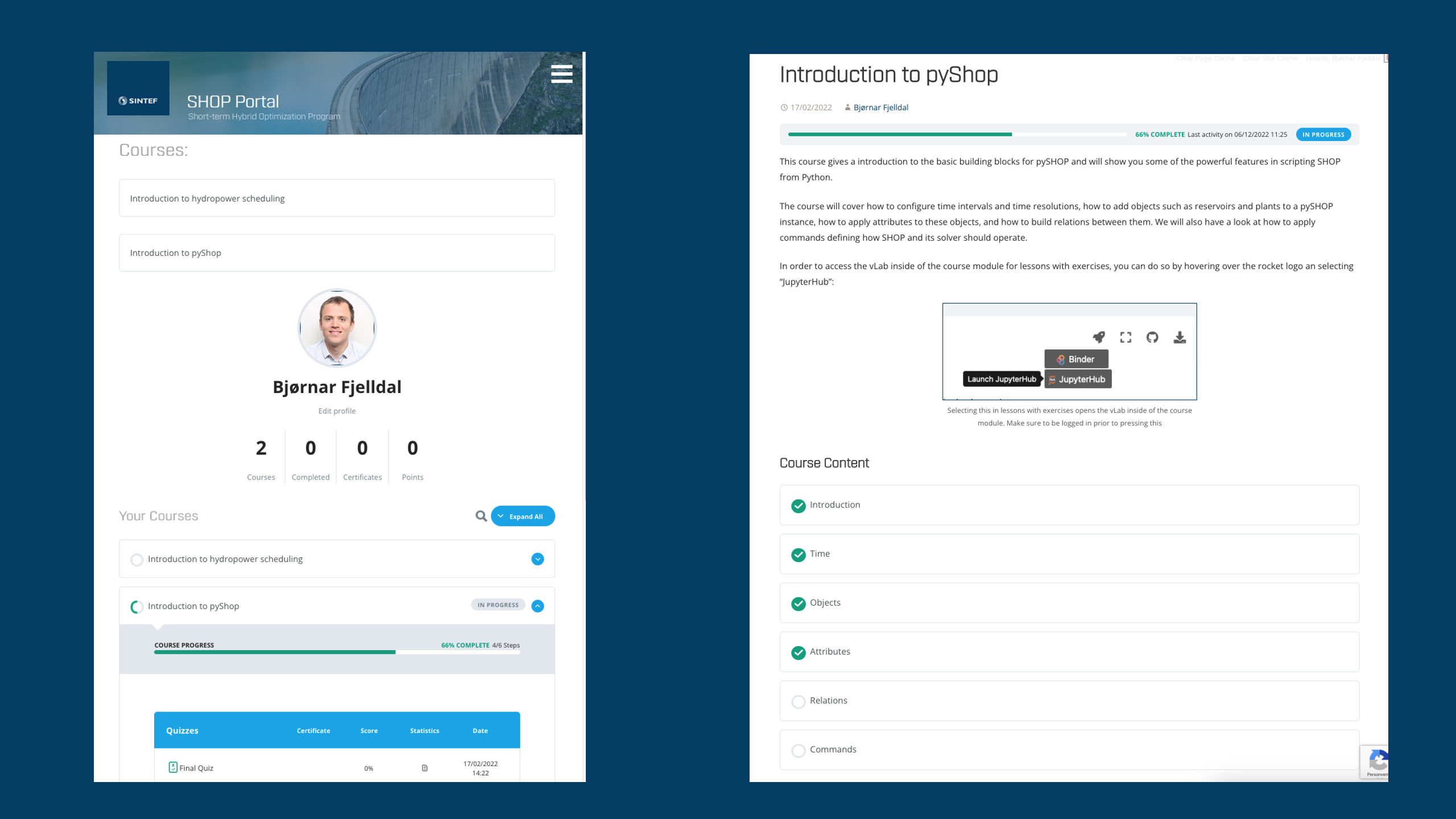
Today, students who collaborate with us as a part of their academic journey are daily driving the vLab. We also use the vLab internally for training and for onboarding of new talent, for serving interactive courses on how to use our software, and we have been successfully leveraging it when hosting physical workshops in EU-, IPN- and KPN-projects. It is also a powerful marketing tool that is used in sales processes making it super-easy for potential new customers and partners to get hands on with our solutions and research.

Successful workshop on simplifying and accelerating pre-qualification of frequency reserves for power grid stability
The Freki project, which aims at developing tools for easier prequalification of frequency containment reserves (FCR), recently used the vLab as a part of a larger workshop. Here the participants got to try code for identifying models of power plants. Moreover, the code let them interactively use the identified models to find governor parameters ensuring that the plant qualifies for delivering FCR.
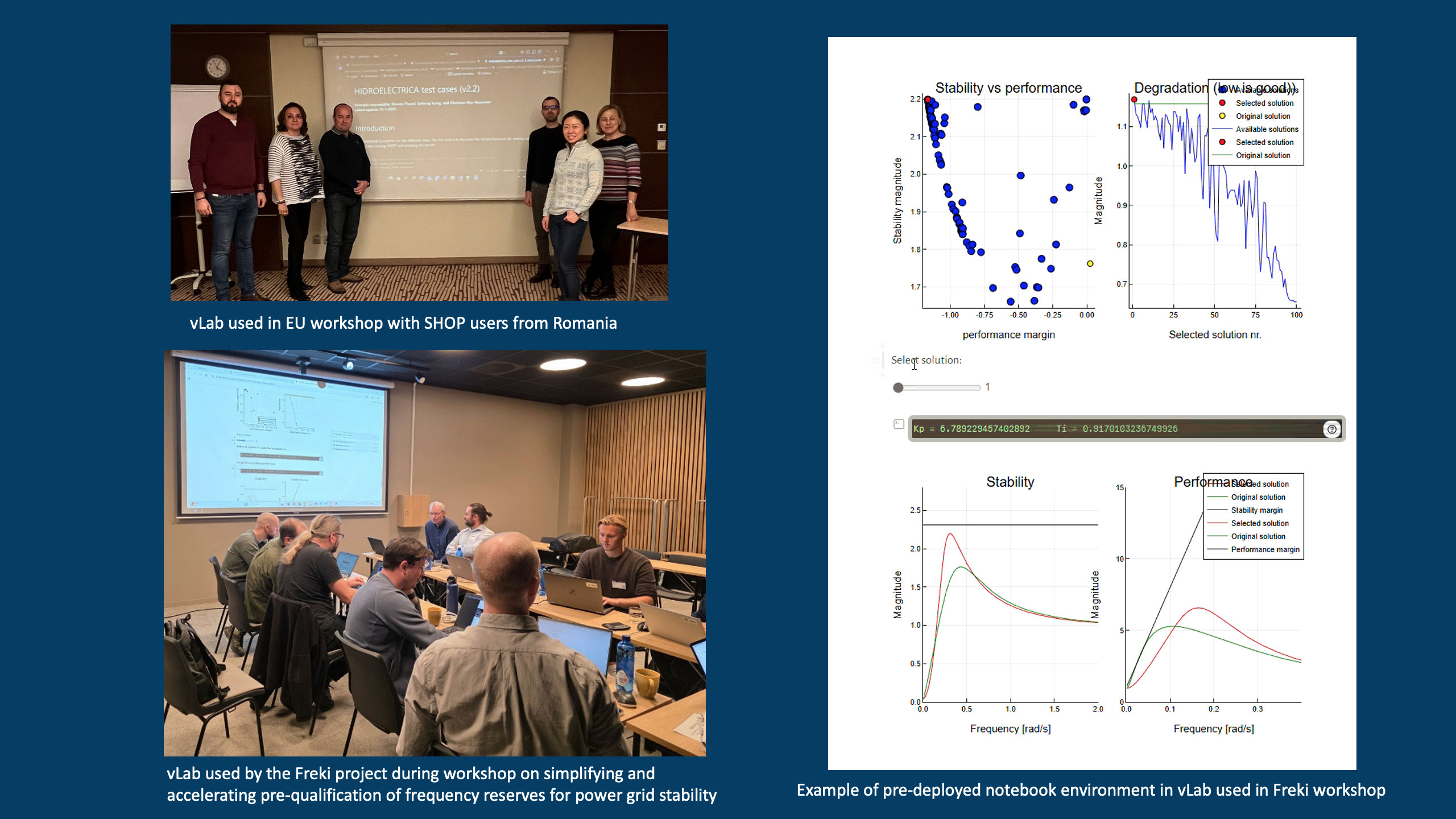
The code was developed using the Julia programming, which most of the participants were not familiar with. Additionally, the code depended on several packages, which would take a significant time to install and precompile.
With the vLab all dependencies were readily installed and precompiled. This let the participants test the code immediately without any prior knowledge of Julia. Consequently, time otherwise spent on installing Julia and dependencies on several different PCs could be spent on testing the code and discussing how to improve it to benefit the partners the most.
Is it for me, and if so, where is it?
The vLab is for anyone in SINTEF who wants to easily share their work in code with others in an interactive and collaborative way. It being applications, models, analysis, scripts and more. It removes the barrier of entry, so that you can spend time on what matters to you and your colleagues.
You can easily register for an account at https://vlab.sintef.energy and gain access to its content based on your affiliation. Our authentication system also grants access to other tools and services in our digital suite of solutions such as web portals for different models, AI assistants and more, should you require those. But more on that on a later blog.
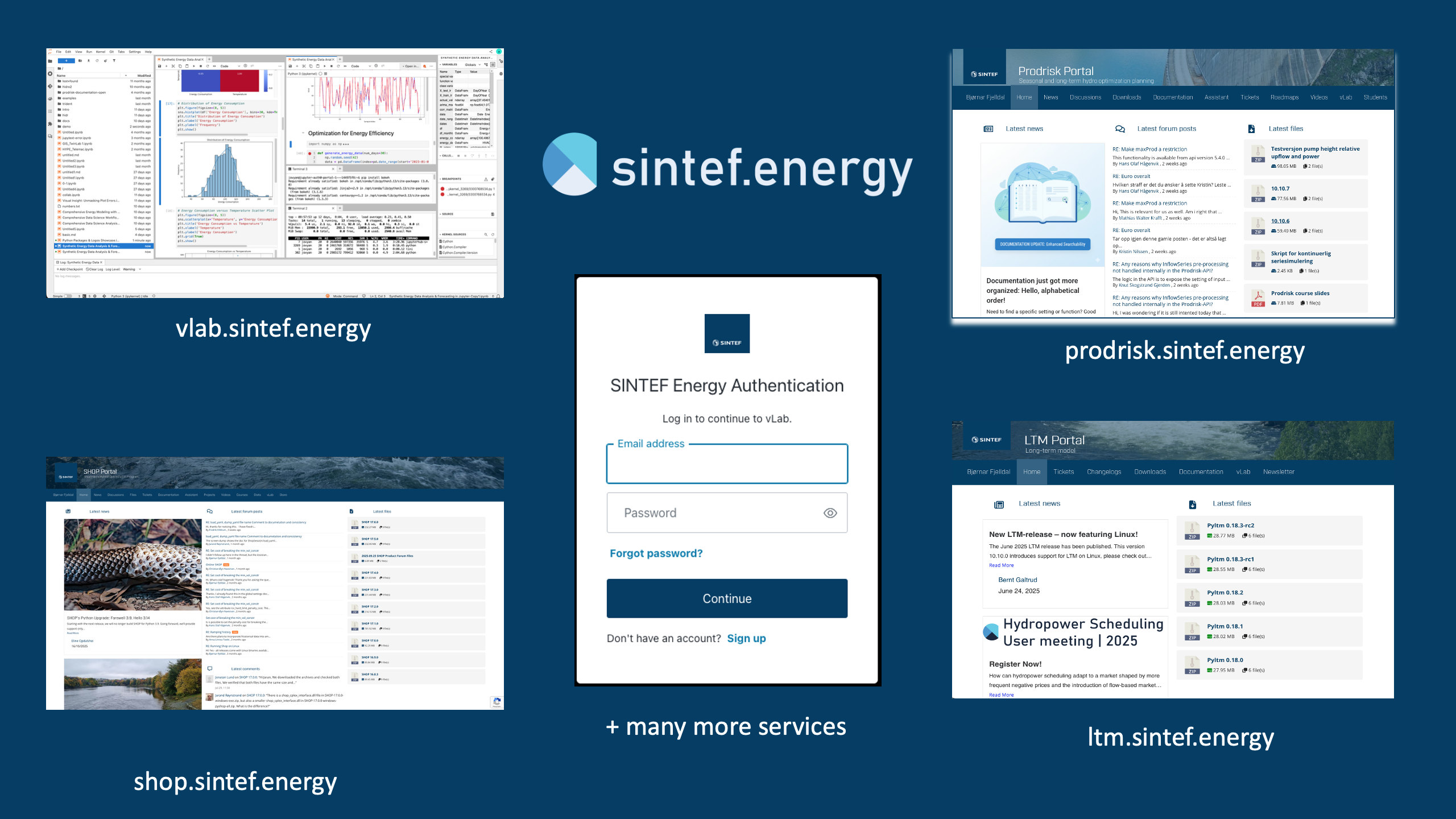
If you want to deploy your own project, model or analysis as a pre-defined digital receipe with your required configuration and environment on the vLab, we can help you reach that goal.








Comments
No comments yet. Be the first to comment!