

Skip to content

SINTEF Blog Gå til forsiden

  • Energy
  • Ocean
  • Digital
  • Health
  • Industry
  • Climate and environment
  • Building
  • Society
  • EN
  • NO
Energy

Understanding the forces at play when boiling CO2 drives a running pipeline fracture

authors
Eskil Aursand
Morten Hammer
Researcher
Stephane Dumoulin
Håkon Ottar Nordhagen
Svend Tollak Munkejord
Chief Scientist
Published: 14. Jun 2016 | Last edited: 16. Apr 2025
2 min. reading
Comments (1)

In the unlikely event of a rupture in a CO2-transport pipeline, the CO2 will exert more forces on the pipe than what would have been the case for natural gas. This is due to the thermodynamic properties of CO2 and implies that the prevention of long running fractures in CO2 pipelines is more challenging than for natural-gas pipelines. In order to construct CO2 Capture and Storage (CCS) systems that are as safe and as economical as possible, it is important to be aware of and to understand this fact. The study having led to this insight is about to be published in Engineering Structures.

(The article may also be read in the form of a preprint.)

First validation against CO2 experiments

The work has spanned several years and has involved the coupling of models describing thermodynamics, fluid flow and structural dynamics with fracture propagation. In 2012, SINTEF performed (in the CO2PIPETRANS project) two of the first crack-arrest experiments with dense phase CO2 in the world. Results from these experiments served as validation of the coupled fluid–structure model.  Our aim is that the model may form the basis for developing engineering methods that safely be used to dimension and operate CO2-transport pipelines and avoid long running-ductile fractures.

Our previous blog gives some more background for the work, which has been conducted in the BIGCCS Centre for environment-friendly energy research. The work has been funded by the Research Council of Norway, and the industrial partners Engie, Gassco, Shell, Statoil and TOTAL.
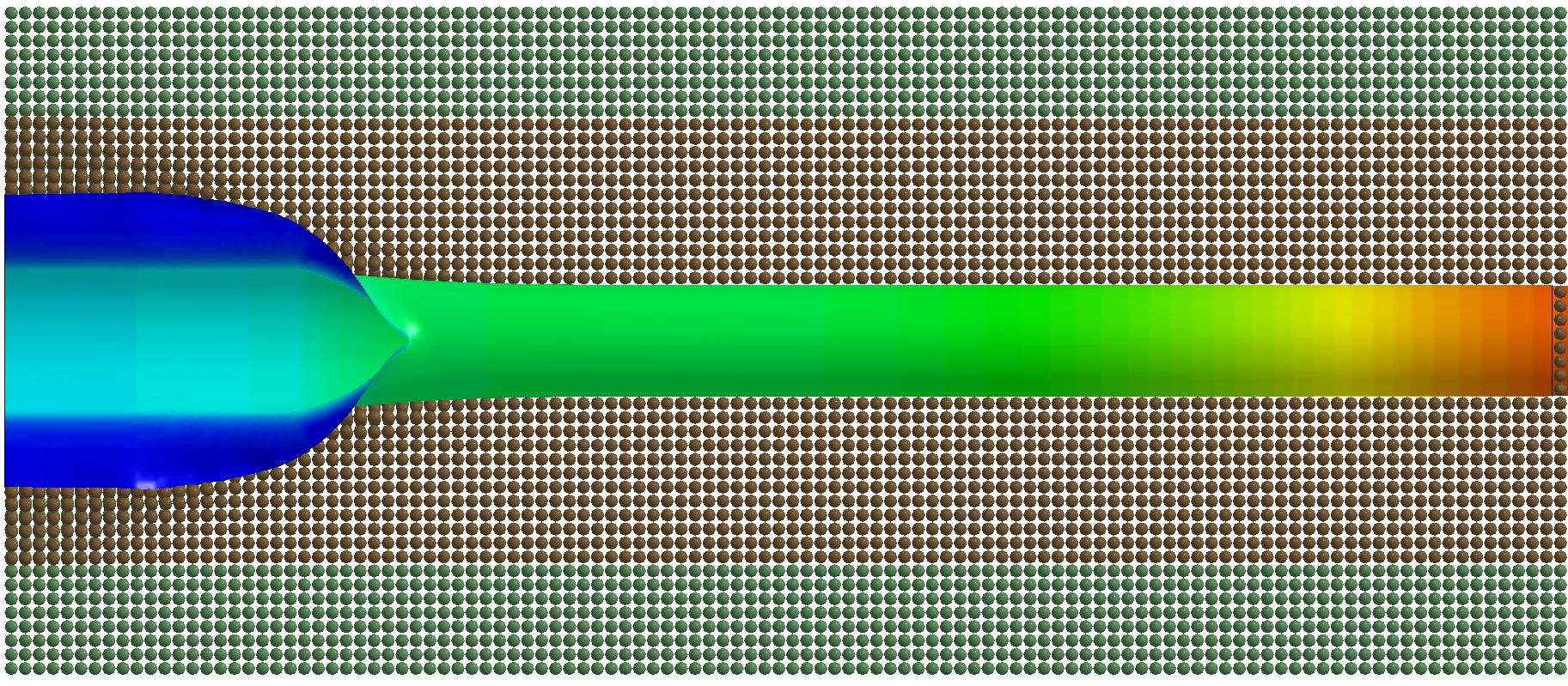
Video: Simulation of a running-ductile fracture in a CO2 pipeline.


Illustration of the pressure exerted by CO2 on a pipeline during a running fracture. Red is high pressure and blue is low. As the pipe ruptures, the pressure drops, but the pressure on the pipe flanks is still relatively high.

Related blogs

  • CO2 transport – safety and efficiency requires quantification
  • Gas or liquid: new CO2 mixture property knowledge needed for efficient and robust CCS
  • Flow of CO2 in pipes
  • Why models are important for safe and efficient CO2 transport

Comments

No comments yet. Be the first to comment!

Leave a comment Cancel reply

Your email address will not be published. Required fields are marked *

More about Energy

Strømnett og en by i bakgurnnen

How do we plan and operate for security of electricity supply?

Susanne Sandell
Susanne Sandell
Researcher

Optimising exhaust stacks on offshore rigs using CFD

Lucia Sileo
Lucia Sileo
Research Scientist
Collage of six innovation steps.

The path to innovation: Technology development stages in wave energy

José Miguel dos Santos Sousa Rodrigues
Senior Research Scientist

Technology for a better society

  • About this blog
  • How to write a science blog
  • Topics and collections
  • Sign up for our newsletter
  • News from NTNU and SINTEF
  • Facebook
Gå til SINTEF.no
SINTEF logo
© 2025 SINTEF Foundation
Privacy Editorial Press contacts Website by Headspin