CO2 is far from being the only emission contributing to climate change. Short-lived climate forcers (SLCFs) are a group of gases, tiny solid particles, and liquid droplets that affect the climate when they are emitted into or formed in the atmosphere. These emissions can be caused by natural occurrences, like volcanoes and forest fires, but also by human activity. One of the greatest contributors of SLCFs from humans are thermochemical conversion processes, namely the combustion of fossil fuels and renewable biomass to produce heat and electricity.
I have gathered and answered some of the most important questions regarding SLCFs to explain what they are, how they are formed, and why they are so important in the mitigation of climate change.
Overview
- What are SLCFs and how do they compare to CO 2 ?
- What are the effects of SLCFs?
- Where do SLCFs come from?
- How can we understand SLCFs better?
- Do SLCFs also occur naturally?
- How important are SLCFs today for global warming?
- How can SLCFs emissions be avoided?
- What is needed to achieve SLCF emission reduction?
What are SLCFs and how do they compare to CO2?
SLCFs include the greenhouse gases CH4 (methane), O3 (ozone, the tropospheric part), HFCs (hydrofluorocarbons), HCFCs (hydrochlorofluorocarbons), and different types of aerosols (e.g. OC, condensed heavy organic species) and particles (e.g. BC, black carbon, like soot) that are insolation influencing aerosols and particles, through reflecting, scattering or absorbing incoming solar radiation.
In addition to these direct climate impacting emissions, SLCFs also include several gas species that are indirect climate impacting emissions, as they themselves do not affect the climate, but they contribute to the formation of aerosols and gases that do. These mainly include NO2 (forming nitrate, NO3–), SO2 (forming sulphate, SO42-), and NH3 (forming ammonium, NH4+), or contributing to forming O3 through photochemical oxidation of VOCs (volatile organic compounds) and CO (carbon monoxide) in the presence of NOx (nitrogen oxides) and sunlight.
The reason we refer to SLCFs as ‘short-lived’ is that their lifetime ranges from minutes to decades, compared to CO2 which persists for centuries. And while we all know that CO2 emissions from the use of fossil fuels leads to global warming, the role and the importance of SLCFs are much less known. However, SLCFs are being researched extensively, and their effect is far from miniscule despite their shorter lifetime.
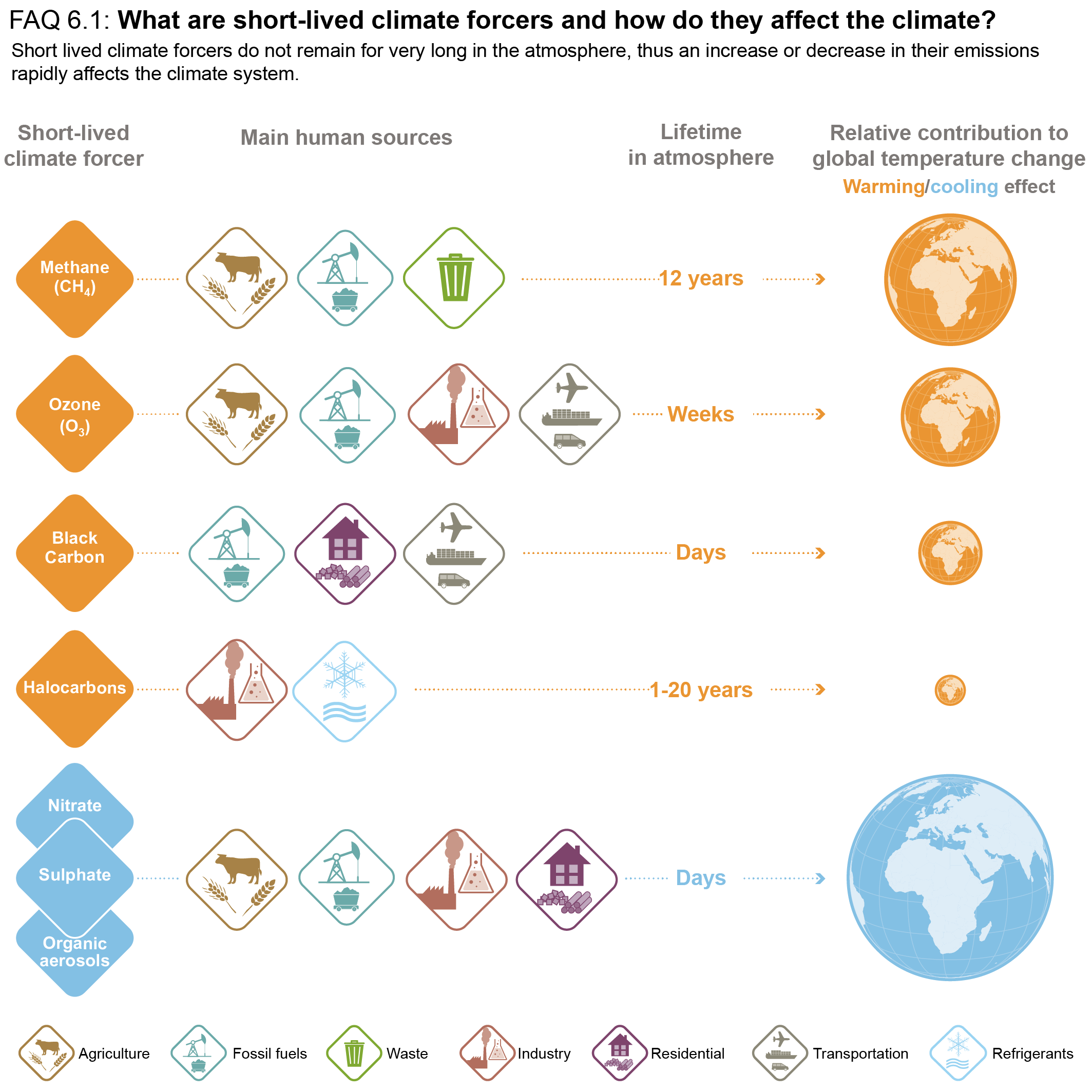
The figure below shows an illustration of the relative contribution of the main human sources of the different SLCFs to global temperature change.
What are the effects of SLCFs?
Some of the SLCFs contribute to global cooling in the form of aerosols and particles in the atmosphere as they are hindering (reflecting, scattering, absorbing) solar radiation (i.e. the insolation) on the surface of the Earth. SLCFs emissions also impact people’s health, contributing to millions of premature deaths worldwide and hundreds of thousands in Europe each year (WHO, EEA).
Black carbon (mainly as soot) is a special particulate emission, as it also contributes to global warming through its highly absorptive properties leading to melting of ice, which can happen far away from the emission source as these particles can be transported long distances in the atmosphere, before being deposited e.g. on arctic ice.
The contribution of the individual SLCFs to climate forcing – i.e., the extent to which they drive changes in the climate system – varies, and their contributing lifetime as well. If we stopped emitting SLCFs today their effect would be fast reduced and eventually diminish. But herein lies the problem, we do need to cut these emissions, which in practise is a gradual and relatively slow process. Hence, human made SLCFs will be a major driver of climate forcing over the longer term.
Where do SLCFs come from?
This is one of the biggest and most important questions we need to answer about SLCFs.
The sources of the SLCFs emissions are incredibly many, both in numbers and technology wise, so keeping a correct emission accounting becomes very challenging. The emission level of several of these emission compounds vary greatly, depending on the operation of the technology in question and on the type of feedstock/fuel being converted by it. Hence, it becomes a very complex picture.
Still, it is very important to try to get a good global overview of the extent of these emissions to establish their current contribution to global warming and cooling, as well as the role their reduction could play in reducing the global warming. SLCFs can, for example, explain why the actual climate forcing is not mirroring climate model predictions. This might be because the models are not considering the reduced cooling effect when the aerosol emissions are reduced.
Recently a study published in Nature (see also news article in NRK) pointed out that the 75% reduction in particle emissions that has been achieved in China since 2010, is likely the main reason for global warming being higher than expected.
From a direct health perspective, it is of course very good that particle emissions are reduced. However, global warming also contributes to increased negative health effects – directly due to the increased temperature or indirectly through wetter and wilder weather conditions which can result in diverse life-threatening impacts.
How can we understand SLCFs better?
The IPCC of the UN has the goal of producing emission factor guidelines for SLCFs by 2027, aimed at providing the needed emission factors to create a good global SLCFs emissions overview, through the 2027 IPCC Methodology Report on Inventories for Short-lived Climate Forcers. I have a role in this report as a contributor to the part on energy, more specifically the stationary combustion part and the small-scale part of this.
This also happens to be a very challenging part, due to the large heterogeneity involved, regarding technologies, their operation, and the different fuels used and their quality. As a result, a large variation in emission factors can be found in the literature for some SLCFs, while for others very limited data exist. In the latter case the uncertainty may become very high, and a natural recommendation then is to focus on establishing more data before providing specific emission factor recommendations.
The report and its recommendations are to be used by authorities when carrying out their national emission accounting in connection with their annual national emission inventories. As such it is important that the recommendations are feasible to implement in the emission accounting for all countries, without being too simplified and hence resulting in too inaccurate emission accounting.
With this in view, emission factors (mass per unit fuel used) can be provided at different detail levels, i.e. as TIER (level) 1, 2, and 3 emission factors. TIER1 is the simplest approach, considering technologies and fuels on a highly aggregated level. TIER2 emission factors includes technology and fuels differentiation and TIER3 can include further specifics giving more accurate emission accounting. The emission factors, when combined with knowledge about the feedstock/fuel usage (mass or volume) will then provide the needed absolute emissions.
The work with collecting and synthesising emission factors are ongoing, and the whole process and the final report in 2027 will include rigorous analyses and reviews, aiming at the best possible final result.
Do SLCFs also occur naturally?
H2O is in fact a very important natural SLCF. Rainclouds with water droplets formed by condensation of water vapor on particle nuclei serve the same function as aerosols, i.e. hindering the insolation. H2O in gas form absorbs infrared heat radiation, as does CO2. However, H2O is not considered as a human made SLCF, or the contribution of human made H2O, e.g. from the combustion of fossil fuels, is very minor compared to the natural H2O cycle.
An exception is high-altitude (stratospheric) H2O emissions (as water vapour, and possibly forming ice crystals) from aviation, above cloud formation altitudes, contributing to global warming. However, a higher temperature in general means more water evaporation and precipitation, but also a higher water vapor holding capacity and hence H2O concentration in the atmosphere and is a factor that influences the H2O – liquid, vapor and solid form – equilibrium between land, sea, and atmosphere and which needs to be considered in overall climate impact assessments.
Of course, as for H2O there are also natural emissions of other SLCFs, e.g. from volcanos during eruption or from forest fires. While human activity hardly influences volcanic activity, this is not the case for forest fires, where the global warming leads to more forest fires. Another natural emission source is CH4 emissions from soil, which increases with increasing microbial activity due to the increasing soil temperature, e.g. in the arctic tundra.
As a side note, large amounts of dust (small mineral particles) being thrown into the atmosphere (i.e. a SLCF) due to an apocalyptic event such as a large meteorite hitting Earth’s surface, is the believed indirect reason for the extermination of the bulk of the land-based dinosaurs, due to heavily impacting atmospheric conditions, tropospheric temperature and biomass production (the photosynthesis).
Natural systems are otherwise emitting small particles, as sea spray (with sea salt and organic matter) and dusts, into the atmosphere at a steady rate, both then acting as SLCFs, but also being crucial for the formation of rainclouds. Without a particle nucleus, water vapor cannot normally start condensing in the atmosphere, and hence rainclouds cannot be formed.
Hence, human activity also influences on natural sources of SLCFs emissions. For correct global warming predictions and knowledge about the effect of reducing anthropogenic SLCFs emissions, it is therefore crucial that all influencing factors of significance are considered in global warming modelling approaches.
How important are SLCFs today for global warming?
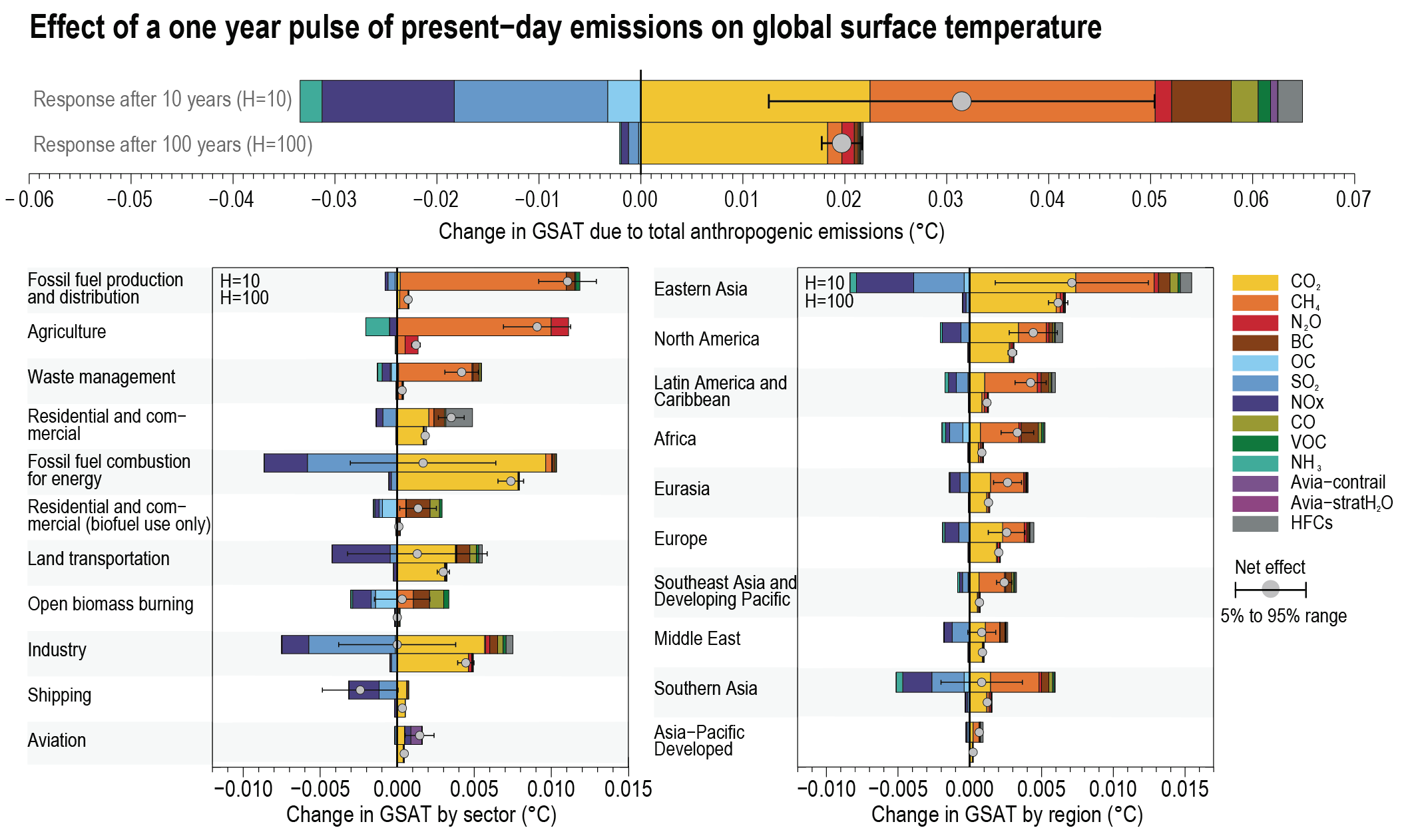
Well, nobody knows for sure, but the following figure is quite descriptive, showing the very significant climate forcing contribution (heating or cooling) of some of the SLCFs in the shorter time perspective. Of course, if we do not significantly reduce these emissions, they will continue to be very important also in a longer time perspective.
How can SLCFs emissions be avoided?
Avoiding SLCFs emissions is all about preventing and controlling the emissions. For stationary combustion applications this is done by implementing modern combustion technologies/appliances, operating them correctly and applying secondary emission reduction measures where needed and feasible.
Some of the SLCFs are hard to abate in smaller scale combustion appliances, e.g. SOx and NOx emissions as their reduction by primary measures (in the conversion technology) are limited and secondary measures (flue gas cleaning) becomes too expensive. Some emissions are also extra sensitive to how the combustion chamber is designed and the combustion process is controlled, which can lead to high emissions even in modern combustion appliances. This is, for example, the case for black carbon emissions from wood-log fired stoves.
What is needed to achieve SLCF emission reduction?
Much is in place already today regarding effective technology measures to reduce SLCFs emissions, and the implementation of modern and effective technologies, replacing the old and polluting ones, is key. However, there is still a need to focus on further emission reduction in these, but also in relatively new thermochemical conversion processes such as with combined production of material and energy products (e.g. biochar/biocarbon) production plants, and in general in the small-scale area where applying secondary measures is not feasible or economic.
While emissions of SLCFs influence us all, many of us can also contribute to their reduction, through ensuring that we operate combustion appliances properly, and through implementing new and improved technology, e.g. modern and clean burning wood stoves.
Then it is research, development and implementation that is needed to innovate new or improve current technologies, as well as a large-scale deployment of these. Hence, there is a need to continue the very comprehensive and good work that has been carried out by academia, research institutes and industries in this area the last decades.





Comments
No comments yet. Be the first to comment!