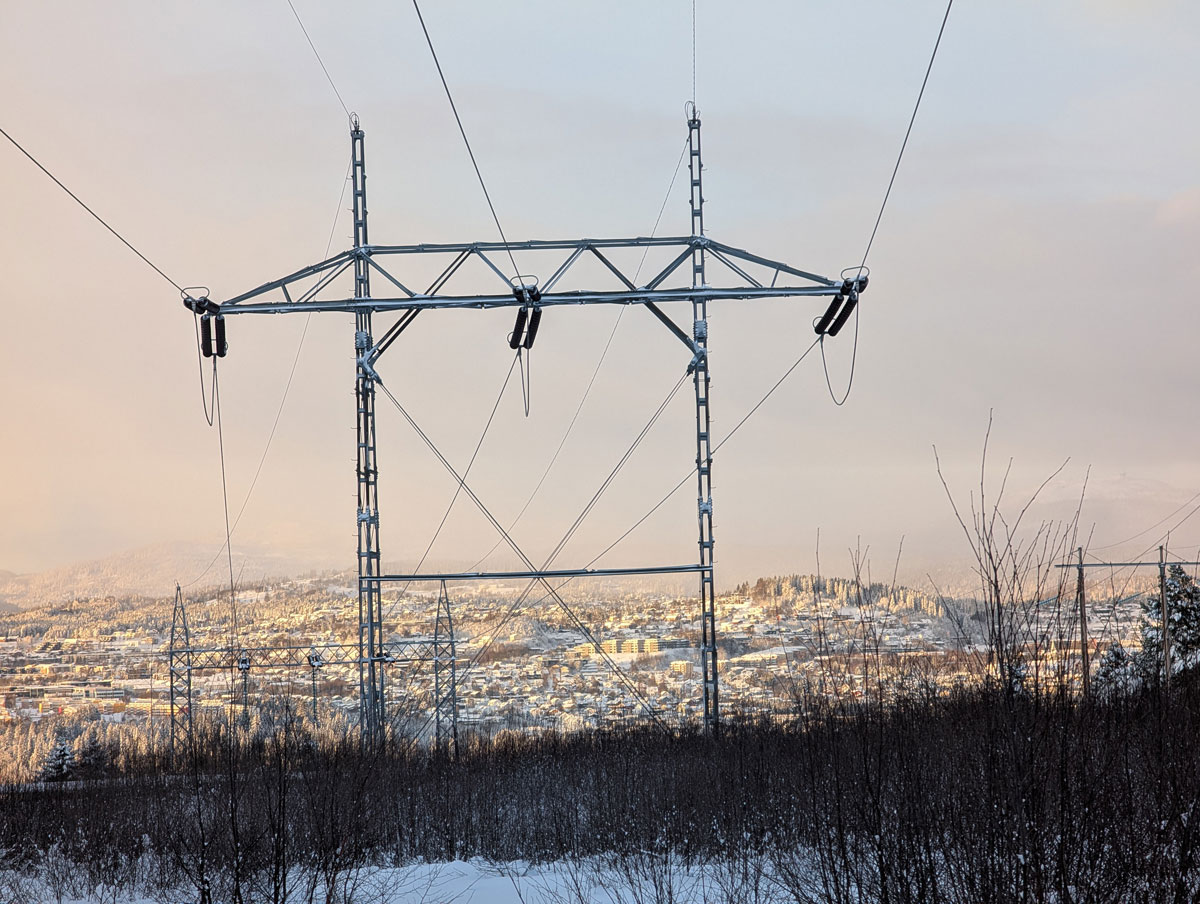

To meet these challenges, grid companies will need to evolve the ways in which they plan and operate the grid, including how they interact with the grid customers.
This includes approaches to manage uncertainty in long-term grid planning, to make better use of existing grid capacity within defined risk limits, and to strengthen monitoring and control in both real-time operation and operational planning. Market- and contract-based flexibility arrangements must be developed further, also considering how they can be coordinated across grid levels so that local actions support system-wide security of supply. These are all areas that FME SecurEL is working on.
If you’re interested in reading more about the increasing stresses on the power system, we recommend the blog post What is security of electricity supply? as background. It explains more about why new concepts for security of electricity supply are needed.
In this blog post, we focus on how the grid companies, grid users and technology providers can use new security of supply concepts in practice: We will expand on what we’ve done so far, what we’re planning to do, and how we plan to reach the overall goals in FME SecurEL.
What are we doing in SecurEL to find solutions?
In work package 2 (Grid development and operation) we mainly focus on several different grid company work processes. This work also considers the perspectives of grid users, such as flexibility providers, aggregators and end users.
Facts
A flexibility provider is a grid customer that has the ability and willingness to modify its production or consumption patterns in order to provide a service to the power system or maintain stable grid operation.
Aggregators bundle and coordinate loads from several flexibility providers and offers it to the grid operator through a flexibility market or through an agreement as one controllable service.
The N-1 criterion means that the power system should be able to withstand failure of a system component (such as a line) without interrupting power supply to end users.
We will work in these five research areas over the eight years of SecurEL:
1. Methods and risk-based criteria for increased grid hosting capacity.
Risk-based criteria as alternatives to traditional deterministic N-1 criteria are investigated to provide opportunities for increased grid capacity. This includes modelling features such as weather dependent failure rates, line capacities and flexibility. Also, to calculate socio-economic value and risks of new operating principles.
2. Distribution system operational planning process.
An operational planning framework is designed that stays consistent with long-term planning, accounts for active measures already “reserved” in planning and integrates new monitoring and component prediction models.
3. Active coordination among operators and grid users
Operational scenarios are defined and validated that require data exchange across transmission and distribution operators (TSO, DSOs), producers, large customers, and market operators, for example coordinated reactive power and congestion management.
4. Distribution grid and technology planning process and strategies.
The planning framework developed in FME CINELDI will be extended to reflect new SoS- and operating concepts, accounting for risk in grid operation and coordinated planning across grid levels.
5. Flexibility market designs and value chains.
Local flexibility market design and market-power risks will be studied, agreement-based flexibility across TSO/DSO levels, and multi-market aggregation models.

What we’ve done so far
Here are some teasers from the work so far:
Risk-based criteria in practice: Illustrative examples were built, using a regional grid model to compare N-1 and risk-based criteria including implications for energy not supplied and dynamic line rating (DLR). The first use case tested was hosting capacity assessments, with other work processes to follow.
Sector coupling for grid hosting capacity: In collaboration with Hamburg University of Technology, we completed a case study showing how heat-sector flexibility (e.g., heat pumps) combined with risk-based planning can increase hosting capacity while safeguarding reliability of supply.
First steps towards closing the loop between planning and operation: We conducted literature studies and dialogues with grid companies to frame representative cases that reveal how planning decisions (e.g., reserving active measures) constrain operational options. Furthermore, an evaluation of open-source tools for joint power-flow and active-measure optimisation was kicked off.
Active coordination scenarios: The work regarding definition and identification of operational scenarios for the Norwegian context is planned, including the validation pathways (pilots and lab) for the scenarios that require data exchange between DSOs, producers and, where relevant, TSO/market actors.
Planning framework evolution: A 132/66 kV reference grid (based on a real grid) is being developed, that will be used to test the methods to be developed in this work package. Some first steps towards a risk-based grid planning framework are defined. This framework will be developed in collaboration with a knowledge-building project called DeCOOP (“Development of coupled offshore and onshore power grids”).
Flexibility markets: An equilibrium model is formulated and implemented to study market efficiency and market-power issues in local flexibility markets. Mitigation options for avoiding these market issues are tested, such as price caps and assessing impacts on grid-costs.
Aggregator modelling: An open-source aggregator model for multi-market participation (spot, FCR/FFR, tariffs; with stochastic extensions) is developed, to quantify costs and value distribution across the flexibility value chain.
What’s next
In the coming years, we will test risk-based criteria for planning and operation as alternatives to current practices, first in simple grid models and then for more complex grids. We will also study how long-term planning and short-term operation can be made more consistent by formulating representative cases that show how active measures and new technologies affect the system across time horizons.
On the operational side, we will review and synthesise knowledge on monitoring and prediction methods, evaluate open-source software for joint optimisation of power flow and active grid measures, and develop fast and flexible methods for solving the “operational planning problem”. In parallel, we will define and validate concepts for active coordination of distributed generation and flexibility resources in Norwegian grids, using dynamic operational envelopes and agreement-based flexibility across TSO/DSO levels.
Finally, we will analyse flexibility market designs and multi-market optimisation strategies for aggregators and explore how large-scale batteries and other flexibility resources can be integrated through well-designed agreements for reserve provision and congestion management.
These efforts will contribute to advance the research frontier within risk-based planning and operation of electricity grids. The results will enable SecurEL’s user partners to operate and develop their grids in a more risk-aware, data-driven and flexibility-oriented manner and to control the risk related to security of electricity supply, ensuring that the power system can support the electrification of society while maintaining security of supply.





Comments
No comments yet. Be the first to comment!