

The electricity supply in Norway has an availability (reliability of supply) of 99.98%. This means that, on average, we experience power outages of 2–3 hours per year. The basis for this figure comes from FASIT.
FASIT is a unique system that covers faults and interruptions across the entire power system, and is used by all grid companies, major power producers and end users, as well as Statnett and the Norwegian Energy Regulatory Authority (RME). Each year, more than 40,000 incidents are recorded in FASIT, ranging from minor low-voltage outages to major disturbances in the transmission grid. We are not aware of any other country that has a system of comparable scope and standardization for such data.
FASIT is based on international standards related to faults and interruptions and has been continuously developed to meet the regulations and regulatory changes that have been introduced since it was first established in 1995.
To understand the significance of FASIT, we need to go back to the beginning.
From idea to a regulation-based system
The history of FASIT begins in the late 1980s. The Energy Act of 1990 introduced new requirements for quality of supply and reporting of interruptions, creating the need for a system to support this. Researchers at EFI (the Electric Power Research Institute – from 1990 the Energy Supply Research Institute, later SINTEF Energy Research) recognized the need for a standardized system that could provide an overview of faults and interruptions across the entire power system, and that could supply input data for reliability analyses. The initiative to establish a project to develop such a system was formally taken by the Working Group on Quality of Supply.
- 1993: The project “Fault and Interruption Statistics” was established. Fifteen electric utilities participated in the development and testing of registration forms.
- 1994: Full-scale testing with 27 utilities. The name FASIT – Feil- og AvbruddsStatistikk I Totalnettet (Fault and Interruption Statistics in the Total Grid) – was proposed by Trondheim Energiverk (now Tensio). (The prize for coming up with the name was a cured ham, which was reportedly enjoyed on a cabin trip the same year.)
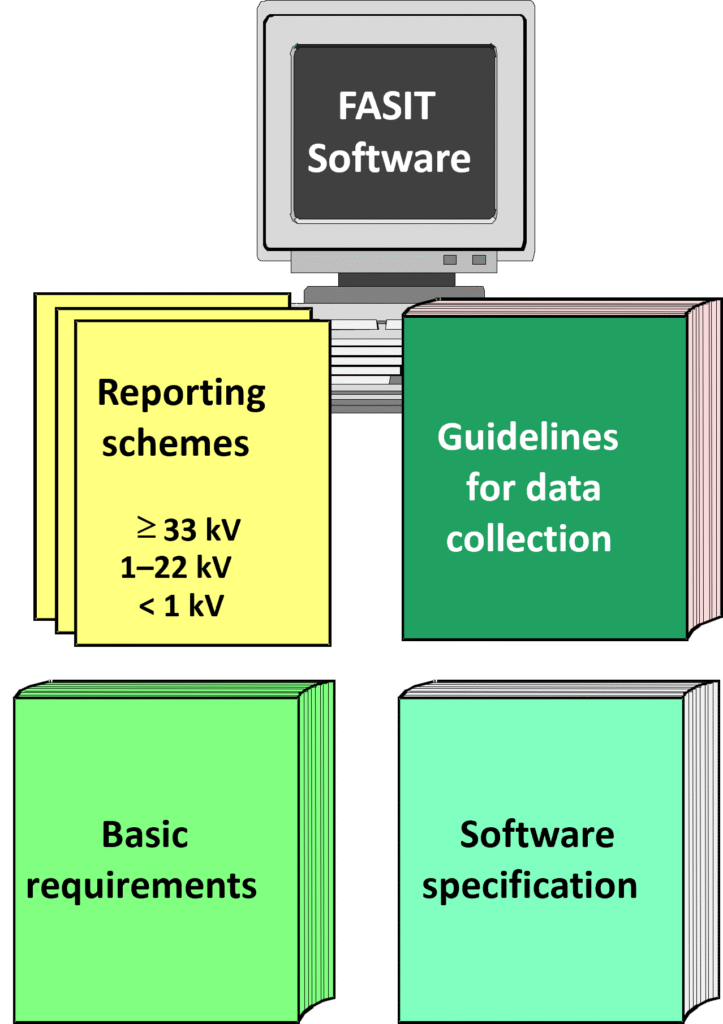
- 1995: FASIT was launched as a national system, consisting of basic requirements, forms for all voltage levels, guidelines for registration, and software specifications. This is illustrated in Figure 1.
Before the idea and initiation of the FASIT project, various systems existed for registering faults and interruptions at different voltage levels. However, these systems were not standardized, served different purposes, and produced different types of data. Those of us working with reliability of supply lacked a coordinated and standardized system. From the beginning, the goal was therefore clear: to establish a common framework for the registration, calculation, and analysis of faults and interruptions. This was quickly incorporated into regulations [1], and today all grid companies, power producers with facilities connected to the regional or transmission grid, and large end users are required to use FASIT.
Milestones and development
FASIT has been developed and is continuously improved by SINTEF Energy Research in collaboration with Renewables Norway, NVE-RME (the regulatory authority), Statnett (the system operator), and grid companies (license holders).
Over three decades, FASIT has evolved in step with developments in the power system, regulation, and technology:
- 1990s: Requirements for reporting long-duration interruptions and energy not supplied (ENS/ILE). A standard method for calculating ILE was introduced in 2000.
- 2000s: Revenue cap regulation and KILE (costs of energy not supplied) became closely linked to FASIT data, based on annual submission of FASIT reports. Statnett replaced its SDI system with FASIT.
- 2010s: Expanded definition of ILE, new cost functions for KILE, and requirements for reporting short interruptions and low-voltage interruptions.
- 2020s: The “New FASIT” with FASIThub and the PQ Portal. Automated information exchange between grid companies, continuous submission of FASIT reports, and closer integration with RME’s network portal.
This development has made FASIT more than just a registration and reporting system—it has become an information system that forms a central part of the power system’s control and management mechanisms.
FASIT today
FASIT covers all voltage levels in the power system, and includes common terminology and definitions, data structuring and classification, registration guidelines, and software requirements. Today, four vendors offer approved FASIT software for use by grid companies, all operating under license agreements with Renewables Norway. The FASIT infrastructure and target groups are shown in Figure 2:
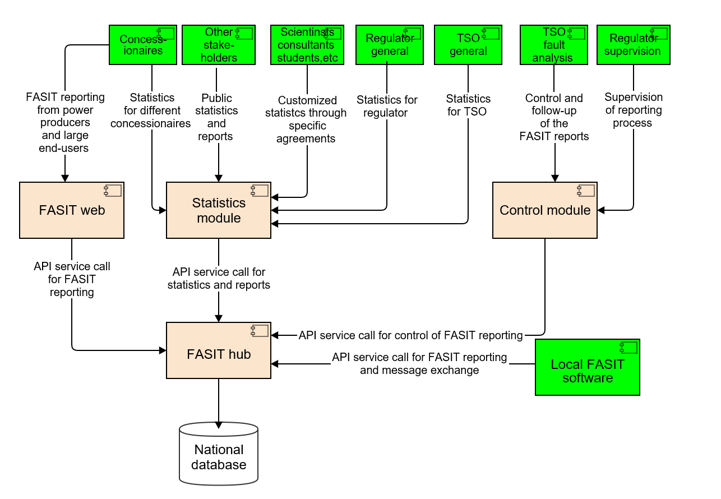
Figure 2 shows the different tools that are part of the FASIT framework (since 2019):
- Local FASIT software at grid companies (called “concessionaires” in the figure) for registration and reporting
- FASITweb for power producers and (large) end users
- FASIThub for data collection and exchange
- Kontrollweb (system operator / Statnett)
- PQ Portal, which provides insight into reliability of supply based on data registered in FASIT
- RME’s interruption statistics, based on data registered in FASIT.
The database in the PQ Portal is continuously updated as new FASIT reports are submitted. With these tools, the foundation for standardized, high-quality registration is well established. This demonstrates that FASIT not only offers a retrospective view on three decades of success but also provides a platform capable of meeting future requirements for security of electricity supply, grid operation, and grid development.
What has FASIT given us?
The purpose of FASIT is to provide information on the reliability of supply of the Norwegian power system. This includes both historical information on reliability of supply and information to estimate expected future reliability of supply. FASIT provides data on operational disturbances and planned outages, faults, causes, and consequences, and is the system used to calculate the cost of energy not supplied (KILE). Through FASIT we have gained:
- A common national statistics framework that provides regulators and the industry with an overview of reliability of supply.
- Standardized methods for calculating ENS/ILE and KILE, which are essential for the revenue cap regulation of grid companies.
- Fault statistics as input data for reliability of supply analyses and a stronger basis for decisions related to maintenance, reinvestments, and emergency preparedness.
- A unique system internationally: no other country has a system that covers the entire power system—from low voltage to transmission—for both component faults and customer interruptions, with the same degree of standardization and with mandatory reporting requirements.
Norway currently has a reliability of supply of about 99.98%. FASIT has been an important part of the foundation for this, both by providing information about faults and causes on the one hand and about KILE on the other, enabling continuous improvements to the power system.
Each year, the Norwegian Energy Regulatory Authority (RME) publishes updated statistics on interruptions caused by operational disturbances and planned outages in the Norwegian power system, based on FASIT registrations. The figures below show an overview of reliability of supply in Norway and the development of ILE and KILE over the past 10 years.
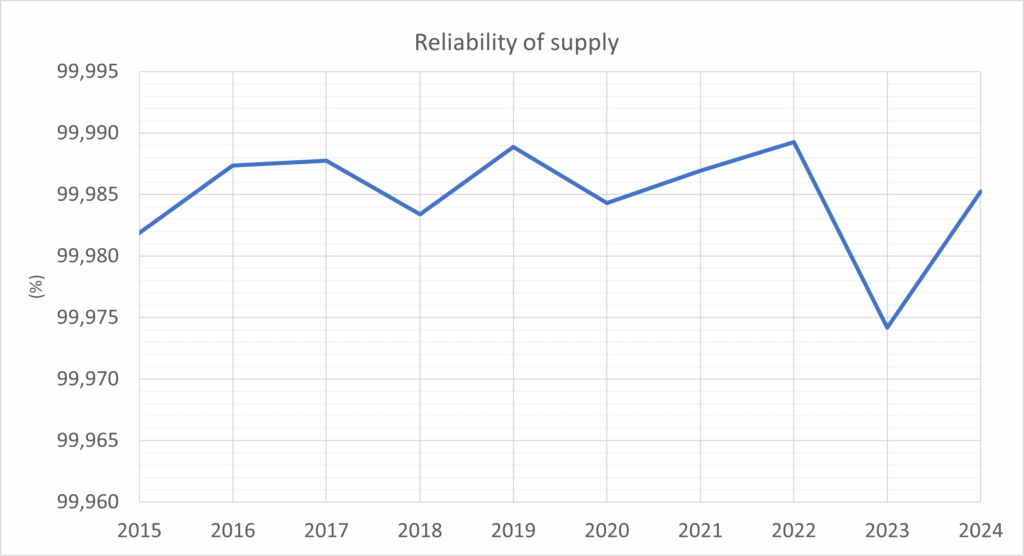
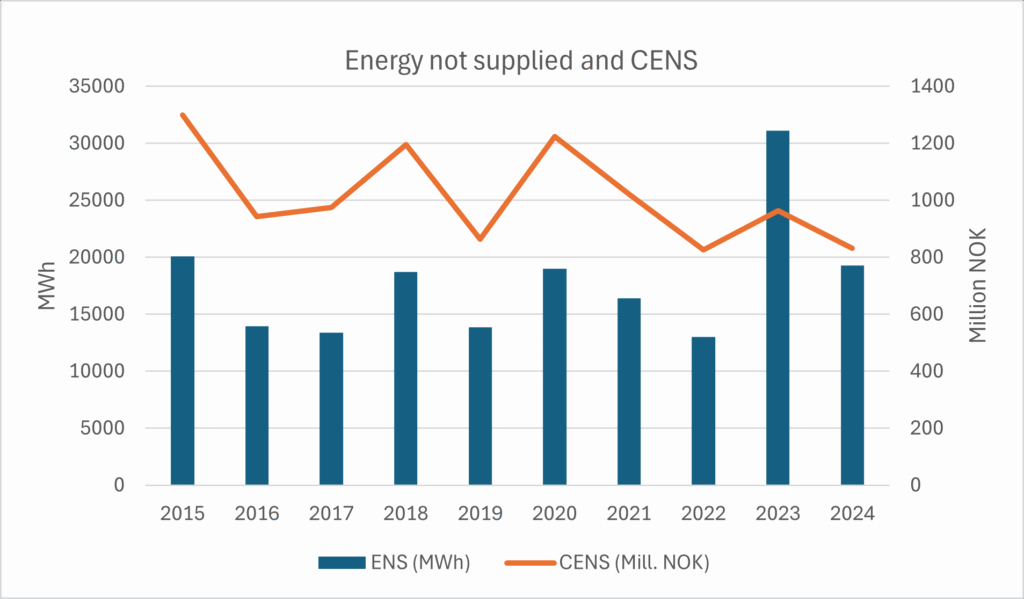
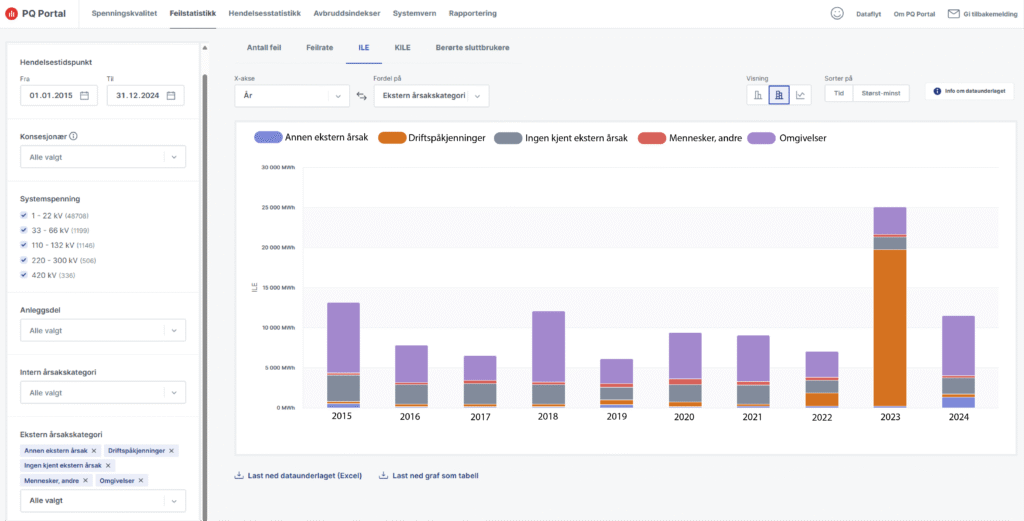
The variation in reliability of supply, ILE, and KILE from year to year is mainly due to the number and type of events, affected end users, and weather conditions. This information can be found in Statnett’s PQ Portal, based on FASIT registrations of operational disturbances, planned outages, faults, causes, and more. Figure 5 is taken from the PQ Portal and shows an example of external fault causes for ILE due to permanent faults in the period 2015–2024. The figure shows that “environmental causes” (mainly weather) accounted for the largest share of ILE, except in 2023 when operational stress was the main cause. This was a highly unusual event [2] in a local grid that spread to the regional distribution grid.
Extraordinary events and vulnerability
FASIT has also been essential in the analysis and reporting of extraordinary events. The system has documented everything from icing on power lines and transformer fires to large-scale blackouts. The data have been used in vulnerability analyses to identify weaknesses and in assessments of socioeconomic costs.

In 2025, several major events occurred in the power system, illustrating the importance of a secure electricity supply: Strong winds and falling trees caused extensive outages in the northern parts of Trøndelag in January, while the extreme weather event Amy in October led to outages in many areas of Southern Norway, with more than 150,000 end users affected in total. In both cases, the damage to the grid was severe and required significant repair work, and some customers were without electricity for as long as 4–5 days. These were serious situations for those affected and resulted in large KILE costs for the grid companies. Extreme weather typically impacts several infrastructures simultaneously, and since these are mutually dependent, the repair work becomes complex and lengthy.
In April 2025, Spain and Portugal were plunged into darkness due to a cascade of voltage increases that caused the power system to collapse into a blackout, and it took roughly 12 hours to restore supply. When an entire country loses power, society comes to a standstill. All critical infrastructures and societal functions are affected. This threatens public safety and generates enormous societal costs.
Such large and extensive events—often referred to as extraordinary—must also be recorded in FASIT. However, it can be extremely challenging to gather complete information on everything that has occurred in different parts of the grid, and it may take months to finalize this work after such an event. The most extensive event registered in FASIT is the 2011 storm Dagmar, which hit large areas of Western and Inland Norway, with about 570,000 end users and 76 grid companies affected.
Even though FASIT cannot prevent events in the power system directly, the knowledge the system provides—about causes, fault types, vulnerabilities, and consequences—can be used to stay ahead of future events by increasing the resilience of the power system, potentially preventing or limiting the extent of unwanted incidents.
New times, new requirements
The power system in 2026 is significantly more complex than it was in 1995. In addition, electrification, digitalization, climate change, and geopolitical tensions are continuously introducing new demands for both the operation and development of the power system, as well as for emergency preparedness. This also creates new needs related to the registration and reporting of fault and interruption data. There are four areas that require particular attention:
- Electrification and sector coupling create more interdependencies and new types of failure sources, such as power electronic converters, electric transport, charging infrastructure, and batteries within the grid.
- Digitalization and automation require integration with new data sources and systems, such as advanced control centre systems and state estimation tools.
- Climate change leads to more frequent and more severe events, from extreme weather to increased infrastructure vulnerability.
- New threats and vulnerabilities require the registration of new types of data and mean that emergency preparedness and security must play a larger role in the statistics.
It is important that we continue to develop FASIT to stay ahead of these developments:
- With the “New FASIT”, conditions are even better for standardized registration, more efficient data quality assurance, and automated reporting.
- The PQ Portal provides insight into power quality and reliability of supply, extending FASIT’s role from being a system for fault and interruption registration to becoming a comprehensive information platform for reliability of supply.
FASIT has, for 30 years, been a success story for the Norwegian electricity sector. It has provided knowledge, a regulatory foundation, and contributed to high reliability of supply. However, the power system of the future requires more. To meet new needs resulting from electrification and digitalization, as well as emerging threats and vulnerabilities, FASIT must continue to evolve—helping ensure that we can rely on the electricity supply as society’s backbone also in the years ahead.
Footnotes
[1] Regulation on quality of supply in the power system, §2A‑1: “Grid companies shall use software that complies with the current FASIT specification when registering and reporting data in accordance with the first and second paragraphs.”
[2] A small fault in a 22 kV cable caused damage to a 132 kV oil‑pressure cable, resulting in an explosive fire and an outage at Mo Industrial Park, with a very long interruption duration.
Recent scientific publications related to FASIT:
A. O. Eggen, J. Heggset, K. Sagen, C. Aabakken, B. T. Hjartsjø, E. A. Østingsen, S. O. Gjerstad: FASIT, the Norwegian reliability data collection system – experiences and utilitarian values, CIRED 2023, Rome, 12–15 June 2023
J. Heggset, K. Johannesen, A. O. Eggen, K. Sagen: National reporting of faults and interruptions using CIM and MADES/ECP, CIRED 2019, Madrid, 3–6 June 2019
G. Kjølle, A. O. Eggen, H. M. Vefsnmo, J. Heggset, A. Bostad, T. Trøtscher, Ø. R. Solheim: Norwegian disturbance management system and database, CIGRE Session, 2016, Paris, 21–26 August 2016
G. Kjølle, H. Vefsnmo, J. Heggset: Reliability data management by means of the standardised FASIT system for data collection and reporting, CIRED 2015, Lyon, 15–18 June 2015
G. Kjølle, R. H. Kyte, M. Tapper, K. Hänninen: Major storms – Main causes, consequences and crisis management, CIRED 2013, Stockholm, 10–13 June 2013, doi: 10.1049/cp.2013.0863
J. Heggset, G. Kjølle, K. Sagen: FASIT – a tool for collection, calculation and reporting of reliability data, CIRED 2009, Prague, 8–11 June 2009
G. Kjølle, O. Gjerde, B. T. Hjartsjø, H. Engen, L. Haarla, L. Koivisto, P. Lindblad: Protection System Faults – a Comparative Review of Fault Statistics, PMAPS 2006, Stockholm, 11–14 June 2006, doi: 10.1109/PMAPS.2006.360319







Comments
1. Could someone please check that availability percentage? You would expect something in the range of 99,9998. It can’t be this bad. And/or can you please link to the underlying method rather than the somewhat vague “based on international standards”. It could be something simply stupid (like including planned maintenance which is typically excluded). This value doesn’t make sense.
2. Related to prevention of a repeat (of incidents in certain incident categories) is of course learning from – at design time – unforseen situations. This implies a systematic RCA (root cause analysis) proces and fault determination which is normal in many industries (like the oil and gas industry not particularly alien to Norway). That procedural context doesn’t seem to be adressed here which is also strange as that would be meaningful regarding incident volume trends.
Thanks for your comments.
As you indicate, the availability given in the blog includes both planned and unplanned outages, and is also affected by the Norwegian topography and climate. The figures are based on the ratio of estimated energy not supplied to the energy actually supplied, and the same figures can also be found on RME’s website https://www.nve.no/reguleringsmyndigheten/publikasjoner-og-data/statistikk/avbrotsstatistikk/.
FASIT is primarily a tool for recording, calculating, and reporting the causes and consequences of failures and interruptions, including the results of any failure analysis, for example, documenting external and/or internal failure causes. It is not intended for performing the actual analysis itself, such as root cause analysis of a specific incident. Note also that FASIT is used for all grid disturbances and interruptions, from minor low voltage interruptions to major transmission grid incidents. It is, however, possible to use the national FASIT database as a source of statistics for analysing the probability and potential consequences of events, including extraordinary events. Causes to, and experiences from, past events can also be used in analysing possible mitigating measures.