Skip to content

SINTEF Blog Gå til forsiden

  • Energy
  • Ocean
  • Digital
  • Health
  • Industry
  • Climate and environment
  • Building
  • Society
  • EN
  • NO
Energy

Models, data and software for safe and efficient CO2 transport

BIGCCS
author
Svend Tollak Munkejord
Chief Scientist
Published: 3. Jun 2015 | Last edited: 16. Apr 2025
2 min. reading
Comments (0)

A two-day technical meeting and seminar in the BIGCCS CO2-transport programme took place 27–28 May in Trondheim. The first day was dedicated to technical presentations, emphasizing the activity in the task on CO2 mixture properties (a.k.a. the CO2Mix project), which will conclude this year. On the second day, the industry participants could try CO2-transport software on their own computers.
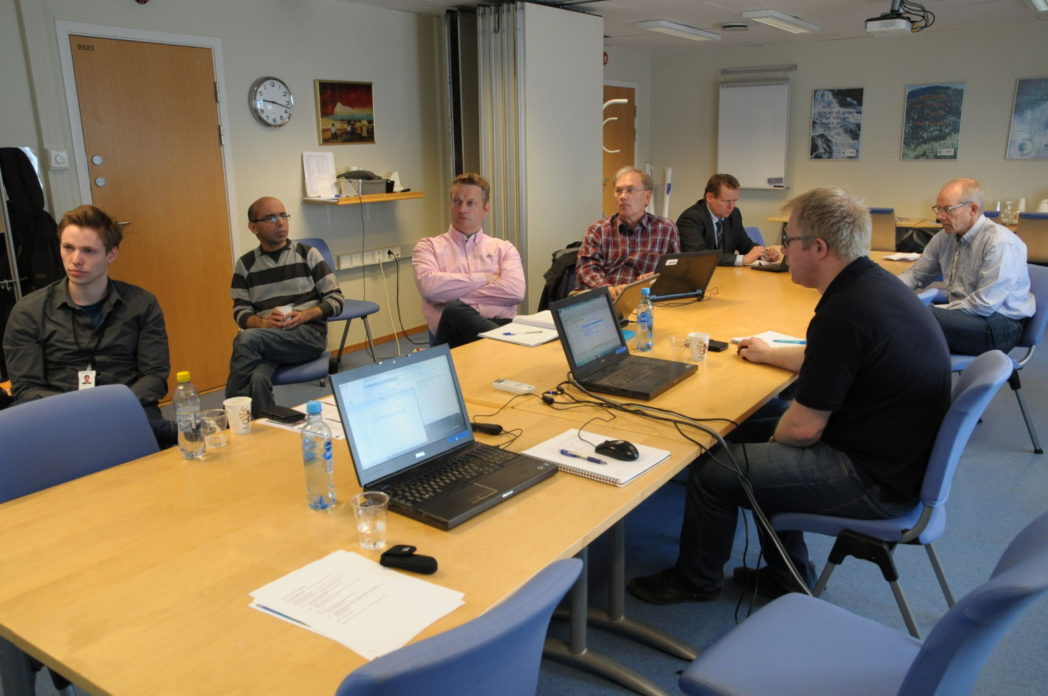
Dr Morten Hammer (SINTEF ER, centre-right) showed the seminar participants how to change interaction parameters in a commercially available thermodynamic software package.
Dr Morten Hammer (SINTEF ER, centre-right) showed the seminar participants how to change interaction parameters in a commercially available thermodynamic software package. Photo: Svend T. Munkejord.

The goal to design and operate CO2-transport (and CCS) systems safely and efficiently requires quantification. In this respect, the BIGCCS CO2-transport programme has two main contributions:

  • A unique coupled fluid-structure model has been developed for fracture-propagation control in CO2-transport pipelines. With some further validation and development, it may reduce the need to perform full-scale tests to design CO2-transport pipelines safe against running-ductile fracture – where today’s engineering methods fail.
  • Unique and accurate thermodynamic data are being generated. They will be employed to improve thermodynamic property models, which, as of today, are not always accurate for CCS applications. In particular, the vapour-liquid equilibrium cell developed in CO2Mix, may be the world’s most accurate.
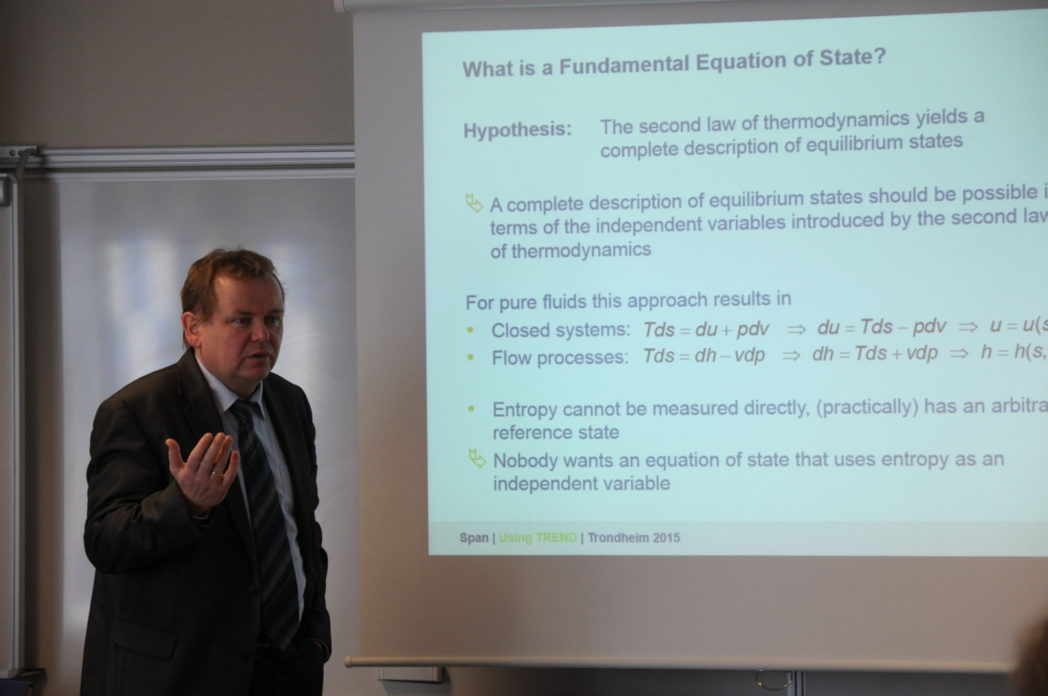
 

Professor Roland Span (RUB) demonstrated the TREND thermodynamic-property library and gave an introduction to the basics.
Professor Roland Span (RUB) demonstrated the TREND thermodynamic-property library and gave an introduction to the basics. Photo: Svend T. Munkejord.
r Håkon Nordhagen (SINTEF MC) showed the details of the BIGCCS coupled fluid-structure model for fracture-propagation control in CO2 pipelines.
Håkon Nordhagen (SINTEF MC) showed the details of the BIGCCS coupled fluid-structure model for fracture-propagation control in CO2 pipelines. Photo: Svend T. Munkejord.

The details of the seminar are available to consortium members in the e-room.  Further, researchers from the BIGCCS CO2-transport programme will give four presentations on the topic at the eigth Trondheim CCS Conference, TCCS-8.

Comments

No comments yet. Be the first to comment!

Leave a comment Cancel reply

Your email address will not be published. Required fields are marked *

More about Energy

Strømnett og en by i bakgurnnen

How do we plan and operate for security of electricity supply?

Susanne Sandell
Susanne Sandell
Researcher

Optimising exhaust stacks on offshore rigs using CFD

Lucia Sileo
Lucia Sileo
Research Scientist
Collage of six innovation steps.

The path to innovation: Technology development stages in wave energy

José Miguel dos Santos Sousa Rodrigues
Senior Research Scientist

Technology for a better society

  • About this blog
  • How to write a science blog
  • Topics and collections
  • Sign up for our newsletter
  • News from NTNU and SINTEF
  • Facebook
Gå til SINTEF.no
SINTEF logo
© 2025 SINTEF Foundation
Privacy Editorial Press contacts Website by Headspin