

Guest blogger: Erlend Grande, Master student, Department of Engineering Cybernetics, NTNU
Erlend Grande, a CINELDI master student, is working on a thesis titled “Data gathering and -assembling from several smart meter HAN ports” is in progress.
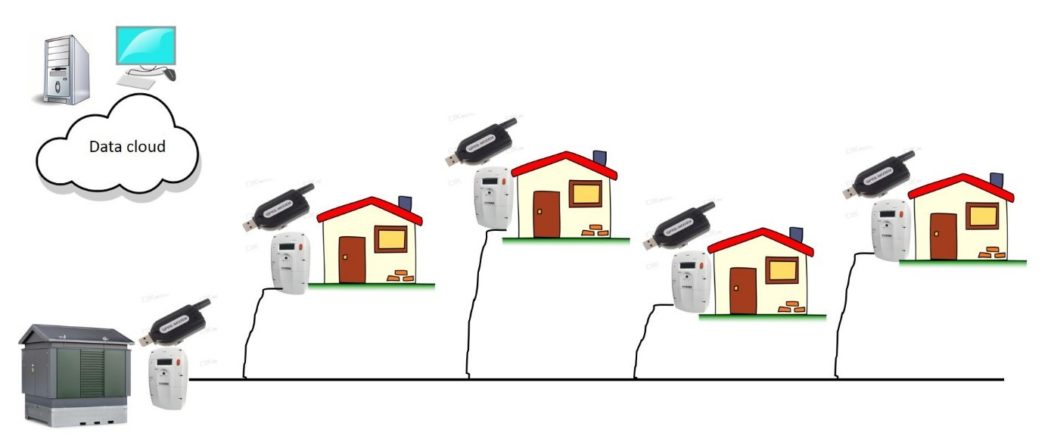
This system will make an efficient system for collecting real-time data from the HAN (home area network) port of distributed smart meters. The information is then transferred to a cloud service for a preliminary analysis of the assembled data.
Smart meter neighborhoods
Normally, the real-time data from the smart meters are used for analyzing the in-house consumption and for in-house energy management systems. However, by analyzing real-time data from several smart meters in a neighborhood, information about the condition of the outdoor connecting grid can be extracted.
As the smart meters are installed in the grid already due to fiscal reasons, these measurements are “nearly free”.
The real-time data from the smart meters can reveal if there is an irregular mismatch between energy from the transformer station and the sum of energy floating in or out of the houses.
Further, the measurements will tell how the voltage varies along the line. This is especially of interest for long lines with prosumers connected to the grid. Depending on which measurements are available on the HAN port on real-time basis, other superior information can be extracted from the sketched system, to the benefit of the utility company
Master thesis focus
The master thesis focuses on the embedded system enabling the real-time data gathering and -assembling from the HAN ports. The described analysis will be implemented just to illustrate the use of the system. Currently, most of the bricks forming a complete system are developed and demonstrated:
- A tiny embedded system for reading the output of the HAN port and interpreting the data.
- A 4G connection to a cloud service for data transfer using existing tele-communication infrastructure.
- A simple graphical user interface for displaying the voltage as a function of location along the line
The remaining work will consist of stitching together the modules, duplicating the equipment and then test the system in real environment, i.e. in a real grid with measurements from all smart meters on a power line from a transformer station.




Comments
No comments yet. Be the first to comment!