
Replacement of fossil fuels with hydrogen is a big trend in energy-intensive industries, with many challenges around hydrogen generation, infrastructure readiness, economic viability, and safe handling at industrial sites.
Like other sectors, the glass industry will have to be completely decarbonised in the next 30 years, and 2050 is only 2 furnaces away (the average lifetime of a glass furnace is 15 years).
At present, the projects addressing the replacement of fossil fuels with H2 in the glass sector remain very limited, compared to other energy-intensive sectors susceptible to H2 utilisation, e.g. Iron/Steel and Chemicals.
H2GLASS
In this context, we are proud to present the Horizon Europe project H2GLASS, addressing the decarbonisation challenge of the Glass industry: H2GLASS was awarded funding at the end of July 2022 and has started the Grant Agreement process. The plan is to start activities in January 2023.
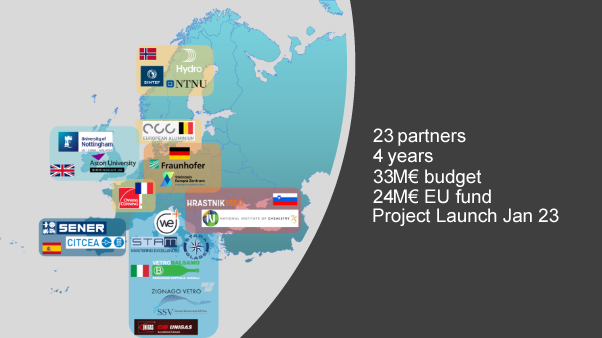
H2GLASS aims to create the technology stack that glass manufacturers need to realise 100% H2 combustion in their production facilities, ensure the required product quality, and manage this safely. The expertise of partners such as Steklarna Hrastnik, PTML PILKINGTON, Owens Corning and Stara Glass, representing the State Of The Art in the use of H2 in the glass process will be an asset for the H2GLASS Consortium, complemented by a group of highly qualified industrial and research institutions (SINTEF Energy, Sintef Industry, Sintef Manufacturing, STAM, STEINBEIS INNOVATION, WE PLUS, NTNU, THE UNIVERSITY OF NOTTINGHAM, KEMIJSKI INSTITUT, FRAUNHOFER, ASTON UNIVERSITY, UNIVERSITAT POLITECNICA DE CATALUNYA, STAZIONE SPERIMENTALE DEL VETRO, SENER, CIB UNIGAS) and other important Glass manufacturers that want to stay at the forefront of sustainable technology (Vetrobalsamo, ZIGNAGO VETRO).
Technology Replicability: The Aluminium demonstrator
H2GLASS will feature a demonstrator for the aluminium industry: together with HYDRO Havrand, the project will prove the transferability of the basic solutions and underlying models to energy-intensive industries that have similarities with the glass manufacturing process, thus strengthening the impact of the project. European Aluminium is also part of the H2GLASS consortium.
H2GLASS network
A big thank you to the Glass associations: Glass Alliance Europe, FEVE (container glass), Glass for Europe (flat glass), ESGA (special glass), EDG (domestic glass), Glass fibre Europe and Assovetro (Italy), and European Aluminium (which is also a member of the Consortium) that supported H2GLASS since the beginning!
The Glass and Aluminium sectors
In the EU, the Glass and Aluminium industries employ >400.000 people in Europe, generate > 3.5B€ and emit about 21.5 Mt CO₂ equivalents. The innovations generated by H2GLASS has the potential to create 10.000 new jobs and unlock 1 – 5B€ revenues for glass technology deployment, as well as generate investments of upwards of 17B€ and 200.000 new jobs for green H2 – all this while cutting emissions by about 80%.
H2GLASS in numbers






Comments
Very Interesting, Good job and thanks for sharing such a good information..
Dear Steffan, thank you very much! Feel free to reach out to me in case you need further info! We will soon launch the project website, while a Linkedin channel is already available.