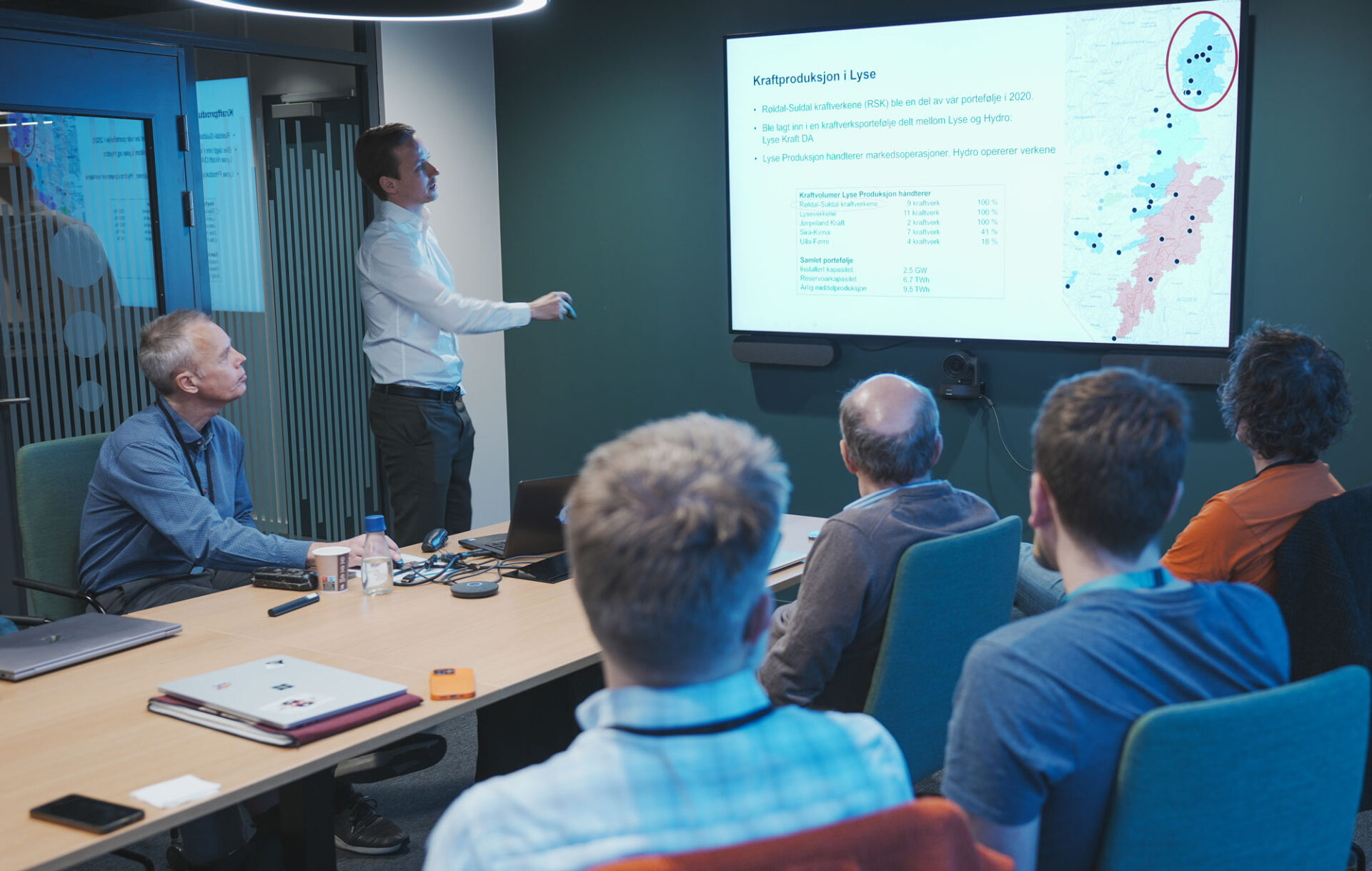

“Hydropower has always delivered two things: energy and energy at the right time, that is, flexibility. Hydropower will continue to deliver both in the future, but flexibility will play a greater role than it historically has”, says Vegard Eiane Kyllingstad, power market analyst at Lyse Produksjon.
He shared some of his thoughts about the future during HydroConnect’s steering committee meeting in late November. Kyllingstad believes that it’s not just about terawatt-hours, but also about flexibility:
“The key is to appreciate flexibility. We need to measure more than just energy; what is the value of delivering energy at the right time?”
In his presentation, he talked about Lyse Produksjon’s plans to upgrade the Røldal-Suldal power system. Upgrading requires significant investments and yields little new energy. However, the upgrade provides the opportunity for more power and flexibility, in addition to being carried out without major environmental impacts.
“With the upgrade of these power plants, production can be shifted even more from surplus periods to times of energy scarcity”, says Kyllingstad.
Security for the hydropower industry
A report from the PotOUt project, associated with FME HydroCen, shows that upgrading hydropower in already developed waterways is a smart use of the energy system, while also preserving nature. One of the recommendations for the authorities in this report to is to facilitate good and predictable conditions for upgrading and expansion. Kyllingstad is also concerned about this:
“If we, as hydropower producers, are to invest billions in upgrading our power plants, we need predictability. Predictability means that the tax system remains stable over time, and any changes do not have retroactive effect on already-built power plants.”
He misses political consensus in the energy field so that the industry can regain confidence.
“In addition, flexible contributions must be rewarded. This means, among other things, that the taxation of power production must be as symmetrical as possible: the state must take an equal part of the investment cost as they take from the income. We then say that the tax is ‘neutral’; it has no distorting effect on our investment decisions. As long as taxation is constant and neutral, there is no problem with a relatively high tax rate”, he says.
Comparison of various energy technologies
In his presentation, he showed how complicated it can be to compare various technologies, such as solar power, wind power, floating offshore wind, hydropower, and nuclear power. Often, the starting point is the development cost per unit of energy delivered.
“But this is a poor way to compare technologies. We must look at the big picture. In addition to development costs, we must also consider the technology’s potential for flexibility, contributions to balance markets, costs for grid development, and the use of natural resources”, says Kyllingstad.
The hydropower industry can contribute to more flexibility and thus a more efficient power system that allows for the intergration of more solar and wind power into the energy system.
“There are no simple solutions, as the reports from the Energy Commission and The 2050 Climate Change Committee, as well as the Power Price Committee’s report, show. But I am glad that we are in Norway because we have the world’s best starting point: hydropower is definitely part of the solution here!”




Comments
Really insightful perspective! 🌍 It’s so true that comparing energy sources purely by development cost misses the broader picture. Factoring in flexibility, resource use, and grid impact gives a much clearer view of long-term sustainability and efficiency. Great point about hydropower’s balancing role! ⚡💧