

The Nordic Smart Building Initiative (NSBI) is a collaborative group and forum that brings together various stakeholders to explore important topics in the field of Smart Buildings and publish actionable insights to help address challenges in this industry. NSBI began its working phase in 2025. Ongoing discussions, preliminary findings, and future plans are shared here.

The Nordic Smart Building Initiative comprises several task forces and working sub-groups conducting collaborative investigations into specific questions related to Smart Buildings in the context of the Nordic countries:
- Mapping smart buildings in the Nordics
- What is a smart building in the Nordic context?
- Tools for smart building design and assessment
- AI and smart controllers for smart buildings
- Digital twins and smart buildings
- Barriers and drivers to the adoption of smart buildings
- Building management/automation systems in smart buildings
- Smart building life cycle and sustainability
- Ontologies and semantic principles for smart buildings
- Teaching and training about smart buildings
The NSBI got kick-started in 2025 and currently counts 40 participants from 27 institutions and companies across 13 countries (Norway, Denmark, Sweden, Finland, Estonia, Lithuania, Latvia, the Netherlands, Poland, Ireland, the USA, Italy, and the U.K.).
The NSBI is led by SINTEF Community (project leader: Hicham Johra; hicham.johra@sintef.no), with endorsements from IBPSA World and IBPSA-Nordic (the International Building Performance Simulation Association in the Nordic countries).
The work of the different subgroups has already started and produced interesting discussions, provided some new insights, identified knowledge gaps, and mapped several key questions to be explored further within the field of Smart Buildings. Some of these insights are presented below.
What is a Smart Building?
Preliminary NSBI discussions [1] have highlighted that definitions of Smart Buildings tend to focus more on the goals they aim to achieve (e.g., improved comfort, energy efficiency, and sustainability) than on the specific technologies used to get there.
A Smart Building is not defined by having specific equipment, such as photovoltaic panels, heat pumps, or electrical batteries. Instead, what makes a building “smart” is its ability to sense, interpret, communicate, and respond intelligently and efficiently to changing internal and external conditions by adjusting the operation of its different actuatable systems. This includes adapting to occupant needs, interacting with energy grids, and optimizing the performance of systems like heating, cooling, lighting, and ventilation.
The term “Smart Building” is widely used today, replacing older terms like “Intelligent Building” or “Automated Building.” Although these terms are sometimes used interchangeably, Smart Buildings represent a more advanced stage of development. They go beyond siloed systems and automation, incorporating interoperability, predictive control, and bidirectional communication with both users and external infrastructures (like the energy grids).
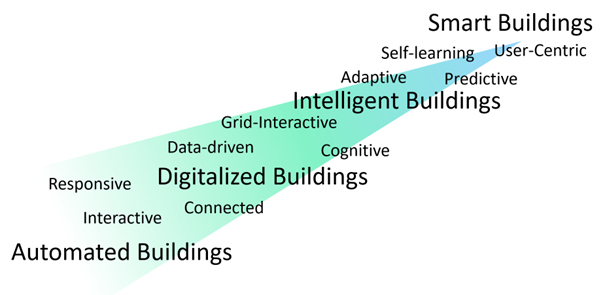
Key features commonly associated with Smart Buildings include:
- Occupant-centric design and control, with adaptability to user behavior and preferences.
- Advanced data analytics and real-time monitoring of building conditions.
- Interoperable systems that enable efficient orchestration of building operations.
- Advanced predictive control and energy flexibility, allowing buildings to respond to external signals like energy prices, grid needs, or weather forecasts.
- Sustainability, through reduced environmental impact and integration of renewables.
- Health and safety enhancements.
- Proactive maintenance for reliable services and indoor environment quality.
Importantly, smartness exists on a spectrum. Buildings can be “smart” to varying degrees depending on how many of these features are in place. The NSBI encourages viewing Smart Building definitions as a framework for progressive transformation, not as a rigid checklist. Nevertheless, a list of minimum requirements is suggested to establish a threshold below which a building cannot be considered a Smart Building:
- Controllable building systems and services.
- A data collection and communication infrastructure.
- Centralized or decentralized supervisory control system that can monitor and optimize several aspects of building performance by adjusting several (if not all) building systems, services, and resources.
- Adaptive control strategy integrating several sources of information from, e.g., indoor and outdoor environments, occupants/users, building systems, energy grids, or infrastructures.
- Interfaces that allow for human interaction and feedback.
The NSBI subgroup focused on Smart Building definitions will continue its work by examining regional interpretations in more detail, exploring frameworks for assessing and ranking levels of smartness, and gathering perspectives from a wide range of stakeholders across the building sector.
AI and smart controllers for Smart Buildings
Recent advancements in smart controllers, such as model-predictive control (MPC) and data-driven modeling tools, have demonstrated significant potential in optimizing building energy systems. Studies across diverse building types and climate zones report heating and cooling energy savings of up to 30%. Despite this promising performance, several key challenges continue to hinder large-scale deployment.
One of the primary barriers is the need for accurate, yet rapid-to-compute building models and localized weather forecasts, both of which must be tailored individually for each building. While data-driven and AI-based approaches offer a promising avenue for automating these tasks, research in this area requires further development to reach practical implementation at scale.
Another significant challenge is the limited number of pilot projects currently available, which restricts broader industry engagement and investment. To address this, the subgroup is exploring the formation of a consortium of testbeds that would serve as a pipeline for piloting and validating smart control solutions in real-world settings.
In parallel, the large-scale deployment of smart building control opens new opportunities for grid-interactive flexibility. Buildings equipped with advanced control systems can provide valuable services to utility providers, including electricity distribution networks and district heating grids. To support this evolution, the subgroup is also focusing on the theoretical foundations of future energy market structures, including peer-to-peer trading models and dynamic pricing schemes for district heating grids.
Digital twins and Smart Buildings
Numerical models allow for new approaches to make buildings smarter. Whilst some approaches, such as model-predictive control, have been around for some time, the concept of Digital Twins promises a step change in model impact. This concept stems from the domain of manufacturing. It assumes a two-way data exchange between a Physical Twin (physical entity/system in the real world) and a Digital Twin (digital/numerical replica/shadow). This two-way communication ensures that the Digital Twin numerical model is constantly updated about the status of the physical system, and thus closely represents what is happening in real life. At the same time, the Digital Twin provides feedback to the physical model, such as control signals, anomaly detection, fault diagnostics, and baseline operation data, ensuring better performance and, hence, greater smartness.
Whilst the concept of Digital Twins is emerging, realizing them in actual buildings is complex, requiring a deep integration between building management systems and simulation models. The NSBI sub-group dedicated to Digital Twins in Smart Buildings is starting to explore these issues.
Barriers and drivers to the adoption of smart buildings
In line with the goals of the Nordic Smart Building Initiative, a dedicated working sub-group investigates the barriers and drivers affecting Smart Building adoption in Nordic countries, with comparisons to other regions in Europe and globally. The Nordic context, marked by cold climates, substantial district heating deployment, high renewable energy penetration, strong digitalization, and robust environmental policies, creates unique opportunities for innovation while also presenting challenges such as high initial costs, climate-related limitations, interoperability gaps, and data privacy issues. Based on the methodology of Affonso et al. [2] and the IEA EBC Annex 81 [3], a systematic literature review is conducted to map technological, financial, societal, environmental, and safety incentives and obstacles. This will inform the development of targeted stakeholder surveys for practitioners, policymakers, and users across the region. These insights will help shape new policies, markets, and technology strategies to accelerate the deployment of Smart Buildings in the Nordics.
Smart building life cycle and sustainability
Preliminary discussions within the dedicated subgroup have highlighted the importance of considering sustainability throughout the entire life cycle of a Smart Building, from production and construction to operation, renovation, and eventual deconstruction. While operational efficiency is often the primary focus of smart building projects, a sustainable approach should also account for embodied environmental impacts, resource consumption, and economic performance. Additionally, it is crucial to align technological innovations with sustainability frameworks to ensure that efficiency gains do not result in higher resource use or costs in other stages of the building’s life cycle.
Smart technologies can enable strategies like adaptive reuse, predictive maintenance, and optimized operation, all of which can extend the lifespan of buildings and their components while reducing environmental impacts and costs. However, achieving these benefits will require closer collaboration among stakeholders, clearer sustainability metrics, and supportive policies that promote life cycle thinking in both environmental and economic terms.
Our future work will focus on incorporating Life-Cycle Assessment into smart building design and assessing carbon emissions across whole buildings (including production, construction, use, and demolition phases). We will then extend the scope to include evaluation of financial costs through Life Cycle Cost analysis for a comprehensive understanding of the economic performance of smart buildings and further integrate social impact assessment to complete the framework for Life Cycle Sustainability Assessment. This approach will provide balanced decision-making that addresses environmental, economic, and social dimensions of sustainability. This work aligns with the goals commonly stated in definitions of Smart Buildings: deliver high performance, cost efficiency, and environmental and social responsibility throughout their entire life cycle.
![Buildings' life cycle stages [4].](https://blog.sintef.com/wp-content/uploads/2025/08/nsbi-life-cycle.png)
The NSBI will continue its work and publish results in various scientific magazines, general-audience articles, conference presentations, and open-access peer-reviewed scientific journals.
For questions or comments about the NSBI, please reach out to Hicham Johra: hicham.johra@sintef.no
References
[1] Johra, H. (2025). Preliminary Discussions from the Nordic Smart Building Initiative on the Definition of Smart Buildings. SINTEF Notes 54. SINTEF Academic Press. https://dx.doi.org/11250/3213623
[2] E.O.T. Affonso, R.R. Branco, O.V.C. Menezes, A.L.A. Guedes, C.K. Chinelli, A.N. Haddad, C.A.P. Soares (2024). The Main Barriers Limiting the Development of Smart Buildings. Buildings, 14(6), 1726. https://doi.org/10.3390/buildings14061726
[3] International Energy Agency – Energy in Buildings and Communities Programme. IEA EBC – Annex 81 – Data-Driven Smart Buildings. https://annex81.iea-ebc.org/
[4] N. Dodd, S. Donatello, M. Cordella (2021). Level(s) – A common EU framework of core sustainability indicators for office and residential buildings, User Manual 1: Introduction to the Level(s) common framework (Publication version 1.1)








Comments
No comments yet. Be the first to comment!